
Last Updated on July 1, 2026 by Bala Kumar
If you’re new to poker, the very first thing you need to master before you sit down at any table, live or online, is poker hand rankings. Every decision you make, from calling a raise to going all-in, depends on understanding which hands beat which.
This guide breaks down the full poker hands order from strongest to weakest, explains tie-breaker rules, shows real examples, walks through the actual mathematical odds behind each hand, shares real tournament moments where these odds played out in dramatic fashion, and gives you a free printable poker hand ranking cheat sheet you can keep next to your screen or in your wallet at the casino.
Quick Answer: Poker Hand Rankings from Best to Worst
Here is the complete poker hand ranking chart, used in Texas Hold’em, Omaha, and virtually every standard poker variant:
| Rank | Hand | Example |
| 1 | Royal Flush | A♠ K♠ Q♠ J♠ 10♠ |
| 2 | Straight Flush | 9♣ 8♣ 7♣ 6♣ 5♣ |
| 3 | Four of a Kind | 7♦ 7♣ 7♥ 7♠ 2♣ |
| 4 | Full House | K♠ K♥ K♦ 4♣ 4♠ |
| 5 | Flush | A♥ J♥ 8♥ 6♥ 3♥ |
| 6 | Straight | 10♣ 9♦ 8♠ 7♥ 6♣ |
| 7 | Three of a Kind | Q♦ Q♣ Q♠ 9♥ 4♦ |
| 8 | Two Pair | J♠ J♦ 5♣ 5♥ 2♠ |
| 9 | One Pair | 8♥ 8♠ K♣ 6♦ 3♥ |
| 10 | High Card | A♣ 10♦ 7♠ 5♥ 2♣ |
Save this table — it’s the foundation for every strategy decision you’ll ever make at the table. If you want to go a step further and calculate your exact winning chances in real time, run your hand through our [Poker Odds Calculator] once you know where it ranks.
Poker Hand Rankings Explained in Detail
1. Royal Flush
The best possible hand in poker. Five consecutive cards of the same suit, running Ace to Ten (A-K-Q-J-10). It’s unbeatable in standard poker.
2. Straight Flush
Five consecutive cards, all the same suit, but not ending in Ace-high (e.g., 9-8-7-6-5 of clubs). If two players have a straight flush, the one with the higher top card wins.
3. Four of a Kind (Quads)
Four cards of the same rank, plus one unrelated “kicker” card. If two players both have four of a kind (only possible with community cards), the higher-ranked quad wins.
4. Full House
Three cards of one rank plus two cards of another rank (e.g., three Kings and two 4s — “Kings full of Fours”). When comparing two full houses, the hand with the higher three-of-a-kind wins first.
5. Flush
Five cards of the same suit, not in sequence. Ties are broken by comparing the highest card, then the next highest, and so on.
6. Straight
Five consecutive cards of mixed suits. Note: Ace can play high (A-K-Q-J-10) or low (5-4-3-2-A), but you can’t “wrap around” (e.g., K-A-2-3-4 is not valid).
7. Three of a Kind (Trips/Set)
Three cards of the same rank plus two unrelated kickers. In Hold’em, this is often called a “set” when two of the three cards are in your hand, or “trips” when two are on the board.
8. Two Pair
Two cards of one rank, two cards of another rank, plus one kicker. The higher pair is compared first when breaking ties.
9. One Pair
Two cards of the same rank plus three unrelated kickers. The most common hand in poker.
10. High Card
When no player has any of the above, the highest single card wins. If tied, the next-highest card is compared, and so on down the hand.
The Real Math: Poker Hand Odds & Probabilities
Knowing the order of hands is only half the picture. Understanding how rare each hand actually is helps you read the table, spot when opponents are representing monsters, and appreciate why certain hands trigger such massive celebrations at the felt.
5-Card Draw Poker Probabilities (out of 2,598,960 possible hands)
| Hand | Number of Ways | Probability | Odds Against |
| Royal Flush | 4 | 0.000154% | 1 in 649,740 |
| Straight Flush (excl. royal) | 36 | 0.00139% | 1 in 72,193 |
| Four of a Kind | 624 | 0.0240% | 1 in 4,165 |
| Full House | 3,744 | 0.144% | 1 in 694 |
| Flush | 5,108 | 0.197% | 1 in 509 |
| Straight | 10,200 | 0.392% | 1 in 254 |
| Three of a Kind | 54,912 | 2.11% | 1 in 47 |
| Two Pair | 123,552 | 4.75% | 1 in 21 |
| One Pair | 1,098,240 | 42.3% | 1 in 2.4 |
| High Card | 1,302,540 | 50.1% | 1 in 2 |
Texas Hold’em: Odds of Making Each Hand by the River (7 cards seen)
Since Hold’em players use the best 5 of 7 cards (2 hole cards + 5 community cards), these are the realistic numbers you’ll actually see at a real table:
| Hand | Approximate Frequency (7-card) |
| Royal Flush | 1 in 30,940 |
| Straight Flush | 1 in 3,590 |
| Four of a Kind | 1 in 594 |
| Full House | 1 in 37.5 |
| Flush | 1 in 32.1 |
| Straight | 1 in 20.6 |
| Three of a Kind | 1 in 19.7 |
| Two Pair | 1 in 3.26 |
| One Pair | 1 in 1.28 |
| High Card | 1 in 1.99 |
This is exactly why a full house or better feels so satisfying online or live — by the river, you’ll actually make one less than 3% of the time, while a single pair or worse shows up in the overwhelming majority of hands dealt.
Real Poker Hand Rankings in Action: Historic Hands That Prove the Math
Numbers on a page are one thing — watching the improbable actually happen at the table is what makes poker unforgettable. Here are a few real, documented moments where these exact hand rankings decided massive pots on poker’s biggest stages.
The 2008 WSOP Main Event Royal Flush. In one of the most replayed hands in WSOP television history, Justin Phillips found a runner-runner royal flush to eliminate Motoyuki Mabuchi, who was holding quad aces at the time — a hand so improbable it’s still cited as one of the defining moments of that year’s Main Event.
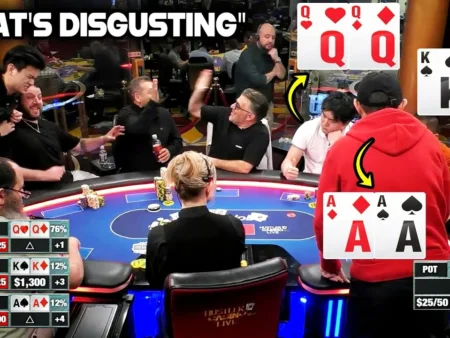
A $653,000 Royal Flush at the NAPT Main Event. More recently, pro player Jeremy Ausmus turned a royal flush to beat an opponent’s rivered quad aces during the North American Poker Tour Main Event. Commentators noted the losing player’s odds of getting beaten in that exact spot were roughly 1 in 2.7 billion — a useful real-world reminder of just how rare it is for the second-best hand at the table to be four-of-a-kind.
Two Full Houses Crushed by a Royal Flush in 2026. At the PokerStars Open in Malaga earlier this year, a three-way pot saw two players holding a full house (aces full of kings, and kings full of jacks) both drawn in against a royal flush, in a hand so dramatic the entire table reportedly stopped to take photos before it was over.
These moments are a great reminder for beginners: even the second- and third-best hands on the entire hand rankings chart can still lose. That’s exactly why understanding poker hands order — not just the top of the list — matters for every decision you make after the flop.
Poker Hand Rankings Tie-Breaker Rules
Ties happen more often than beginners expect, especially in Hold’em where community cards are shared. Here’s how ties are resolved at each level:
- Same hand type: Compare the rank of the cards forming the hand first (e.g., a pair of Kings beats a pair of Queens).
- Still tied: Compare kickers, highest to lowest.
- Fully identical hands (using the same 5 cards from the board): The pot is split — this is called a “chop.”
Understanding kickers is one of the most overlooked parts of poker hands order, and it’s a common source of confusion for new players who don’t realize their “winning” pair can be outkicked.
Printable Poker Hand Ranking Cheat Sheet
Keep this simplified version handy — print it, save it as your phone wallpaper, or screenshot it before your next session.
POKER HAND RANKINGS (Best to Worst)
1. Royal Flush — A-K-Q-J-10, same suit (1 in 30,940 in Hold’em)
2. Straight Flush — 5 sequential cards, same suit (1 in 3,590)
3. Four of a Kind — 4 cards, same rank (1 in 594)
4. Full House — 3 of a kind + a pair (1 in 37.5)
5. Flush — 5 cards, same suit, any order (1 in 32.1)
6. Straight — 5 sequential cards, mixed suits (1 in 20.6)
7. Three of a Kind — 3 cards, same rank (1 in 19.7)
8. Two Pair — 2 different pairs (1 in 3.26)
9. One Pair — 2 cards, same rank (1 in 1.28)
10. High Card — No matching cards (1 in 1.99)
Tip: Print this at wallet size (business card format) and laminate it for a durable at-the-table reference. The odds column doubles as a great conversation piece next time someone at the table hits a big hand.
Conclusion
Understanding poker hand rankings and the correct poker hands order is the foundation of becoming a better player. Whether you are playing Texas Hold’em, Omaha, or online poker, knowing which hands beat others helps you make faster and smarter decisions at the table.
From the unbeatable Royal Flush to the simple High Card, every hand has its own value, probability, and strategic importance. Learning poker hand rankings with odds, tie-breaker rules, and real examples allows beginners to avoid costly mistakes and gives experienced players a stronger understanding of hand strength.
Keep this poker hand ranking cheat sheet nearby, practice recognizing different combinations, and use tools like a poker odds calculator to improve your decision-making. Mastering the basics of poker hands order is the first step toward developing winning poker strategies and becoming a more confident player.
FAQs
1. What are the poker hand rankings from best to worst?
The poker hand rankings from strongest to weakest are Royal Flush, Straight Flush, Four of a Kind, Full House, Flush, Straight, Three of a Kind, Two Pair, One Pair, and High Card.
2. Which poker hand is the strongest in Texas Hold’em?
A Royal Flush is the strongest possible poker hand. It consists of A-K-Q-J-10 cards of the same suit and cannot be beaten in standard poker games.
3. How do poker hands tie and who wins?
When players have the same hand type, the winner is decided by comparing the highest-ranking cards and then kickers. If both players have identical five-card hands, the pot is split, known as a chop.
4. What are the odds of getting a Royal Flush in poker?
A Royal Flush is one of the rarest poker hands. In Texas Hold’em, the chance of making a Royal Flush by the river is approximately 1 in 30,940.
5. Why are poker hand rankings important for beginners?
Understanding poker hand rankings helps beginners know which hands are strong, make better betting decisions, calculate winning chances, and build effective poker strategies.
Founder of PokerClubGames.com and a Poker Researcher with 10+ years of experience in SEO, WordPress development, and gaming content strategy. Specializes in researching online poker sites, poker apps, tournaments, bonuses, and poker strategies. Experienced in poker platform reviews, affiliate marketing, and creating SEO-focused poker content for global audiences.
For collaborations, media inquiries, or poker-related partnerships:
Contact: Info@hugecount.com