

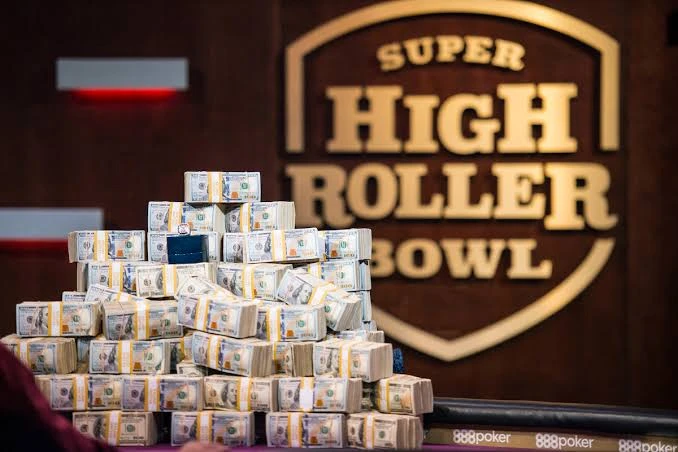
Super High Roller Bowl
Last Updated on August 10, 2026 by Bala Kumar
1. Introduction
There’s a reason poker media treats the Super High Roller Bowl differently from almost every other tournament on the calendar. It isn’t the biggest field, and it isn’t even the richest single prize pool anymore, but it’s the event where the buy-in floor alone filters the entry list down to a room full of players who could all plausibly be considered among the best in the world. When the Super High Roller Bowl launched in July 2015 with a $500,000 buy-in, it redefined what “high stakes” even meant in tournament poker, and it’s carried that reputation through a decade of six- and seven-figure buy-ins ever since.
Why does it matter? Because unlike most flagship series, the SHRB isn’t really about accessibility, it’s about exclusivity by design. The buy-in itself does the work a satellite structure does for other tournaments: it guarantees that every single opponent across the table is either independently wealthy, backed by serious money, or both, and playing at a level where mistakes get punished instantly and severely.
Who should play it? Realistically, this is a tournament for a very specific tier of player, established high-stakes professionals and well-capitalized businesspeople who treat six-figure buy-ins as a normal part of their poker life. For everyone else, the Super High Roller Bowl is one of the best spectator products in the game, streamed in full on PokerGO.
Key highlight: Multi-million-dollar first-place prizes, a championship ring awarded to the winner, and a format that’s evolved into three distinct flavors each year, the classic No-Limit Hold’em SHRB, a Pot-Limit Omaha edition, and a Mixed Games edition, giving the brand more year-round presence on the PGT calendar than any other major.
2. Tournament Rating (5-Star Format)
- Prestige & Popularity: ★★★★★ — The single most recognizable “super high roller” brand in poker, running continuously since 2015 and now anchoring three separate PGT majors a year.
- Prize Pool Value: ★★★★★ — Multi-million-dollar first-place prizes are the norm, not the exception; the inaugural 2015 event still holds the record with a $21.5M prize pool and a $7.525M top prize.
- Competition Level: ★★★★★ — Arguably the toughest recurring field in poker. Every single entrant is either an elite professional or a serious, well-bankrolled action player.
- Accessibility (Buy-in/Entry): ★☆☆☆☆ — The least accessible tournament on the PGT calendar by design, buy-ins run from $100,000 up to $300,000+, with essentially no satellite path for the average player.
3. Tournament Overview
- Organizer / Platform: PokerGO / Poker Central, part of the PokerGO Tour (PGT) since the tour’s 2021 launch
- First launched: July 2015, at ARIA Resort & Casino, Las Vegas
- Location: Primarily live, with stops that have included the PokerGO Studio (Las Vegas), the Merit Royal Hotel Casino & Spa (North Cyprus), and a 2020 online edition on partypoker
- Frequency: Multiple editions per year, the classic NLH edition, a Pot-Limit Omaha edition, and (since 2025) a Mixed Games edition, each run roughly once annually
- Tournament type: Flagship series, one of the PGT’s four designated “majors,” alongside the PokerGO Cup, Poker Masters, and U.S. Poker Open
4. Buy-in & Entry Details
- Buy-in range: Historically $300,000 for the classic NLH edition, though the most recent instalment (Super High Roller Bowl X, December 2025) ran at a reduced $100,000 buy-in; the PLO and Mixed Games editions have consistently run at $100,000
- Format: Freezeout-style with re-entry generally permitted through a defined late-registration window, given the small, high-value fields
- Satellite qualification: Limited but present, PokerGO periodically runs lower buy-in satellites ($5,000–$10,000 range) feeding into select SHRB events for well-bankrolled semi-pros
- Freeroll availability: None directly into the SHRB itself
5. Prize Pool & Payout Structure
Prize pools are built entirely from the entry pool rather than a standalone guarantee, and they scale dramatically given the buy-in size.
2026 example (Super High Roller Bowl: $100k Mixed Games, February 2026):
- 38 total entries
- $3,800,000 total prize pool
- Winner Yuri Dzivielevski collected $1,300,000, defeating a stacked final table that included Jared Bleznick, Benny Glaser, and Nick Schulman
Most recent classic edition (Super High Roller Bowl X, December 2025):
- 23 total entries at $100,000 buy-in
- $2,300,000 total prize pool
- Champion Joao Simao defeated Jason Koon heads-up for $1,100,000 after a marathon, back-and-forth match
Typical payout structure across SHRB events:
- 1st place: Roughly 45–50% of the prize pool (notably steeper than most MTTs, reflecting the small field size)
- Final table (top 4–7 spots, depending on field size): Typically the only spots paid, given fields often run between 20–40 entries
- A min-cash at this level is still a life-changing sum for most players, SHRB X’s min-cash alone paid $200,000
6. Tournament Format & Structure
- Game type: Primarily No-Limit Hold’em for the classic edition; dedicated Pot-Limit Omaha and Mixed Games (10-game rotation including 2-7 Triple Draw, Badugi, Razz, Stud Hi-Lo, and more) editions run separately each year
- Blind levels: Long, high-roller-standard levels built for extended strategic play rather than a fast structure
- Starting stacks: Deep by design, typically well over 100 big blinds given the skill level and buy-in involved
- Tournament speed: Deepstack, multi-day format for the flagship editions rather than single-day turbo play
7. Special Features
- Championship ring: Unlike most PGT majors, the SHRB awards a dedicated championship ring to its winner, on top of the prize money and PGT points, a signature touch that’s become part of the brand’s mystique
- Three distinct annual editions: The classic NLH SHRB, the PLO edition, and the Mixed Games edition each carry their own numbering and history, giving dedicated players three separate shots at a title across the calendar year
- Global footprint (historically): Unlike most PGT majors that stay fixed at ARIA, the SHRB has traveled to China, London, the Bahamas, Australia, Russia, and Cyprus over its history, though recent editions have consolidated at the PokerGO Studio
- Studio production: Every final table streams live on PokerGO with full commentary and hole-card cameras, the same broadcast treatment given to WSOP final tables
8. Player Field & Competition Level
This is, without real competition, the toughest recurring field in poker. Recent editions have featured a roster reading like a who’s-who of the game’s elite, Jason Koon, Sam Soverel, Daniel Negreanu, Phil Hellmuth, Michael Mizrachi, Nick Schulman, Andrew Lichtenberger, Jared Bleznick, and Benny Glaser have all appeared at recent final tables or deep runs.
Is it soft or tough? Unambiguously tough. There is no recreational dilution at this buy-in level, every opponent is either a full-time high-stakes professional or a serious action player with the bankroll and game to match.
Best strategy approach: Because fields are small (often 20–40 entries) and stacked with talent, variance plays an outsized role, even elite players cash in the minority of these events. Deep-stacked patience, careful table selection when possible, and genuine mastery of ICM at four-to-seven-handed final tables separate repeat cashers from one-time finalists.
9. Past Winners & Results
| Edition | Year | Winner | Buy-in | 1st Prize |
| Super High Roller Bowl I (inaugural) | 2015 | Brian Rast | $500,000 | $7,525,000 |
| Super High Roller Bowl (online) | 2020 | Justin Bonomo | $102,000 | $1,775,000 |
| Super High Roller Bowl (Cyprus) | 2021 | Wiktor Malinowski | $250,000 | $3,690,000 |
| Super High Roller Bowl VI | 2021 | Michael Addamo | — | $3,402,000 |
| Super High Roller Bowl VII | 2022 | Daniel Negreanu | — | $3,312,000 |
| Super High Roller Bowl VIII | 2023 | Isaac Haxton | $300,000 | $2,760,000 |
| Super High Roller Bowl: $100k PLO | Oct 2024 | Seth Davies | $100,000 | $1,500,000 |
| Super High Roller Bowl: Mixed Games (inaugural) | Mar 2025 | Chad Eveslage | $100,000 | $1,200,000 |
| Super High Roller Bowl: $100k PLO III | Oct 2025 | John Riordan | $100,000 | $1,250,000 |
| Super High Roller Bowl X | Dec 2025 | Joao Simao | $100,000 | $1,100,000 |
| Super High Roller Bowl: $100k Mixed Games | Feb 2026 | Yuri Dzivielevski | $100,000 | $1,300,000 |
Justin Bonomo holds the record for most SHRB titles overall (3), while Isaac Haxton and Seth Davies have each captured two titles across different editions. Results transparency is strong throughout, every SHRB event is archived in full on PGT.com and cross-referenced through The Hendon Mob poker database.
10. Schedule & Key Dates: Upcoming (Next Few Months)
The 2026 PGT season has already delivered one SHRB edition, the $100k Mixed Games event (Feb 12–14, won by Yuri Dzivielevski). Based on the series’ consistent annual pattern, here’s what to expect through the rest of 2026:
| Timeframe | Expected Event | Historical Pattern | Notes |
| August–September 2026 | No SHRB activity typically scheduled here | The PLO and classic NLH editions have historically landed in October and December respectively in recent years | This window overlaps with Poker Masters’ traditional September slot instead |
| October 2026 | Super High Roller Bowl: $100k Pot-Limit Omaha (expected) | The PLO edition ran in October in both 2024 and 2025 | Not yet officially confirmed by PGT at time of writing, check pgt.com/schedule directly |
| December 2026 | Super High Roller Bowl XI (classic NLH edition, expected) | The numbered flagship edition has closed out the PGT calendar year in 2022, 2023, and 2025 | Buy-in has fluctuated between $100,000 and $300,000 in recent years, exact 2026 buy-in not yet announced |
Note: Exact dates for the remaining 2026 SHRB editions had not been officially confirmed by PGT at the time of writing. The pattern above reflects the series’ consistent scheduling over the past several years, but should be verified at pgt.com/schedule before planning travel or satellite play.
11. How to Play (Step-by-Step)
- Create a PokerGO account to follow official schedule announcements and satellite opportunities as they’re released.
- Recognize that direct buy-in is the standard path, there is minimal satellite infrastructure feeding into SHRB events compared to major tours.
- If pursuing a satellite route, watch for PGT-announced qualifiers in the $5,000–$10,000 range ahead of a specific SHRB edition.
- Register directly through PokerGO/PGT’s registration system or in person at the host venue once the schedule is confirmed.
- First-timer tip: Study recent SHRB final tables on PokerGO before considering entry, the average skill level here is unlike anything else in poker, and going in underprepared is an expensive mistake.
12. Pros and Cons
✅ Pros
- The single most prestigious “super high roller” brand in the game, with a decade of history
- Multi-million-dollar prizes remain realistic even at reduced buy-in levels
- Three distinct annual editions (NLH, PLO, Mixed Games) give variety across the calendar
- Exceptional broadcast quality and full final table streaming on PokerGO
❌ Cons
- Effectively inaccessible to all but a tiny fraction of players given the buy-in floor
- Minimal satellite infrastructure compared to majors like the WSOP
- Small field sizes mean even elite players face significant variance
- 2026 remaining schedule not yet fully confirmed as of this writing
13. Strategy Tips
Beginner tip (for spectators/students, given the buy-in realistically restricts entry): Watch how differently players approach preflop 3-bet and 4-bet ranges here compared to mid-stakes tournaments, aggression frequencies are dramatically higher because every opponent respects fold equity differently at this level.
Mid-stage strategy: With small fields and deep stacks, players who go deep consistently tend to avoid unnecessary confrontations early, preserving flexibility rather than building a stack through marginal aggression against equally skilled opponents.
Final table approach: ICM math is essential, with payout structures this top-heavy (often 45%+ to first), final table decisions hinge heavily on pay jump awareness rather than pure hand strength alone.
Bankroll advice: This isn’t a tournament that fits standard bankroll guidelines for the average player, entrants are typically expected to have either a bankroll built specifically for six-figure buy-ins or outside backing/staking arrangements common at this level.
14. Devices & Accessibility
- Live access: In-person entry required at the host venue (most recently the PokerGO Studio, ARIA Resort & Casino, Las Vegas)
- Streaming access: Full live coverage and on-demand replays available via the PokerGO app across desktop, mobile, and connected TV platforms for subscribers
- Online/live hybrid: The tournament itself is live-only in its current era, though a full online edition was held on partypoker in 2020
15. Who Is It Best For
- Beginners: Not a playing target under any realistic circumstance, but an outstanding free education resource via PokerGO’s full broadcast coverage
- Recreational players: Best experienced purely as a spectator, the buy-in floor puts entry out of reach for the vast majority of the poker community
- Professional grinders: Reserved specifically for the established high-stakes tier, this is the tournament that separates “good pro” from “elite pro” in terms of who’s actually competing
16. Final Verdict
The Super High Roller Bowl isn’t trying to be accessible, and that’s precisely the point. It’s the purest concentration of elite talent you’ll find in tournament poker, a small, brutal field playing for prizes that regularly clear seven figures, streamed with the production polish of a major TV event. For the handful of players who can genuinely afford the buy-in, it remains one of the most prestigious titles in the game, complete with a championship ring most tournaments don’t bother offering. For everyone else, it’s simply essential viewing, watching the best in the world play against each other with nowhere to hide is some of the best free poker education anywhere. Worth following closely, even if the felt itself stays out of reach.
FAQs
What is the buy-in for the Super High Roller Bowl?
Buy-ins have historically ranged from $100,000 to $300,000 depending on the edition. The classic No-Limit Hold’em edition has run as high as $300,000, while the PLO and Mixed Games editions have consistently run at $100,000. The most recent classic edition, Super High Roller Bowl X (December 2025), ran at a reduced $100,000 buy-in.
Who won the most recent Super High Roller Bowl?
Yuri Dzivielevski won the Super High Roller Bowl: $100k Mixed Games in February 2026, defeating a 38-entry field for $1,300,000. The most recent classic NLH edition, Super High Roller Bowl X, was won by Joao Simao in December 2025 for $1,100,000.
Who has won the most Super High Roller Bowl titles?
Justin Bonomo holds the record with three Super High Roller Bowl titles. Isaac Haxton and Seth Davies have each won two titles across different editions of the series.
Is there a satellite path into the Super High Roller Bowl?
Satellite access is limited compared to major tours. PokerGO occasionally runs satellites in the $5,000–$10,000 range ahead of select SHRB events, but direct buy-in remains the standard entry method given the tournament’s exclusivity.
When is the next Super High Roller Bowl in 2026?
Based on the series’ historical pattern, a Pot-Limit Omaha edition is expected around October 2026 and the flagship numbered edition (Super High Roller Bowl XI) around December 2026, following the pattern of recent years. Exact 2026 dates have not yet been officially confirmed by PGT, check pgt.com/schedule for the finalized calendar.
Disclosure: PokerClubGames may earn a commission when you use links to poker operators. This never changes the price you pay. 18+ (21+ where required). Gambling involves risk. How we make money