
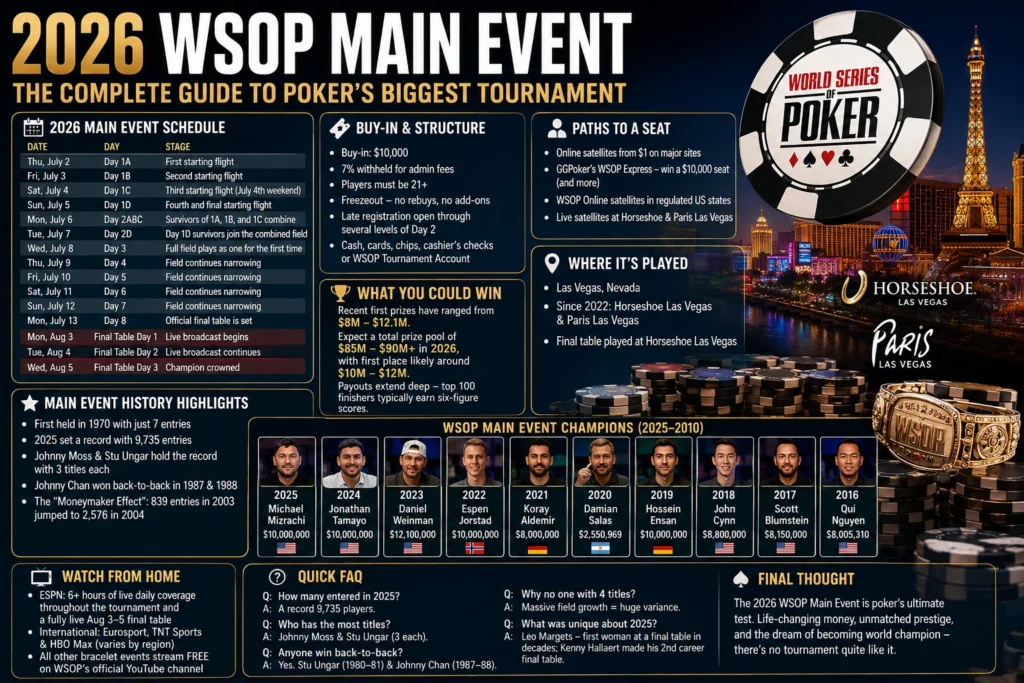
2026 WSOP Main Event: The Complete Guide to Poker’s Biggest Tournament
On this page
There’s a reason poker players talk about “the Main Event” the way golf fans talk about “the Masters”, say it without further explanation and everyone in the room knows exactly which tournament you mean. The 2026 WSOP Main Event isn’t just the richest and most prestigious event of the summer; it’s the one tournament capable of turning a total unknown into a poker millionaire and a household name inside a single week, the way it did for Chris Moneymaker back in 2003.
Whether you’re interested in the WSOP Main Event schedule, the WSOP Main Event buy-in, how to enter the WSOP Main Event, the latest WSOP Main Event payouts, or looking back at WSOP Main Event past winners, this guide covers everything you need to know. We’ll also explain how WSOP satellites 2026 offer players a low-cost route into poker’s biggest tournament.
This year’s edition is already underway, and whether you’re planning to actually sit down and play, chase a seat through a satellite, or just want to follow along from home, here’s a genuinely complete picture of what’s happening, when, and how it all works.
What Makes the Main Event Different From Every Other WSOP Event
The WSOP runs 100 bracelet events across a two-month summer calendar, but the Main Event is the one built to be the centerpiece—it’s the tournament the entire schedule is essentially designed to build toward. The field mixes everyone from grinders who’ve sat in for pocket change to seasoned pros with multiple bracelets to online qualifiers who’ve never played a live tournament of this size before. That collision of skill levels, combined with a freezeout structure where one bad beat ends your summer, is exactly what gives the Main Event its unique texture. Nowhere else in poker do you get quite that same mix of amateur dream-chasing and professional precision colliding at the same felt.
The Full 2026 Main Event Schedule
The tournament runs across four separate starting flights, which exist so that thousands of players can all begin their week without needing a single room large enough to seat the entire field at once. Here’s how the full schedule breaks down:
| Date | Day | Stage |
| Thursday, July 2 | Day 1A | First starting flight |
| Friday, July 3 | Day 1B | Second starting flight |
| Saturday, July 4 | Day 1C | Third starting flight (July 4th weekend) |
| Sunday, July 5 | Day 1D | Fourth and final starting flight |
| Monday, July 6 | Day 2ABC | Survivors of 1A, 1B, and 1C combine |
| Tuesday, July 7 | Day 2D | Day 1D survivors join the combined field |
| Wednesday, July 8 | Day 3 | Full field plays as one for the first time |
| Thursday, July 9 | Day 4 | Field continues narrowing |
| Friday, July 10 | Day 5 | Field continues narrowing |
| Saturday, July 11 | Day 6 | Field continues narrowing |
| Sunday, July 12 | Day 7 | Field continues narrowing |
| Monday, July 13 | Day 8 | Official final table is set |
| Monday, August 3 | Final Table Day 1 | Live broadcast begins |
| Tuesday, August 4 | Final Table Day 2 | Live broadcast continues |
| Wednesday, August 5 | Final Table Day 3 | Champion crowned |
That gap between July 13 and August 3 isn’t a scheduling accident — it’s a deliberate choice tied to a new multi-year broadcast partnership with ESPN. Instead of playing the final table out the same week the field gets set, as has traditionally happened, this year’s nine finalists will spend three weeks as public figures before a single hand of the final table is dealt, while ESPN airs curated prime-time build-up coverage to grow the audience for a fully live broadcast finish.
Buy-In, Structure, and Who Can Actually Play
The entry fee sits at $10,000, exactly where it’s been since the tournament’s earliest days back in 1972 — a number that would need to be closer to $86,000 today just to keep pace with inflation, which tells you something about how deliberately the WSOP has kept this buy-in accessible relative to what it could have charged. Roughly 7% of every buy-in gets withheld from the prize pool for administrative costs, which is standard practice across major tournament poker.
Anyone 21 or older can register directly with the full buy-in — there’s no qualification requirement, no invitation needed, and no restriction based on nationality. You can pay with cash, major credit or debit cards, cashier’s checks from an accredited account, casino chips, or through a WSOP Tournament Account, though card payments and tournament account transactions typically carry an added processing fee.
It’s worth understanding what you’re signing up for structurally: this is a freezeout. There are no rebuys and no add-ons. Once your chips are gone, your Main Event is over for the year, full stop. That permanence is part of what makes the tournament feel different from softer, forgiving formats — every decision from Day 1 carries real weight because there’s no second chance to buy back in.
Late registration stays open through several levels into Day 2, giving latecomers a real window to jump in even after missing all four opening flights, though exact registration close details can shift slightly year to year based on structure sheets released closer to the event.
What You Could Actually Win
Predicting an exact prize pool before the field is fully counted is guesswork, but recent history gives a pretty reliable range to work from. Here’s how the last several years have played out:
| Year | Entries | Champion | First Prize |
| 2025 | 9,735 | Michael Mizrachi | $10,000,000 |
| 2024 | 10,112 | Jonathan Tamayo | $10,000,000 |
| 2023 | 10,043 | Daniel Weinman | $12,100,000 |
| 2022 | 8,663 | Espen Jorstad | $10,000,000 |
| 2021 | 6,550 | Koray Aldemir | $8,000,000 |
Notice the pattern: entries have hovered in the 8,500-10,100 range for most of the last five years, and first prize has consistently landed between $8 million and $12.1 million depending on exactly how many players show up. If 2026 tracks that same range, a reasonable expectation is a total prize pool north of $85-90 million, with first place likely landing somewhere around $10-12 million. Payouts extend far deeper than just the winner, too — the top 100 finishers typically all walk away with six-figure scores, and hundreds more make some kind of money finish even if it’s a fraction of the buy-in back.
How to Actually Get a Seat Without $10,000 Upfront
Most players who end up at a Main Event table didn’t wire $10,000 straight to the cashier — they sat in. Online satellites are by far the most accessible route, with entry points starting as low as $1 on major platforms and winners walking away with a full $10,000 seat, occasionally bundled with additional travel or accommodation value on top. GGPoker’s WSOP Express promotion is one of the most prominent international paths of this kind, structured specifically to feed players from a small buy-in all the way up to a Main Event seat over a series of escalating satellite rounds.
For players physically located in a regulated US state like Nevada, WSOP Online runs its own dedicated satellite schedule in the lead-up to the series, typically on a recurring weekly basis, with full details published inside the platform’s tournament lobby closer to the date. Live satellites also run continuously at the host venues in the days before and during the Main Event itself, for anyone who’d rather try to win their way on-site rather than online.
Where This Tournament Is Actually Played
The Main Event takes place in Las Vegas, which has hosted the WSOP in one form or another since the very first Main Event was played in 1970. Since 2022, the series has been split across Horseshoe Las Vegas and Paris Las Vegas on the Strip, with various ballrooms and poker rooms across both properties hosting different stages of play throughout the summer. The final table itself is played at Horseshoe, giving the tournament’s ultimate stage a consistent home each year.
The History Behind the Bracelet
Understanding where the Main Event sits today means knowing a little about where it came from. The very first Main Event in 1970 had just seven entries and no formal prize structure. Compare that to last year’s 9,735-entry field, and the growth of this tournament essentially mirrors the growth of poker as a mainstream sport over the past five decades.
A few records worth knowing: Johnny Moss and Stu Ungar share the record for most Main Event titles, with three wins apiece — Moss claimed his in 1970, 1971, and 1974, while Ungar took his in 1980, 1981, and a memorable comeback win in 1997. No player has managed to win it a fourth time, and no one has repeated as champion in consecutive years since the tournament ballooned into a multi-thousand-entry field, which says a lot about just how much variance and skill both play a role once the numbers get this large. Doyle Brunson, despite only winning twice, made seven final tables across his career — a longevity record that arguably says as much about sustained excellence as raw win totals do.
The Complete List of WSOP Main Event Champions
Here’s the full record, year by year, from the very first Main Event through 2025. Watching the entries column climb is its own story about how poker grew from a niche Vegas curiosity into a global phenomenon:
| Year | Entries | Champion | Country | Prize |
| 2025 | 9,735 | Michael Mizrachi | United States | $10,000,000 |
| 2024 | 10,112 | Jonathan Tamayo | United States | $10,000,000 |
| 2023 | 10,043 | Daniel Weinman | United States | $12,100,000 |
| 2022 | 8,663 | Espen Jorstad | Norway | $10,000,000 |
| 2021 | 6,550 | Koray Aldemir | Germany | $8,000,000 |
| 2020 | 1,379 | Damian Salas | Argentina | $2,550,969 |
| 2019 | 8,569 | Hossein Ensan | Germany | $10,000,000 |
| 2018 | 7,874 | John Cynn | United States | $8,800,000 |
| 2017 | 7,221 | Scott Blumstein | United States | $8,150,000 |
| 2016 | 6,737 | Qui Nguyen | United States | $8,005,310 |
| 2015 | 6,420 | Joe McKeehen | United States | $7,683,346 |
| 2014 | 6,683 | Martin Jacobson | Sweden | $10,000,000 |
| 2013 | 6,352 | Ryan Riess | United States | $8,361,570 |
| 2012 | 6,598 | Greg Merson | United States | $8,531,853 |
| 2011 | 6,865 | Pius Heinz | Germany | $8,715,638 |
| 2010 | 7,319 | Jonathan Duhamel | Canada | $8,944,310 |
| 2009 | 6,494 | Joe Cada | United States | $8,547,042 |
| 2008 | 6,844 | Peter Eastgate | Denmark | $9,119,517 |
| 2007 | 6,358 | Jerry Yang | United States | $8,250,000 |
| 2006 | 8,773 | Jamie Gold | United States | $12,000,000 |
| 2005 | 5,619 | Joe Hachem | Australia | $7,500,000 |
| 2004 | 2,576 | Greg Raymer | United States | $5,000,000 |
| 2003 | 839 | Chris Moneymaker | United States | $2,500,000 |
| 2002 | 631 | Robert Varkonyi | United States | $2,000,000 |
| 2001 | 613 | Carlos Mortensen | Spain | $1,500,000 |
| 2000 | 512 | Chris Ferguson | United States | $1,500,000 |
| 1999 | 393 | Noel Furlong | Ireland | $1,000,000 |
| 1998 | 350 | Scotty Nguyen | Vietnam | $1,000,000 |
| 1997 | 312 | Stu Ungar | United States | $1,000,000 |
| 1996 | 295 | Huck Seed | United States | $1,000,000 |
| 1995 | 273 | Dan Harrington | United States | $1,000,000 |
| 1994 | 268 | Russ Hamilton | United States | $1,000,000 |
| 1993 | 220 | Jim Bechtel | United States | $1,000,000 |
| 1992 | 201 | Hamid Dastmalchi | Iran | $1,000,000 |
| 1991 | 215 | Brad Daugherty | United States | $1,000,000 |
| 1990 | 194 | Mansour Matloubi | Iran | $895,000 |
| 1989 | 178 | Phil Hellmuth | United States | $755,000 |
| 1988 | 167 | Johnny Chan | United States | $700,000 |
| 1987 | 152 | Johnny Chan | United States | $625,000 |
| 1986 | 141 | Berry Johnston | United States | $570,000 |
| 1985 | 140 | Bill Smith | United States | $700,000 |
| 1984 | 132 | Jack Keller | United States | $660,000 |
| 1983 | 108 | Tom McEvoy | United States | $540,000 |
| 1982 | 104 | Jack Straus | United States | $520,000 |
| 1981 | 75 | Stu Ungar | United States | $375,000 |
| 1980 | 73 | Stu Ungar | United States | $385,000 |
| 1979 | 54 | Hal Fowler | United States | $270,000 |
| 1978 | 42 | Bobby Baldwin | United States | $210,000 |
| 1977 | 34 | Doyle Brunson | United States | $340,000 |
| 1976 | 22 | Doyle Brunson | United States | $220,000 |
| 1975 | 21 | Brian Roberts | United States | $210,000 |
| 1974 | 16 | Johnny Moss | United States | $160,000 |
| 1973 | 13 | Walter Pearson | United States | $130,000 |
| 1972 | 8 | Thomas Preston | United States | $80,000 |
| 1971 | 6 | Johnny Moss | United States | $30,000 |
| 1970 | 7 | Johnny Moss | United States | N/A (voted champion) |
A few things jump out looking at the full list side by side. The jump from 839 entries in Moneymaker’s 2003 win to 2,576 the very next year is the single most dramatic one-year swing in the tournament’s history, and it’s not a coincidence — that’s the Moneymaker Effect in real numbers, not just a phrase people repeat. It’s also worth noticing that Johnny Chan won back-to-back in 1987 and 1988, one of only a handful of players to ever go back-to-back, and that entries didn’t reliably clear the 6,000 mark until the mid-2000s poker boom fully took hold.
Why This History Actually Matters If You’re Playing Today
Beyond trivia value, there’s a genuinely useful lesson in these numbers for anyone thinking about entering a future Main Event: the game has gotten dramatically harder to run deep in purely because of field size, not because today’s average player is necessarily better prepared than a 1980s regular was relative to their own era. Winning three times in a 100-entry field and winning three times in a 9,000-entry field are not remotely comparable achievements in terms of variance, which is exactly why Moss and Ungar’s records have stood for so long and why most serious poker minds don’t expect them to fall anytime soon.
Watching From Home
If you’re not making the trip to Vegas, following along has genuinely never been easier. ESPN’s new multi-year rights deal means at least six hours of live daily coverage throughout the tournament itself, building toward a fully live broadcast of the August 3-5 final table. International audiences have their own dedicated coverage through a separate multi-year partnership bringing the Main Event to Eurosport, TNT Sports, and HBO Max across different regions, while every other bracelet event on the broader schedule streams free on the WSOP’s official YouTube channel.
Final Thoughts
The 2026 WSOP Main Event remains poker’s ultimate test, combining life-changing prize money, unmatched prestige, and the dream of becoming the next world champion. Whether you’re planning to buy in directly, qualify through WSOP satellites 2026, or simply follow the action from home, there’s no tournament quite like the Main Event.
FAQs
How many players entered the 2025 WSOP Main Event?
The 2025 WSOP Main Event drew a record 9,735 entries, the largest field in the tournament’s history at that point.
How can I enter the 2026 WSOP Main Event?
Players can enter by paying the $10,000 buy-in directly or by qualifying through WSOP satellites 2026, with online satellites starting from as little as $1 on select poker platforms.
How much does the WSOP Main Event winner receive?
The winner’s prize varies by field size. Recent WSOP Main Event payouts have awarded first-place prizes between $8 million and $12.1 million, with the 2025 champion receiving $10 million.
Who has won the most WSOP Main Event titles?
Johnny Moss and Stu Ungar share the record with three WSOP Main Event victories each, making them the tournament’s most successful champions.
When is the 2026 WSOP Main Event final table?
The 2026 WSOP Main Event reaches its official final table on July 13, with play resuming after a scheduled break on August 3-5, when the new world champion will be crowned.
Disclosure: PokerClubGames may earn a commission when you use links to poker operators. This never changes the price you pay. 18+ (21+ where required). Gambling involves risk. How we make money