
Last Updated on August 18, 2026 by Bala Kumar
Video poker has a whole family tree of “Bonus” variants, and if you’ve played Double Double Bonus Poker, you already understand the appeal, and the pain, of chasing four of a kind. Triple Double Bonus Poker takes that same idea and cranks the volatility up another notch. It’s not a beginner’s game, and it’s not trying to be. It’s built for players who understand variance, respect the math, and don’t mind a cold streak in exchange for the occasional monster hit.
Let’s break down what makes this game different, how to actually play it correctly, and where triple double bonus poker strategy diverges from the more familiar double double bonus poker strategy most video poker players learn first.
What Makes Triple Double Bonus Poker Different
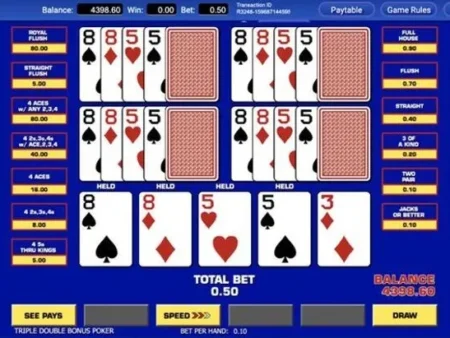
Triple Double Bonus is part of the same bonus poker family as Double Double Bonus, but the payout structure has been reshuffled in a way that dramatically changes how the game feels to play. The trade-off is simple but brutal: some of the “everyday” hands pay less, while the rare, big hands pay a lot more.
Specifically:
- Two pair pays only 1 coin per coin bet — a big step down from the standard 2 coins you’d see in Jacks or Better or even Double Double Bonus.
- Three of a kind pays 2 coins instead of the usual 3.
- In exchange, four Aces with a 2, 3, or 4 kicker pays the same as a royal flush — an enormous payout for a hand you’ll actually land far more often than a natural royal.
- Four 2s, 3s, or 4s with a kicker also pay double what they would in Double Double Bonus.
That’s the whole personality of the game in one paragraph. You’re giving up steady, small returns on common hands so that when you do connect with quads — especially aces — the machine pays you like you just hit something special. It’s a high-variance trade, and it’s exactly why sharp players who understand bankroll management are drawn to it.
The Pay Tables You Need to Know
Not all Triple Double Bonus machines are created equal, and the differences between versions matter more here than in almost any other video poker variant. The game is usually described using a full house/flush shorthand, similar to how Jacks or Better games are labeled “9/6” or “8/5.”
- 9/7 pay table — the best version you’ll find, returning roughly 99.58% with perfect play. This means 9 coins on a full house and 7 coins on a flush. It’s mostly found in the Las Vegas locals market and a handful of regional casinos, so it’s worth hunting for if you’re serious about the game.
- 9/6 pay table — the most common version you’ll encounter, both online and in land-based casinos, returning around 98.15%. Still a very playable game, just not quite as generous.
- 9/5 and lower pay tables — these show up on the Strip and in bars, and the return drops noticeably. Anything paying 8 coins or fewer on a full house dips under 96%, which is where the game starts to lose its appeal even for players who enjoy the variance.
The takeaway here is simple: always check the pay table before you sit down. A difference of one or two coins on the full house and flush lines can swing your long-term return by more than a full percentage point — and on a high-variance game like this, that gap compounds fast over a long session.
Triple Double Bonus Poker Strategy: The Core Adjustments
If you already know Double Double Bonus, you’re most of the way there — but there are specific triple double bonus poker strategy adjustments you need to internalize, because playing it exactly like Double Double Bonus will cost you money.
Start with the basic hierarchy. Stand pat on a royal flush, straight flush, four Aces (with or without a kicker), four 2s/3s/4s with a kicker, and four 5s through Kings. From there, the strategy generally follows this priority order when you’re deciding what to hold:
- Made hands and strong draws first — pat straight flushes, four of a kinds, full houses, flushes, straights, and three of a kind all get held as-is before you consider breaking them for a draw.
- Four to a royal flush almost always beats holding a made flush or straight, given the size of the royal payout.
- Three to a royal flush frequently outranks a made pair or even two pair, which feels counterintuitive if you’re coming from Jacks or Better, but makes sense once you remember two pair only pays 1 coin here.
- Low pairs (2s through 4s especially) get held more aggressively than you might expect, purely because of how much four of a kind on those cards is now worth. A low pair here isn’t just “a shot at trips” — it’s a shot at one of the biggest payouts in the game.
- High pairs (Jacks through Aces) are held over most two-pair situations, since a single high pair carries real upside toward a bonus four of a kind, while two pair caps out at that weak 1-coin return.
The single biggest mental shift for players coming over from Double Double Bonus poker strategy is learning to respect the low pairs and the three-to-a-royal draws more than instinct tells you to, while treating two pair as a much less attractive hand than you’re used to. In Double Double Bonus, two pair is a comfortable, forgettable win. In Triple Double Bonus, it’s barely a win at all — and that single difference reshapes a surprising number of borderline decisions throughout a session.
Comparing Triple Double Bonus to Double Double Bonus Poker
It’s worth pausing on this comparison directly, since the two games are so closely related that players often assume the strategy transfers one-to-one. It doesn’t.
Double Double Bonus Poker strategy revolves around chasing four of a kind on Aces and low cards (2s through 4s) with a kicker, similar to Triple Double Bonus, but the surrounding pay structure is gentler. Two pair and three of a kind pay closer to what you’d expect from a standard bonus game, which means the overall variance is lower and the swings are less punishing over a normal session.
Triple Double Bonus takes that same bonus-chasing concept and turns the dial up. The reduced payouts on two pair and three of a kind mean your baseline win rate drops, and you’ll go through longer stretches without a meaningful payout. But the ceiling is dramatically higher — four Aces with a kicker paying royal-flush money is a huge deal, and it happens far more often than an actual royal flush would.
If you’re deciding between the two games, the honest answer is that it comes down to temperament and bankroll. Players who want steadier, more predictable sessions tend to prefer Double Double Bonus. Players who don’t mind dry spells in exchange for bigger spikes — the “quad-chasers,” as the game is sometimes nicknamed — gravitate toward Triple Double Bonus.
Bankroll Management for a High-Variance Game
Because Triple Double Bonus leans so heavily on rare, big-payout hands, your bankroll needs to be built for the swings. A good general rule for high-volatility video poker is to avoid risking more than about 5% of your total bankroll in a single session, and to size your bets so you can comfortably play at least 500 hands without busting during a normal cold streak. Given how much of this game’s return is concentrated in a small number of huge hands, that cushion matters more here than it would in something steadier like Jacks or Better.
It’s also worth setting a realistic expectation going in: you will have losing sessions on this game, even playing perfect strategy. That’s the nature of the trade-off you’re making for the shot at those enormous four-Aces payouts. If that kind of variance stresses you out rather than excites you, this probably isn’t the right game for your bankroll — and that’s a completely reasonable thing to know about yourself before you sit down.
Final Thoughts
Triple Double Bonus Poker isn’t trying to be everyone’s favorite video poker game, and that’s part of its appeal. It rewards players who’ve put in the time to learn the correct triple double bonus poker strategy, who understand why holding a low pair over two pair makes mathematical sense here even when it feels wrong, and who have the bankroll discipline to ride out the dry stretches between big hits. Find a 9/6 or, better yet, a 9/7 pay table, learn the hand-hierarchy adjustments that separate this game from Double Double Bonus, and you’re playing one of the more genuinely skill-rewarding variants in the entire bonus poker family.
FAQs
1. What is Triple Double Bonus Poker?
Triple Double Bonus Poker is a high-variance video poker variant that offers exceptionally large payouts for certain four-of-a-kind hands, especially four Aces with a 2, 3, or 4 kicker.
2. What is the best Triple Double Bonus Poker pay table?
The 9/7 pay table is generally considered one of the best, offering a theoretical return of about 99.58% with optimal play. A 9/6 version is also widely available.
3. How is Triple Double Bonus different from Double Double Bonus?
Triple Double Bonus reduces payouts for common hands such as two pair and three of a kind while increasing payouts for specific four-of-a-kind combinations. This makes it more volatile than Double Double Bonus.
4. What hands should I prioritize in Triple Double Bonus Poker?
Prioritize made premium hands, four of a kind, four-card royal draws, and bonus opportunities involving Aces and low cards. Low pairs can also be valuable because of their potential to develop into high-paying quads.
5. Is Triple Double Bonus Poker good for beginners?
It can be played by beginners, but its high variance and complex strategy make it less forgiving than simpler video poker variants. Players should learn the correct strategy and use disciplined bankroll management before playing for significant stakes.
Founder of PokerClubGames.com and a Poker Researcher with 10+ years of experience in SEO, WordPress development, and gaming content strategy. Specializes in researching online poker sites, poker apps, tournaments, bonuses, and poker strategies. Experienced in poker platform reviews, affiliate marketing, and creating SEO-focused poker content for global audiences.
For collaborations, media inquiries, or poker-related partnerships:
Contact: partnerships@pokerclubgames.com