
Last Updated on July 11, 2026 by Bala Kumar
If you’re sitting down at a poker table for the first time, or you’ve been playing for years but still second-guess yourself when the cards hit the felt, one question always comes back around: what beats what in poker? Understanding poker hand rankings isn’t just trivia. It’s the foundation every strategic decision is built on, from your preflop range to your final call on the river.
This guide breaks down the full poker hand ranking chart, explains how ties are settled, and answers the questions players search for most heading into 2026.
What Are Poker Hand Rankings?
Poker hand rankings are the fixed order that determines which five-card combination wins a hand. In nearly every major variant, Texas Hold’em, Omaha, Seven-Card Stud, the same standard poker hands ranked system applies, from the rare and powerful Royal Flush all the way down to a lone High Card.
Knowing these rankings cold is non-negotiable. You can have flawless bluffing instincts and perfect bet sizing, but if you don’t know whether a flush beats a straight (it does), you’re playing blind.
The Complete Poker Hand Rankings Chart (Best to Worst)
Here’s the full poker hand hierarchy, from strongest to weakest:
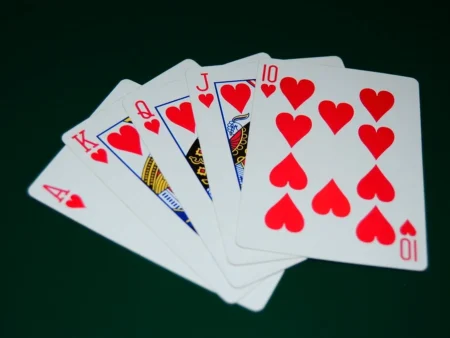
1. Royal Flush
The best hand in poker. A, K, Q, J, and 10, all in the same suit. It’s essentially the highest possible straight flush, and it’s rare enough that many players go their whole careers without ever holding one.
2. Straight Flush
Five consecutive cards, all the same suit, for example, 5-6-7-8-9 of hearts. Any straight flush beats four of a kind, no matter how high the quads are.
3. Four of a Kind (Quads)
Four cards of identical rank, plus one unrelated card (the kicker). Four Kings will always beat Four Queens, regardless of what else is on the board.
4. Full House (Boat)
Three cards of one rank plus a pair of another — for instance, three Jacks and two 8s. When two players both have a full house, the hand with the higher three-of-a-kind wins.
5. Flush
Five cards of the same suit that aren’t in sequential order. Flushes are compared card-by-card starting from the highest card down.
6. Straight
Five consecutive cards of mixed suits. An Ace can play high (10-J-Q-K-A) or low (A-2-3-4-5), but it can’t wrap around, meaning K-A-2-3-4 is not a valid straight.
7. Three of a Kind (Trips or Set)
Three cards of the same rank, plus two unrelated kickers. In Hold’em, players often distinguish between “trips” (using one card in hand and two on the board) and a “set” (a pocket pair matched by one card on the board) — the hand strength is identical, but a set is typically much harder for opponents to see coming.
8. Two Pair
Two separate pairs plus one kicker. When comparing two-pair hands, the higher pair is evaluated first, then the second pair, then the kicker.
9. One Pair
Two cards of matching rank plus three unrelated kickers. This is one of the most common winning hands at showdown in low-stakes and recreational games.
10. High Card
No pair, no sequence, no matching suits, just the best single card you’re holding. When two players both have high card hands, the rankings come down to comparing each card in descending order.
How Are Poker Hand Rankings Determined?
Poker hand rankings are based on statistical rarity. The harder a combination is to make, the higher it ranks. A Royal Flush, for example, has odds of roughly 1 in 649,740 in a five-card draw, which is exactly why it sits at the top of the poker hands chart, while something as common as One Pair sits near the bottom.
This is also why suits themselves carry no inherent value in standard poker. A flush in spades is worth exactly the same as a flush in clubs; what matters is the rank of the cards within the flush, not which suit produced it.
How Do You Break a Tie in Poker?
Ties are more common than most beginners expect, and understanding poker hand ranking ties is a critical part of learning the game.
- Kickers matter. If two players both have One Pair, the pair itself is compared first. If the pairs match, the highest unmatched card (the kicker) decides the winner.
- Flushes and High Card hands are compared card-by-card, from highest to lowest, until one player’s card is higher.
- True ties happen. If both players hold the exact same five-card ranking with no kicker advantage, for example, an identical board plays for both players in Hold’em — the pot is split.
Knowing how to read a kicker situation quickly at the table is one of the small edges that separates confident players from hesitant ones.
Do Poker Hand Rankings Ever Change?
For the most part, standard Texas Hold’em hand rankings are universal and don’t change. However, a few variants flip or alter the order:
- Lowball and Razz invert the traditional hierarchy, rewarding the lowest hand instead of the highest.
- Short Deck (Six Plus) Hold’em, which has grown significantly in popularity on the high-stakes circuit, removes cards 2 through 5 from the deck. This changes the math enough that a Flush actually beats a Full House in most Short Deck formats — the opposite of standard rankings.
- Wild card games occasionally introduce a Five of a Kind, which sits above a Royal Flush when it’s possible.
If you’re moving between game types in 2026, and with Short Deck’s continued rise on the high-roller circuit, more recreational players are trying it, it’s worth double-checking the specific rules before you sit down.
Why Poker Hand Rankings Still Matter in 2026
With solver-based strategy, GTO study tools, and AI-assisted training now standard across the poker world, it might seem like hand rankings are old news. They’re not. Every solver output, every ICM calculation, and every exploitative adjustment a high-stakes pro makes is still built on top of this same basic hierarchy. You can’t understand why a professional check-raises the river with a flush draw, or why a set is so much stronger than trips in practice, without first understanding how poker hands rank relative to each other.
For beginners, memorizing this chart is step one. For experienced players, it’s the framework; everything else, pot odds, range construction, bluffing frequency, gets built on top of.
Final Thoughts
Whether you’re learning poker hand rankings for beginners or brushing up before your next home game or casino trip, the order from Royal Flush down to High Card is the single most important thing to have memorized before you ever look at your cards. Once it’s second nature, you can stop thinking about what beats what, and start thinking about how to win.
FAQs
1. What is the highest-ranking hand in poker?
The Royal Flush is the highest-ranking poker hand. It consists of A, K, Q, J, and 10 of the same suit and cannot be beaten in standard poker games.
2. Does a flush beat a straight in poker?
Yes. In standard poker variants like Texas Hold’em and Omaha, a Flush always beats a Straight because it is a rarer hand.
3. How are ties decided in poker?
Ties are usually broken using kickers. If players have the same ranked hand, the highest unmatched card determines the winner. If both players have identical five-card hands, the pot is split.
4. Are poker hand rankings the same in every poker variant?
Most popular games, including Texas Hold’em, Omaha, and Seven-Card Stud, use the same hand rankings. However, variants such as Short Deck Hold’em, Razz, and Lowball use modified ranking rules.
5. What’s the easiest way to memorize poker hand rankings?
Start by remembering the order from strongest to weakest: Royal Flush, Straight Flush, Four of a Kind, Full House, Flush, Straight, Three of a Kind, Two Pair, One Pair, and High Card. Regular play and reviewing a poker hand rankings chart will help you memorize them quickly.
Founder of PokerClubGames.com and a Poker Researcher with 10+ years of experience in SEO, WordPress development, and gaming content strategy. Specializes in researching online poker sites, poker apps, tournaments, bonuses, and poker strategies. Experienced in poker platform reviews, affiliate marketing, and creating SEO-focused poker content for global audiences.
For collaborations, media inquiries, or poker-related partnerships:
Contact: Info@hugecount.com