
Last Updated on July 15, 2026 by Bala Kumar
Poker looks simple from the outside, cards, chips, a table full of people trying not to give anything away. It’s only once you sit down that you realize how much is actually happening underneath: hand rankings, position, betting structure, bankroll math, and a dozen small decisions per hand that add up over a session. This guide is built to get you from “I’ve never played” to “I understand what’s actually going on at the table,” covering the rules, formats, terminology, and resources you need before you ever put real money on the felt.
If you’re looking for tactical strategy adjustments once you already know the basics, our companion piece on poker tips for beginners covers that ground. This guide is the foundation that comes first.
What Is Poker, Exactly?
At its core, poker is a card game where players bet on who holds, or can convincingly represent, the best hand, using a combination of skill, math, and reading opponents. Unlike games of pure chance, poker rewards decision-making over time; a single hand can go either way, but skilled players win consistently across enough hands because they make better decisions on average than their opponents.
Nearly every popular poker format shares the same foundation: a standard 52-card deck, a rotating dealer position, and a structure of blinds or antes that force action. What changes between variants is how many cards you’re dealt, how many you share with the table, and how betting rounds are structured.
Poker Hand Rankings
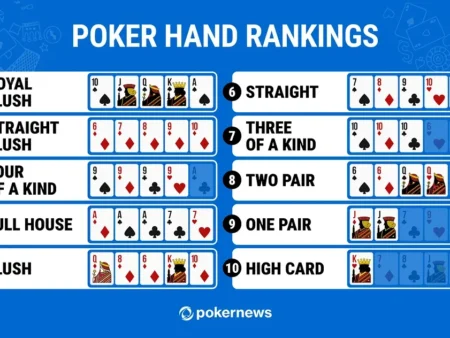
Before anything else, memorize these, they’re identical across almost every major poker variant, from strongest to weakest:
- Royal Flush: A, K, Q, J, 10, all the same suit
- Straight Flush: Five consecutive cards, same suit
- Four of a Kind: Four cards of the same rank
- Full House: Three of a kind plus a pair
- Flush: Five cards of the same suit, not in sequence
- Straight: Five consecutive cards, mixed suits
- Three of a Kind: Three cards of the same rank
- Two Pair: Two separate pairs
- One Pair: Two cards of the same rank
- High Card: No matching cards or sequence; highest card plays
Get comfortable identifying these instantly. In the middle of a hand, pausing to work out whether a straight beats a flush is a habit you want gone before you play for real money.
The Main Types of Poker Games
Texas Hold’em
The most widely played poker format in the world, live and online. Each player gets two private “hole cards,” and five community cards are dealt face-up in stages, shared by everyone at the table. It’s the format most beginners should learn first, simply because it’s the easiest to find games for and the most resources are built around it.
Omaha (and Pot-Limit Omaha)
Similar structure to Hold’em, but each player receives four hole cards instead of two, and must use exactly two of them combined with three community cards. The extra cards mean stronger average hands and more complex decision-making — generally recommended as a second format to learn, not a first.
Seven-Card Stud
An older format with no shared community cards — each player receives a mix of face-down and face-up cards over several betting rounds. Less common today but still played in mixed-game formats and some live rooms.
Tournament vs. Cash Game Structure
Regardless of which card game you choose, you’ll also choose between two very different formats:
- Cash games use real-money chips that hold consistent value, and you can leave the table anytime with whatever you have. Stack sizes stay stable, which makes the learning curve gentler.
- Tournaments require a fixed buy-in, blinds increase over time, and you’re eliminated once your chips run out. Tournaments demand constantly shifting strategy as stacks get shallower relative to the blinds — a harder format to learn on, but where most of poker’s biggest prizes and prestige live.
Essential Poker Terminology
A working vocabulary makes everything else in this guide click faster:
- Blinds — forced bets posted before cards are dealt, keeping the action moving
- Position — your seat relative to the dealer button; acting later gives you more information
- Pot odds — the ratio between the current pot size and the cost of a contemplated call, used to judge whether a call is profitable
- All-in — betting your entire remaining stack on a single hand
- Fold, call, raise, check — the four basic actions available to you on your turn
- Flop, turn, river — the three stages community cards are revealed in Texas Hold’em
- Bankroll — the total money you’ve set aside specifically for playing poker, separate from other funds
How to Actually Get Started Playing
- Learn the rules of one format thoroughly before branching out. Texas Hold’em is the standard starting point.
- Play free or low-stakes games first. Most major platforms offer play-money tables or micro-stakes real-money games specifically for this stage.
- Set aside a dedicated bankroll. Never play with money you need for anything else, and keep your stakes well below what your bankroll can absorb — a common guideline is 20–30 buy-ins for whatever stake you’re playing.
- Choose a platform with strong beginner traffic. Some rooms run softer, more recreational-heavy tables than others; research this before committing to one site.
- Track your sessions. Even basic notes on what confused you or what worked will accelerate your learning far more than volume alone.
Best Poker Learning Books
Once you’ve got the mechanics down, the fastest way to genuinely improve is reading — the right material compresses years of hard-won experience into a few hundred pages. Some of the best poker learning books for someone starting out include:
- “Harrington on Hold’em” by Dan Harrington, a tournament-focused classic that’s still one of the clearest explanations of stack sizes and survival strategy available
- “The Theory of Poker” by David Sklansky, not written specifically for beginners, but foundational for understanding why good poker decisions work, not just what they are
- “Elements of Poker” by Tommy Angelo, focused on the mental and emotional discipline side of the game, which trips up more new players than bad hand-reading does
Among the best poker strategy books for beginners specifically, “Harrington on Hold’em” remains the most commonly recommended starting point for tournament players, while cash game beginners are often better served starting with something more modern and structured, like Peter Clarke’s “The Grinder’s Manual.”
Best Poker Strategies for Beginners
A full breakdown of strategy lives in our dedicated tips guide, but the short version worth internalizing immediately:
- Play tighter than feels natural. Fewer starting hands, played more confidently, beats a wide range played passively.
- Respect your position at the table. The same hand can be a raise on the button and a fold from an early position.
- Don’t chase losses or overreact to variance. A bad session doesn’t mean your strategy is wrong; a good one doesn’t mean it’s time to move up in stakes.
- Study more than you grind, especially at first. An hour of focused review often teaches more than several hours of unreflective play.
Where Beginners Are Actually Playing in 2026
The path into poker today is more accessible than it’s ever been. Nearly every major operator , GGPoker, PokerStars, ACR Poker, 888poker, runs micro-stakes tables specifically suited to new players, and satellite systems now let beginners work their way into major tournaments for a fraction of the direct buy-in. Mystery Bounty tournaments, in particular, have become a popular entry point for new tournament players, since the format’s hidden-prize element makes big fields feel less intimidating than a standard freezeout. Welcome bonuses at major sites also give new players extra starting capital to build experience with, worth researching before you make your first deposit anywhere, since terms vary significantly between operators.
FAQs
1. How long does it take to learn poker as a beginner?
Most beginners can learn the basic rules and hand rankings within a few hours. Developing solid decision-making and strategy, however, usually takes weeks or months of regular practice and study.
2. Can I learn poker without risking real money?
Yes. Many online poker sites offer free-play tables where beginners can practice the rules, betting, and gameplay before moving to real-money games.
3. What is the biggest mistake new poker players make?
One of the most common mistakes is playing too many starting hands. Beginners often stay in weak hands instead of folding, which leads to unnecessary losses over time.
4. Do I need to memorize all poker hand rankings before playing?
Yes. Knowing poker hand rankings is essential because you’ll need to recognize winning hands quickly during live or online games without slowing down your decisions.
5. Is poker based on skill or luck?
Luck influences the outcome of individual hands, but poker is widely recognized as a game of skill over the long run. Players who consistently make better decisions tend to achieve better results over many sessions.
Founder of PokerClubGames.com and a Poker Researcher with 10+ years of experience in SEO, WordPress development, and gaming content strategy. Specializes in researching online poker sites, poker apps, tournaments, bonuses, and poker strategies. Experienced in poker platform reviews, affiliate marketing, and creating SEO-focused poker content for global audiences.
For collaborations, media inquiries, or poker-related partnerships:
Contact: Info@hugecount.com