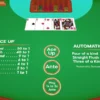
Walk past the table games in almost any casino and you’ll spot Three Card Poker. It’s simple, fast and hugely popular. A few tables down, often with fewer players around it, you might find its bigger brother: Four Card Poker.
Most players never sit down at it, usually because they assume it’s just Three Card Poker with an extra card. It isn’t.
Four Card Poker changes the way you win, the way you bet, and how much the casino keeps. Played correctly, the house edge on the main game is lower than Three Card Poker’s. And the game gives you one decision that actually matters: how much to raise.
This guide covers the rules, hand rankings, payouts, the best strategy, and exactly how it compares with Three Card Poker.
What Is Four Card Poker?
Four Card Poker is a casino table game in which you play against the dealer, not against other players. It was invented by Roger Snow and is distributed by Shuffle Master, the same company behind Three Card Poker.
The basic idea:
- You get five cards and make your best four-card hand.
- The dealer gets six cards (five face down, one face up) and makes their best four-card hand.
- Best four-card hand wins.
That’s it. You never draw or exchange cards. Your only decisions are whether to stay in the hand and how much to bet.
If you enjoy casino poker games like this, you may also like our guide to Mississippi Stud rules and payouts.
Four Card Poker Hand Rankings
Four-card hands rank differently from normal five-card poker. With only four cards, three of a kind is harder to make than a straight or flush, so it ranks higher.
| Rank | Hand | Example | Chance (best 4 of your 5 cards) |
| 1 | Four of a Kind | 9♠ 9♥ 9♦ 9♣ | 0.024% |
| 2 | Straight Flush | 5♥ 6♥ 7♥ 8♥ | 0.080% |
| 3 | Three of a Kind | Q♠ Q♦ Q♣ 4♥ | 2.26% |
| 4 | Flush | 2♦ 7♦ J♦ K♦ | 4.41% |
| 5 | Straight | 8♣ 9♦ 10♠ J♥ | 3.92% |
| 6 | Two Pair | 6♠ 6♥ K♦ K♣ | 4.75% |
| 7 | One Pair | A♠ A♦ 3♣ 8♥ | Most common paying hand |
| 8 | High Card | A♣ J♦ 7♠ 2♥ | — |
Note that there’s no full house or royal flush in Four Card Poker, because you only use four cards.
Beginner note: Straight Flush ranks below Four of a Kind here, the opposite of standard poker, because four of a kind is rarer with four cards. Many new players get this wrong, so it’s worth memorising.
How to Play Four Card Poker: Step by Step
Step 1: Place your bets
You have two starting bets, and you can make one or both:
- Ante: You’re betting your hand beats the dealer’s.
- Aces Up: A side bet that pays if you get a pair of aces or better, whatever the dealer has.
Some casinos add extra side bets, such as a progressive jackpot or a “6 Card Bonus.” These vary by casino.
Step 2: The deal
You get five cards. The dealer gets six, with one turned face up. That upcard matters, as you’ll see in the strategy section.
Step 3: Fold or raise
Look at your cards and decide:
- Fold: You lose your Ante.
- Play: Make a Play bet of 1x, 2x or 3x your Ante.
This choice is where Four Card Poker differs most from Three Card Poker.
Step 4: The showdown
The dealer reveals all six cards and makes their best four-card hand. Then:
- If your hand is better or equal: Ante and Play both pay 1 to 1. You win ties.
- If the dealer’s hand is better: You lose the Ante and Play bets.
Step 5: Bonuses are paid
If you have three of a kind or better, you get an Ante Bonus, even if the dealer beats you. Your Aces Up bet, if you made one, is settled on your hand alone.
Four Card Poker Payouts
Ante Bonus (paid even if you lose to the dealer)
The standard paytable used in casinos today:
| Hand | Pays (on Ante) |
| Four of a Kind | 25 to 1 |
| Straight Flush | 20 to 1 |
| Three of a Kind | 2 to 1 |
This is the table posted at casinos such as Hard Rock Atlantic City and Cypress Bayou, and it’s the one the house edge figures below are based on.
Aces Up side bet
Aces Up paytables vary more from casino to casino, and the paytable changes the house edge a lot. Here’s how the common versions compare:
| Hand | Most common table | Best-value table | Worst table |
| Four of a Kind | 50 to 1 | 50 to 1 | 50 to 1 |
| Straight Flush | 40 to 1 | 40 to 1 | 40 to 1 |
| Three of a Kind | 8 to 1 | 9 to 1 | 7 to 1 |
| Flush | 5 to 1 | 6 to 1 | 5 to 1 |
| Straight | 4 to 1 | 4 to 1 | 4 to 1 |
| Two Pair | 3 to 1 | 2 to 1 | 3 to 1 |
| Pair of Aces | 1 to 1 | 1 to 1 | 1 to 1 |
| House edge | 3.89% | 1.98% | 6.15% |
Practical tip: Always read the Aces Up paytable on the felt before betting. The difference between the best and worst versions is more than 4% of every bet. That’s the gap between a reasonable side bet and a poor one.
Four Card Poker Strategy: When to Raise
Your raise decision is the whole game. Good decisions cut the house edge sharply; poor ones hand money to the casino.
Simple strategy (easy to remember)
- Pair of 10s or better: Raise 3x
- Pair of 2s through 9s: Raise 1x
- Anything else: Fold
This simple strategy gives a house edge of about 3.40%.
Better strategy (uses the dealer’s upcard)
With a few adjustments for the dealer’s face-up card, you get very close to perfect play:
- Pair of Aces or better: Always raise 3x.
- Pair of Jacks, Queens or Kings: Raise 3x, but only 1x if the dealer’s upcard is higher than your pair and doesn’t match one of your cards.
- Pair of 9s or 10s: Raise 3x, but only 1x if the dealer’s upcard is higher than your pair.
- Pair of 8s: Raise 1x (3x only against a dealer 2).
- Pair of 3s through 7s: Raise 1x.
- Pair of 2s, or no pair with A-K-Q: Fold, unless the dealer’s upcard matches one of your cards, then raise 1x.
- Everything else: Fold.
This brings the house edge down to about 2.85%. Perfect computer play only improves that to 2.79%.
Why you’ll fold a lot
Using good strategy, you’ll fold roughly 47% of hands. That feels wrong at first. You might fold five or six hands in a row. But folding weak hands is exactly why the house edge is so low. Players who “play everything” turn a good game into a bad one.
The real cost: element of risk
Because you often bet 3x, your average total bet is about 2.14 times your Ante. Measured against everything you actually put on the table (called the element of risk), the casino’s advantage is only about 1.30%. That’s among the better numbers in the casino table game pit.
Four Card Poker vs Three Card Poker
This is the comparison most players are searching for.
| Feature | Four Card Poker | Three Card Poker |
| Your cards | 5 (best 4) | 3 |
| Dealer’s cards | 6 (best 4), one face up | 3, all face down |
| Dealer must qualify? | No, the dealer always plays | Yes, Queen-high or better |
| Raise amount | 1x to 3x your Ante | 1x only |
| Who wins ties? | Player | Dealer’s and player’s hands compared, with no automatic player advantage |
| Can you see a dealer card? | Yes, one upcard | No |
| Main bonus bet | Ante Bonus (3 of a kind or better) | Ante Bonus (straight or better) |
| Side bet | Aces Up | Pair Plus |
| House edge (main game) | About 2.79% with good play | About 3.37% with good play |
| Element of risk | About 1.30% | About 2.01% |
| Difficulty | Medium: raise size matters | Easy: just play Q-6-4 or better |
What the differences mean in practice
1. No dealer qualification changes everything.
In Three Card Poker, when the dealer doesn’t qualify, you get paid on the Ante but your Play bet is just returned. In Four Card Poker, the dealer always plays, so every hand is a real contest. That’s why folding weak hands matters more here.
2. You can raise up to 3x.
This is Four Card Poker’s biggest advantage. When you have a strong hand, you can bet three times as much. Three Card Poker never lets you press your edge like that.
3. The dealer gets an extra card.
This is how the casino balances things. The dealer picks the best four from six cards while you pick from five, so the dealer will often make slightly better hands. Winning ties, seeing an upcard and raising 3x are your compensation.
4. You get information.
The dealer’s upcard is real information. It’s the reason the better strategy above can lower the house edge.
Which game should you play?
- Choose Three Card Poker if you want the simplest possible game, with almost no decisions.
- Choose Four Card Poker if you want a better house edge and don’t mind folding often and thinking about raise sizes.
For players who enjoy the strategy side of poker, Four Card Poker is the more rewarding game.
Common Mistakes to Avoid
- Playing every hand. Folding nearly half your hands is correct. Calling with no pair and no ace is the most expensive mistake in the game.
- Always raising 1x. Being too cautious with strong pairs costs as much as being reckless with weak ones. With a pair of 10s or better, raise 3x.
- Ignoring the dealer’s upcard. It changes your best play with middle pairs.
- Betting Aces Up blind. Check the paytable first. A 6.15% house edge version is a poor bet.
- Confusing the hand rankings. Three of a kind beats a flush and a straight here.
Final Verdict
Four Card Poker is a better game than its quiet tables suggest. With sensible strategy, the house edge on the main game is about 2.8%, and the element of risk is about 1.3%. That’s noticeably better than Three Card Poker, and you also get the fun of real decisions every hand.
Learn three things before you play: the hand rankings (three of a kind beats a flush), the simple raise rule (3x with 10s or better, 1x with smaller pairs, otherwise fold), and to check the Aces Up paytable.
Want to sharpen your poker instincts first? Practise free on our Texas Hold’em practice table, test hands with our poker odds calculator, and set a budget with our bankroll calculator.
For more game guides, browse our poker games section, including Open Face Chinese Poker, or catch up on the latest poker news.
FAQs
How do you play Four Card Poker?
You place an Ante (and/or the Aces Up side bet), get five cards and use your best four. The dealer gets six cards, one face up. You then fold or raise 1x to 3x your Ante. The best four-card hand wins, and the player wins ties.
What is the difference between Four Card Poker and Three Card Poker?
In Four Card Poker, you get five cards, the dealer gets six, the dealer always qualifies, you can raise up to 3x, and you win ties. Three Card Poker uses three cards each, the dealer must qualify with Queen-high, and you can only raise 1x. Four Card Poker has a lower house edge with good strategy.
Does the dealer need to qualify in Four Card Poker?
No. Unlike Three Card Poker, the dealer always plays in Four Card Poker, regardless of their hand.
What is the best strategy for Four Card Poker?
A simple version: raise 3x with a pair of 10s or better, raise 1x with a pair of 2s through 9s, and fold everything else. Adjusting for the dealer’s upcard lowers the house edge further.
Founder of PokerClubGames.com and a Poker Researcher with 10+ years of experience in SEO, WordPress development, and gaming content strategy. Specializes in researching online poker sites, poker apps, tournaments, bonuses, and poker strategies. Experienced in poker platform reviews, affiliate marketing, and creating SEO-focused poker content for global audiences.
For collaborations, media inquiries, or poker-related partnerships:
Contact: partnerships@pokerclubgames.com