

Best ICM Calculators Compared: ICMIZER vs HRC vs Our Free Tool
On this page
Last Updated on October 13, 2026 by Bala Kumar
Every tournament player has made the call that looked obvious, won the hand, and still lost money. Not chips, money. That’s ICM at work, and it’s why serious tournament players eventually start using an ICM calculator.
The problem is choosing one. ICMIZER and HRC (Holdem Resources Calculator) are the two names you’ll hear most, and both cost real money. Free tools exist too, and for many spots they’re all you need. This guide compares all three types honestly, shows you a worked example, and helps you decide what’s worth paying for.
What Is ICM, in Plain English?
ICM (Independent Chip Model) converts your tournament chips into their real-money value.
In a cash game, a chip is worth exactly its face value. In a tournament, it isn’t. If you have half the chips in play, you don’t have half the prize pool, because first place doesn’t pay everything. The more chips you have, the less each extra chip is worth to you. The fewer you have, the more each one matters for surviving to the next pay jump.
An ICM calculator does that conversion for you. You enter the stacks and the payouts, and it tells you what each stack is worth in dollars, and whether a shove, call or fold makes or loses money.
A Real Example: Why ICM Changes Your Calls
We ran this spot through the standard ICM model (Malmuth-Harville) ourselves. It’s a classic sit-and-go bubble: four players left, three get paid.
Payouts: $50 / $30 / $20 (total prize pool $100)
| Player | Chips | Share of chips | ICM value |
| A | 4,500 | 45% | $35.64 |
| B | 3,000 | 30% | $30.02 |
| C | 1,500 | 15% | $20.13 |
| D | 1,000 | 10% | $14.21 |
Notice the pattern. The chip leader holds 45% of the chips but only about 36% of the money. The shortest stack holds 10% of the chips but about 14% of the money. That’s ICM’s core lesson: big stacks are worth less than their chips, and short stacks are worth more.
Now the decision. Player C shoves 1,500 all in, and Player B (3,000 chips) has to decide whether to call.
- If B folds: B keeps $30.02 in equity.
- If B calls and wins: B has 4,500 chips, C is out, and B’s equity rises to $37.68.
- If B calls and loses: B drops to 1,500 chips, and equity falls to $20.13.
B is risking about $9.89 to gain about $7.66. To break even, B needs roughly 56% equity to call. In a cash game, the same call would need about 50%.
That 6-point gap is the “risk premium,” and it’s exactly the kind of thing that’s almost impossible to feel at the table. Hands that are comfortable calls in chip terms become folds, and players who ignore it bleed money on every bubble.
Simplified example ignoring blinds and antes. Real calculators include them.
The Three Options at a Glance
| ICMIZER | HRC (Holdem Resources Calculator) | Free ICM calculator | |
| Best for | Daily push/fold study and drilling | Deep final-table and complex-spot analysis | Quick checks, deals, learning ICM |
| Price | Basic ~79.99/yr;Pro~159.99/yr or ~$29.99/mo | Classic from $9.99/mo (yearly); Pro from $29.99/mo (yearly) | Free |
| Push/fold ranges | Yes | Yes | No (equity only) |
| Future Game Simulation (FGS) | Yes | Yes | No |
| Bounty/PKO spots | Yes | Yes | Usually no |
| Hand history review | Yes, Replayer (Pro) | No built-in replayer | No |
| Training drills | MTT Coach quizzes (Pro) | Limited | No |
| Postflop solving | No, preflop only | Yes (Pro, any stack depth) | No |
| Learning curve | Gentle | Steep | Very easy |
Prices as published by HRC’s pricing page and reported by VIP-Grinders for ICMIZER (June 2026). Both companies change prices and run regular sales, so check their sites before buying.
ICMIZER: The Practical Choice for Most Players
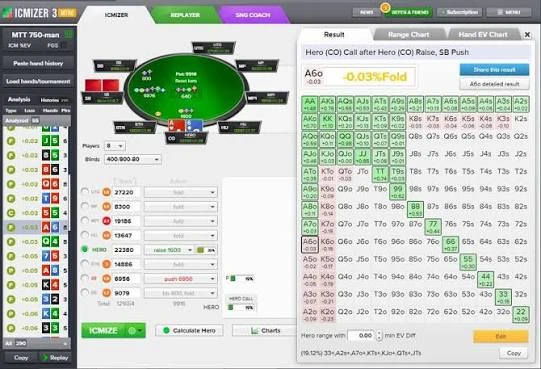
ICMIZER has been around since its free beta in 2011, and it’s built around one question tournament players ask constantly: should I shove, call or fold here?
What it does well
- Fast push/fold answers. Enter the stacks and payouts and you get Nash ranges in seconds, shown as $EV, %EV or chip EV.
- FGS (Future Game Simulation). Standard ICM assumes the tournament ends after the current hand. FGS looks a few hands ahead and accounts for blinds coming around. That matters most when stacks are short and blinds are high.
- Bounty and PKO support. This is important now that knockout formats dominate online schedules.
- Replayer (Pro). Import your hand histories and it grades your decisions, showing how much EV each mistake cost you.
- MTT Coach (Pro). Quiz-style drills that build pattern recognition, so the right decisions become automatic.
Where it falls short
- It’s a preflop tool. If you want postflop solutions, you’ll need something else.
- The full feature set is best on desktop. The mobile app focuses on drills.
Who should buy it: mid-stakes and low-stakes MTT and sit-and-go players who want to fix push/fold leaks quickly. The Basic plan covers the calculator, and Pro is worth it if you’ll actually use the Replayer and drills.
HRC: The Heavyweight
HRC is the tool final-table specialists and high-stakes regulars tend to swear by. Where ICMIZER is about speed and repetition, HRC is about depth.
What it does well
- Full game-tree solving. HRC Pro handles tournaments and cash games at any stack depth, with unlimited trees (limited only by your computer’s RAM) and dedicated postflop solves.
- Complex final tables. Multi-way spots, unusual payout structures and deal-making analysis are where HRC shines.
- Strong free tools. HRC also offers a free ICM Equity Calculator, a Large Field ICM tool, a Nash calculator and heads-up push/fold tables.
Where it falls short
- The learning curve is real. Building a tree properly takes practice, and beginners can easily get bad answers from bad setups.
- There’s no built-in hand history replayer or drill mode like ICMIZER’s.
Pricing in detail
| Plan | Classic | Pro |
| Monthly | $16.66/mo | $49.99/mo |
| Quarterly | 13.33/mo(39.99 billed) | 39.99/mo(119.97 billed) |
| Yearly | 9.99/mo(119.90 billed) | 29.99/mo(359.90 billed) |
HRC Classic is built for stacks up to about 30 big blinds, while Pro removes the limits. Both come with a 14-day money-back guarantee and a free trial for Classic.
Who should buy it: players who regularly reach final tables, study deeply between sessions, or want postflop analysis as well as ICM.
Our Free ICM Calculator: When Free Is Enough
Not every spot needs a solver. Our free ICM calculator does the core job: enter each player’s stack and the payout structure, and it instantly shows every player’s tournament equity in real money.
That covers more situations than you might think:
- Deal-making at final tables. When players discuss a chop, ICM gives a fair starting point for each stack’s share. You can run it on your phone in seconds.
- Learning how ICM feels. Change one stack and watch the dollar values shift. It’s the quickest way to build intuition for bubble pressure.
- Checking simple calls. As in the example above, you can compare “fold,” “call and win” and “call and lose” equities to find the break-even equity you need.
What a free tool won’t do: generate push/fold ranges, simulate future hands, handle bounties, or review your hand histories. When you need those, that’s when ICMIZER or HRC earns its price.
[Link to the PokerClubGames free ICM calculator]
Which ICM Calculator Should You Choose?
Choose the free tool if:
- You play casually or are just learning ICM
- You mostly need deal calculations or quick equity checks
- You’re not ready to spend money on study software
Choose ICMIZER if:
- You play lots of sit-and-gos, Spins or MTTs online
- You want fast push/fold answers and drills to fix leaks
- You want to review your own hands for ICM mistakes
Choose HRC if:
- You reach final tables regularly and play for meaningful money
- You want full-tree or postflop analysis
- You’re comfortable with a steeper learning curve
Practical tip: start free. If you find yourself checking the same kind of spot over and over, such as bubble calls or short-stack shoves, that’s the signal ICMIZER will pay for itself. Move to HRC when your questions go beyond “shove or fold.”
Common ICM Mistakes Calculators Help You Catch
- Calling too loose on the bubble. As the example shows, you often need well above 50% equity.
- Medium stacks punting. The stack in the middle usually suffers the most ICM pressure, because it has short stacks below it to outlast.
- Big stacks not attacking enough. If ICM restricts your opponents’ calls, the chip leader can shove wider and profitably.
- Ignoring ICM in bounty events. Bounties change the math, because part of the prize is paid immediately when you knock someone out, so plain ICM numbers can mislead you.
FAQs
What is an ICM calculator in poker?
It converts tournament chip stacks into real-money equity based on the payout structure, so you can see whether a decision gains or loses money, not just chips.
Is ICMIZER better than HRC?
They suit different players. ICMIZER is faster and easier for push/fold study and drills. HRC is deeper and better for complex final tables and postflop analysis.
How much does ICMIZER cost?
Recently reported prices are about $79.99 a year for Basic and about $159.99 a year (or about $29.99 a month) for Pro. Check ICMIZER’s site for current prices and sales.
How much does HRC cost?
HRC Classic starts at $9.99 a month on a yearly plan, and HRC Pro starts at $29.99 a month on a yearly plan. Monthly and quarterly options cost more.
Is a free ICM calculator good enough?
For deal-making, learning, and simple call checks, yes. For push/fold ranges, future-hand simulation or bounty spots, you’ll need ICMIZER or HRC.
What is FGS in poker?
Future Game Simulation. It extends ICM by simulating upcoming hands, including blinds and antes, instead of assuming the tournament ends after the current hand.
Disclosure: PokerClubGames may earn a commission when you use links to poker operators. This never changes the price you pay. 18+ (21+ where required). Gambling involves risk. How we make money