

Last Updated on July 27, 2026 by Bala Kumar
Introduction
Open Face Chinese Poker (OFC) grew out of traditional closed-face Chinese poker, but here’s the good news for newcomers: you don’t need to know anything about the original game to jump straight into OFC. It’s a standalone experience with its own rhythm and rules. This beginner poker guide will show you exactly how to play OFC poker from your very first hand.
Like other poker variants, players draw cards one at a time and try to build the strongest possible hand while their opponents do the same. But OFC has one major twist — there’s no betting at all during play. Instead, players agree to compete “per point,” with scoring that feels closer to card games like hearts or gin rummy than to traditional poker.
By the time a hand is finished, every player will have arranged all 13 of their cards into three separate hands: the top, the middle, and the bottom. This guide walks through exactly how to play, how scoring works, and how the game’s signature Fantasyland bonus round comes into play.
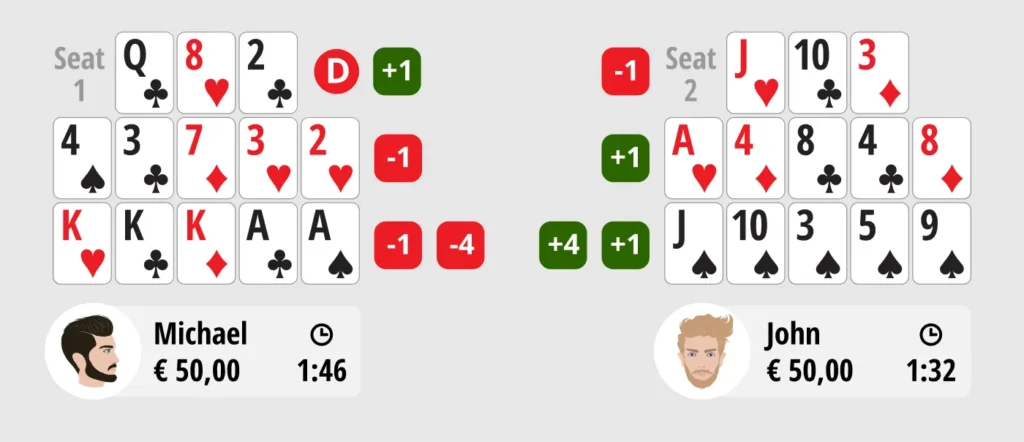
How the Three Hands Work (Top, Middle, Bottom Hand)
Every OFC hand revolves around the top middle bottom hand structure. Each player’s top hand is compared against every opponent’s top hand, the middle against the middle, and the bottom against the bottom, with points won or lost based on how each row measures up.
All three hands are scored using standard poker hand rankings. The middle and bottom are full five-card hands, while the top only holds three cards but is still scored the same way — meaning the best possible top hand is three of a kind, and most top hands end up being simple high-card or one-pair hands.
Because each player needs a full 13 cards to play, OFC supports a maximum of four players at once, though the game is most commonly played heads-up between two opponents.
The Main Objective: Making a Qualifying Hand
The first and most important goal in OFC is building a qualifying hand. There’s a strict rule that governs this: your bottom hand must be at least as strong as your middle hand, and your middle hand must be at least as strong as your top hand.
Since players place their cards one at a time without knowing what’s coming next, this isn’t always achievable. For example, if you’ve already committed a pair of kings to your middle hand, but you’re chasing a straight on the bottom using only lower cards, you’re locked into needing that straight to complete, otherwise your hand won’t qualify.
If a hand fails to meet this rising-strength requirement, it’s called a “foul.” Much like a foul frame in bowling, there’s no extra penalty beyond the obvious one: all three of your rows, top, middle, and bottom, are automatically scored as a loss against any opponent who does make a qualifying hand.
Step-by-Step: How a Round of OFC Is Played
OFC follows familiar poker conventions when it comes to dealing and turn order:
- The dealer button. Just like in Hold’em, OFC uses a dealer button. The player to the left of the button acts first, action moves clockwise, and the button rotates after every hand.
- The opening deal. Each player receives five cards to start and places them, one at a time, into their top, middle, or bottom row.
- Cards go face-up. Every card is placed face-up on the table — this is exactly where the “open-face” name comes from.
- Turns rotate. Once a player finishes arranging their five opening cards, the next player reveals their five cards and begins their own arrangement.
- One card at a time. After the opening round, each player is dealt one additional card at a time and must place it immediately, still face-up.
- No take-backs. Once a card is placed in a row, it’s locked there for the rest of the hand, there’s no way to move it later.
If you already understand basic poker hand rankings, a flush beats a straight, quads beat a full house, and so on, you have everything you need to start playing. As long as everyone at the table trusts each other (or an impartial judge) to score hands correctly, you’re ready to go.
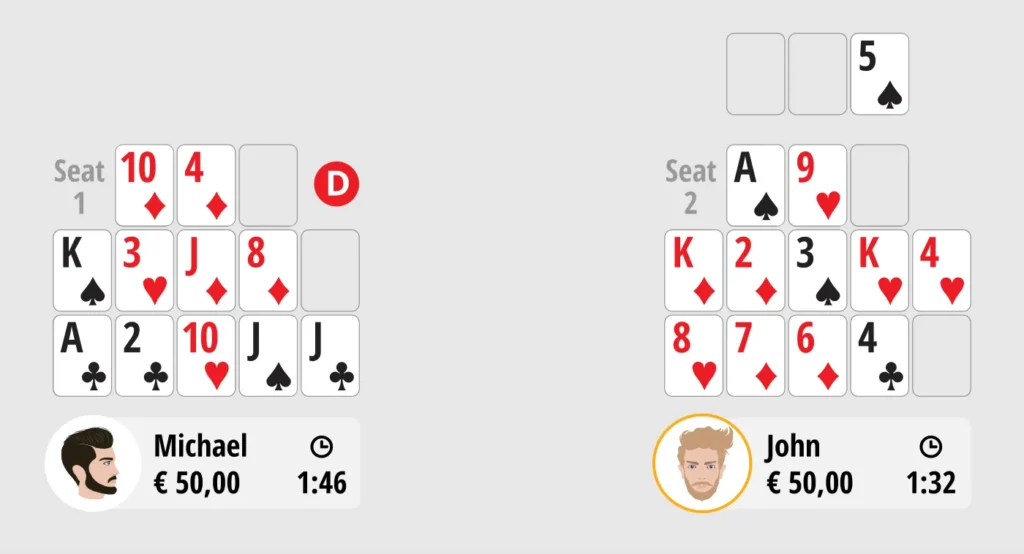
How Scoring Works in OFC
Understanding OFC scoring rules is simple, even if there are a few detailed cases to learn along the way. You don’t need to memorize every rule before you start much like picking up a new video game, you can learn many of the finer points as you play.
Scoring happens after all 13 cards have been placed, and it’s done entirely on a point basis:
- Each row is worth one point to whichever player wins it. For example, if you have a pair of jacks in your middle hand and your opponent only has king-high, you win one point for that row.
- If you win two of the three rows against an opponent, you win a net one point overall.
- Everyone scores independently. In games with three or four players, each player compares hands against every other player individually. Unlike Hold’em, there’s no folding, if you lose to one opponent but beat another, you still collect points from the player you beat.
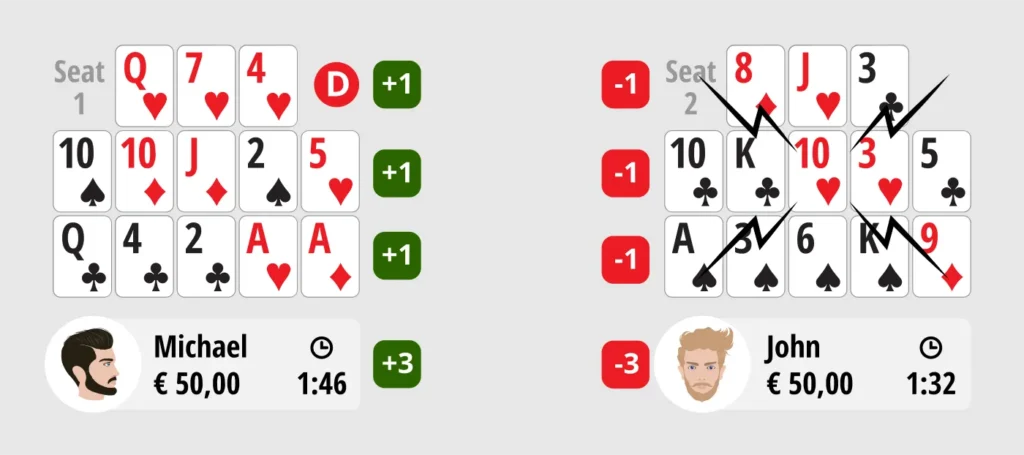
The Scoop Bonus (Scoop Bonus OFC)
Beyond the basic +1/-1 scoring per row, OFC includes a range of bonus points that can be worth far more than a single point. The most well-known of these is the scoop bonus OFC players chase every hand: if you beat an opponent’s top, middle, and bottom hands all at once, you earn an additional three points on top of your row wins, making a full scoop worth six points overall. This is sometimes called the “1-6” scoring system.
Bonus Points for Big Hands
To encourage players to take chances on big hands, these Chinese poker bonuses reward strong qualifying hands in every row, regardless of whether that hand actually wins the row. If both players happen to make bonus-worthy hands in the same row, those bonuses can cancel each other out, leaving only the standard one-point row score in play.
Bonus values scale depending on which row the hand is in. Here’s the complete breakdown:
OFC Bonus Scoring System
| Bottom Hand | Bonus | Middle Hand | Bonus | Top Hand | Bonus |
| — | — | Three of a Kind | +2 | 66 | +1 |
| Straight | +2 | Straight | +4 | 77 | +2 |
| Flush | +4 | Flush | +8 | 88 | +3 |
| Full House | +6 | Full House | +12 | 99 | +4 |
| Quads | +10 | Quads | +20 | 1010 | +5 |
| Straight Flush | +15 | Straight Flush | +30 | JJ | +6 |
| Royal Flush | +25 | Royal Flush | +50 | +7 | |
| — | — | — | — | KK | +8 |
| — | — | — | — | AA | +9 |
| — | — | — | — | 222 | +10 |
| — | — | — | — | 333 | +11 |
| — | — | — | — | 444 | +12 |
| — | — | — | — | 555 | +13 |
| — | — | — | — | 666 | +14 |
| — | — | — | — | 777 | +15 |
| — | — | — | — | 888 | +16 |
| — | — | — | — | 999 | +17 |
| — | — | — | — | 101010 | +18 |
| — | — | — | — | JJJ | +19 |
| — | — | — | — | QQQ | +20 |
| — | — | — | — | KKK | +21 |
| — | — | — | — | AAA | +22 |
A quick way to read this table: the top hand section starts with pair bonuses (66 through AA), then moves into three-of-a-kind bonuses (222 through AAA) once you’re past a pair of aces. The middle hand bonuses are exactly double the bottom hand bonuses for the same hand, for example, a full house is worth +6 on the bottom but +12 in the middle, since making a big hand in the middle is statistically harder to pull off.
Fantasyland: The Game’s Signature Bonus Round
One of the most distinctive parts of OFC strategy is an optional rule called Fantasyland poker. It must be agreed upon before a game begins, but it’s worth noting that most OFC games played online and in casinos use it by default, so it’s always worth confirming before you sit down.
Here’s how it works:
- If you make a qualifying top hand of queens or better, your very next hand is played “in Fantasyland.”
- Fantasyland is treated as a bonus round tied to the hand that triggered it. In most formats, the dealer button doesn’t move, and opponents aren’t allowed to quit or sit out during your Fantasyland round.
- The Fantasyland player gets a major edge: instead of placing cards one at a time, they’re dealt all 13 cards at once and set their entire hand before their opponents even begin playing.
- Once everyone else finishes their hands under standard rules, the Fantasyland hand is revealed and scored like any other hand, but with the benefit of having been arranged with perfect information.
Staying in Fantasyland
Since seeing all 13 cards at once makes it fairly easy to requalify for a top hand of queens or better, the bar for staying in Fantasyland is stricter than the bar for entering it. To remain in Fantasyland for another hand, a player needs to make:
- Quads or better on the bottom
- A full house or better in the middle
- Three of a kind or better on top
Table Etiquette and House Rules
A few informal norms tend to govern OFC games:
- It’s fine to sit out or step away between hands, but once a hand has started, it must be played through to completion.
- Because Fantasyland is treated as a continuation of the hand that triggered it, players aren’t allowed to skip or quit during someone else’s Fantasyland round if they were part of the hand that led to it.
- It’s considered good etiquette to announce when you’re staying in Fantasyland.
- Many tables ask the Fantasyland player to set their hand face-down and avoid changing it once other players begin their turn.
Popular OFC Variants
While the standard rules described above are close to universal, both online and in casinos that spread the game during major tournament series, a couple of variants have picked up real popularity:
- Criss-cross OFC: Two players each play two hands, effectively creating a four-handed game between just two people.
- Pineapple OFC: The most popular twist on standard rules. Instead of receiving one card per round after the opening deal, players are dealt three cards at a time and must place two of them while discarding the third, speeding up gameplay and adding a new layer of decision-making.
Conclusion
Open Face Chinese Poker combines the simple, intuitive appeal of a points-based card game with the same hand-building drama found in Texas Hold’em and seven-card stud, plus a dash of the high variance you’d find in a game like blackjack. It’s easy to pick up, don’t be intimidated by the bonus tables, and a total beginner can win right from their very first session.
One of the best parts of OFC is how transparent it is: since every card is played face-up, spectators have access to exactly the same information as the players at the table, making it just as easy to learn by watching as it is by playing. Whether you’re picking it up as a side game between tournament breaks or diving into a dedicated mobile app, OFC offers a genuinely fresh way to enjoy poker.
FAQs
1. How do you play Open Face Chinese Poker (OFC)?
In Open Face Chinese Poker, each player builds three hands from 13 cards: a 3-card top hand, a 5-card middle hand, and a 5-card bottom hand. Cards are placed face-up one at a time, and once placed, they cannot be moved.
2. What is a foul in Open Face Chinese Poker?
A foul occurs when your bottom hand is weaker than your middle hand or your middle hand is weaker than your top hand. A fouled hand automatically loses all three rows against any opponent with a qualifying hand.
3. How does scoring work in Open Face Chinese Poker?
Players earn one point for each row they win (top, middle, or bottom). Additional bonus points are awarded for strong hands (royalties), and a player who wins all three rows against an opponent earns a scoop bonus.
4. What is Fantasyland in Open Face Chinese Poker?
Fantasyland is a bonus round earned by making a qualifying top hand, typically a pair of Queens or better. In the next hand, the player receives all 13 cards at once and arranges the entire hand before opponents complete theirs.
5. What is the difference between standard OFC and Pineapple OFC?
In standard OFC, players receive one card at a time after the initial five-card deal. In Pineapple OFC, players receive three cards each turn, keep two, and discard one, making the game faster and adding more strategic decisions.
Founder of PokerClubGames.com and a Poker Researcher with 10+ years of experience in SEO, WordPress development, and gaming content strategy. Specializes in researching online poker sites, poker apps, tournaments, bonuses, and poker strategies. Experienced in poker platform reviews, affiliate marketing, and creating SEO-focused poker content for global audiences.
For collaborations, media inquiries, or poker-related partnerships:
Contact: Info@hugecount.com