
Poker Bankroll Calculator 2026: How Much Money Do You Need to Play?
On this page
Last Updated on October 14, 2026 by Bala Kumar
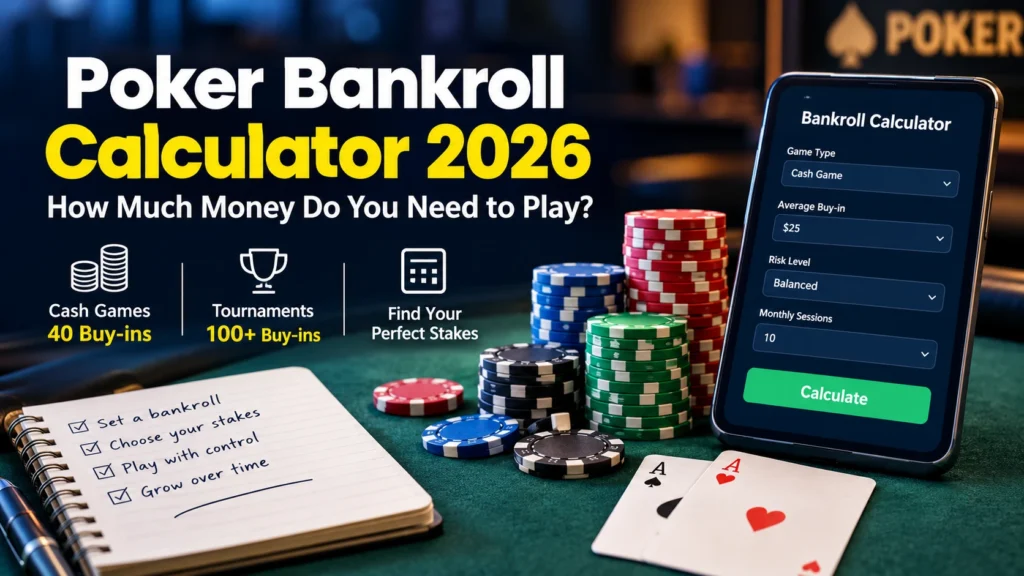
Here’s the short answer. Most players need 40 buy-ins for cash games and 100 buy-ins for tournaments. So if you want to play $25 cash games, you need about $1,000. If you want to play $10 tournaments, you also need about $1,000.
That’s the quick rule. The real answer depends on what you play, how well you play, and how much risk you can live with. In this guide we’ll explain the 2026 numbers in plain English, show the math behind them, and help you find the right stakes using our free Poker Bankroll Calculator.
What Is a Poker Bankroll?
A poker bankroll is money set aside only for poker. It is not your rent, your savings or your emergency fund. It’s a separate pot that can go up and down without affecting your everyday life.
Think of it like a shop’s working capital. A shop needs enough cash to survive slow months before the good ones arrive. Poker works the same way. Even a winning player has losing weeks and sometimes losing months. The bankroll is what keeps you in the game until your skill shows in your results.
The rule that ties everything together: only use money you can afford to lose. If you’d feel stressed losing it, it’s not bankroll money.
How Much Money Do You Need in 2026?
This table uses our calculator’s Balanced setting: 40 buy-ins for cash games and 100 buy-ins for tournaments.
Bankroll 100:cashgamesuptoNL2(2 buy-in), tournaments up to $1
Bankroll 250:cashgamesuptoNL5(5 buy-in), tournaments up to $2.50
Bankroll 500:cashgamesuptoNL10(10 buy-in), tournaments up to $5
Bankroll 1,000:cashgamesuptoNL25(25 buy-in), tournaments up to $10
Bankroll 2,000:cashgamesuptoNL50(50 buy-in), tournaments up to $20
Bankroll 4,000:cashgamesuptoNL100(100 buy-in), tournaments up to $40
Bankroll 10,000:cashgamesuptoNL200(200 buy-in), tournaments up to $100
“NL25” means no-limit hold’em with 0.10/0.25 blinds, where a full buy-in is 100 big blinds ($25). Most online sites use this naming.
Want to check your own numbers? Enter your buy-in, game type and risk level into the Poker Bankroll Calculator. It takes less than 30 seconds.
Why You Need So Many Buy-Ins
New players are often surprised. If you win more than you lose, why would you need 40 buy-ins?
The answer is variance, the short-term luck in poker. You can make every right decision and still lose because your opponent hits a card on the river. Over thousands of hands luck evens out, but in the short run it can be brutal.
The Real Math Behind Downswings
Poker researchers measure swings with two numbers:
Win rate: how much you win on average, measured in big blinds per 100 hands (bb/100). A solid online winner might make 3 bb/100.
Standard deviation: how much your results swing around that win rate. In 6-max no-limit hold’em, about 90 bb/100 is typical.
The standard bankroll formula is: Bankroll = −ln(risk of ruin) × SD² ÷ (2 × win rate)
That looks scary, so here’s what it means in practice. For a 3 bb/100 winner with a standard deviation of 90:
Accept a 5% chance of going broke: you need about 4,000 big blinds, or 40 buy-ins
Accept a 1% chance of going broke: you need about 6,200 big blinds, or 62 buy-ins
This is exactly why 40 buy-ins is the Balanced setting in our calculator. It isn’t a random number. It’s what the math gives a typical winning player at a 5% risk level.
How Win Rate Changes Everything
Now look at how much skill matters. Using the same 5% risk and 90 bb/100 standard deviation:
Strong winner (5 bb/100): about 24 buy-ins needed
Solid winner (3 bb/100): about 40 buy-ins needed
Small winner (1 bb/100): about 121 buy-ins needed
Losing player: no bankroll is big enough over the long run
The lesson is uncomfortable but important. A bigger bankroll can’t fix a losing game. It only gives a winning player time to show their edge. If you’re still learning, put your energy into improving, with study tools like our Preflop Decision Trainer and Pot Odds guide.
How Deep Can a Downswing Go?
Using the same formula, a 3 bb/100 winner at 90 standard deviation has:
About a 23% chance of a 20 buy-in downswing at some point
About a 5% chance of a 40 buy-in downswing at some point
So roughly one in four solid winners will one day lose 20 buy-ins in a row, purely from bad luck. With only 20 buy-ins, that player goes broke. With 40, they survive and keep playing.
Cash Game Bankroll: How Many Buy-Ins in 2026?
Cash games have the lowest variance in poker, so they need the smallest bankroll.
Aggressive (25 buy-ins): for recreational players who can top up their bankroll from income, or players taking a short shot at higher stakes
Balanced (40 buy-ins): recommended for most online players in 2026
Conservative (60 buy-ins): for anyone who would struggle to rebuild after going broke, or semi-pros who depend on poker income
Why 2026 Needs More Than the Old 20 Buy-In Rule
You may still see “20 buy-ins is enough” on older websites. That advice comes from a time when online games were much softer. Today, solver-trained regulars, fast-fold tables and tighter win rates mean most poker coaches now suggest 30–50 buy-ins for online cash games.
Live Cash Games Need Fewer Buy-Ins
Live games are slower and usually softer, so swings per session are smaller and win rates are often higher. Many players use 20–30 buy-ins for live cash. For a 1/2 game with a $300 buy-in, that’s 6,000–9,000.
Tournament Bankroll: Why You Need 100+ Buy-Ins
Tournaments are a different world. Usually only about 15% of the field gets paid, and most of the money goes to the top few places. You can play well for weeks without a big score, then win a month’s worth of buy-ins in one night.
Here are typical tournament bankroll levels in 2026:
Recreational players: 50–100 buy-ins
Balanced (our calculator’s default): 100 buy-ins
Serious online grinders: 150–200 buy-ins
Full-time large-field MTT pros: 200–300 buy-ins
Field Size Matters
The bigger the field, the bigger the swings. GGPoker’s Ocean KO recently set an all-time record with 420,084 entries. In a field that size, even the best player in the world will almost never win. Large-field tournaments need the top end of the bankroll range. Small-field events need less.
What Real High-Stakes Events Tell Us
This week’s live results show why even pros don’t use 100 buy-ins for every event:
At Poker Masters 2026, Myles Mullaly won a $10,000 event for $218,400. A 100 buy-in bankroll for that event would be $1,000,000.
At the KPC Poker Series in Jeju, Yan Wen Yee won the $5,000 King’s Debut for $247,600. A 100 buy-in bankroll for that one would be $500,000.
Very few players have bankrolls that size. So how do they play? Many sell action (backers pay part of the buy-in in exchange for part of the winnings), win their seat through satellites, or treat a big event as a planned shot with a fixed amount they’re willing to lose. These are all valid bankroll strategies, and everyday players can use them too.
Sit & Go and Spin & Go Bankroll
Sit & Gos (single table): about 50–100 buy-ins. Variance sits between cash games and big tournaments.
Spin & Go and lottery-style formats: about 150+ buy-ins. These are the swingiest formats in poker, because huge multipliers are rare.
Hyper-turbos: more buy-ins than standard speed, because short stacks and fast blinds add luck.
A common mistake is mixing formats with one rule. If you play NL25 cash and $5 Spins, your Spin bankroll needs 150 buy-ins even if your cash game only needs 40.
How to Use the Poker Bankroll Calculator (Step by Step)
Our free calculator turns all of this into one number.
Step 1: Choose Your Game Type
Select Cash Game or Tournament. Sit & Gos fall under tournaments.
Step 2: Enter Your Average Buy-In
Use your usual buy-in, not the biggest one you play. If you play $5, $10 and $20 tournaments, your average might be about $10.
Step 3: Pick a Risk Level
Aggressive, Balanced or Conservative. If you’re unsure, choose Balanced.
Step 4: Add Your Monthly Sessions
This shows your monthly exposure, meaning how much money is in play each month, so you can plan more realistically.
Example Results
A cash player at $50 buy-ins on Balanced gets a recommended bankroll of $2,000 (40 buy-ins).
A tournament player at $20 buy-ins on Conservative gets $2,400 (120 buy-ins).
When to Move Up and When to Move Down
Move up when you have the full recommended bankroll for the next stake, for example 40 buy-ins at NL50 ($2,000) before you play NL50. Some players wait until they have 45–50 buy-ins, so one bad session doesn’t send them straight back down.
Take a shot if you like, but plan it. Set aside a fixed amount, such as 3–5 buy-ins at the higher stake. If you lose it, move back down with no emotion.
Move down as soon as you fall below your minimum. If you’re a NL25 player and your bankroll drops under $1,000, play NL10 until it recovers. Moving down isn’t failure. It’s what keeps strong players in the game.
Bankroll Mistakes That Make Players Go Broke
- Playing above your bankroll because “I’m better than these players.”
- Chasing losses by jumping up in stakes after a bad session.
- Mixing poker money with living money.
- Ignoring rake. At low stakes, rake can take a big share of your profit.
- Multi-tabling beyond your bankroll. Four tables at once means four buy-ins at risk.
- Playing while tilted. Set a stop-loss, such as 3 buy-ins per session.
- Treating one big win as your new normal. One deep run doesn’t change your true win rate.
How to Build a Bankroll From Small Amounts
No bankroll? You can still start:
Freerolls: free tournaments with real prizes, such as the GGPoker $100,000 Weekly Freeroll or the GGPoker Daily Freebie.
Welcome bonuses and rakeback: these return part of the rake you pay and act like extra win rate. Compare offers on our poker bonuses page.
Start at micro stakes: with $100, NL2 cash or $1 tournaments let you learn without big risk.
Track every session: you can’t manage what you don’t measure.
Choosing the right site matters too, because traffic, rake and game quality all affect your win rate. Our poker site reviews compare the main options.
Final Thoughts
Bankroll management isn’t exciting, but it’s the reason some players last for years while others go broke in a month. The 2026 rule of thumb is simple: 40 buy-ins for cash, 100+ for tournaments, more for big fields and Spins. The real goal goes beyond surviving downswings. It’s playing without fear, because every decision is easier when the money in front of you isn’t money you need.
Before your next session, take 30 seconds to check your numbers with our Poker Bankroll Calculator. For deeper strategy, read our Ultimate Poker Tournament Strategy Guide and ICM guide.
FAQs
How much money do I need to start playing poker?
You can start with 50–100 at micro stakes. With $100 you can play NL2 cash games (40 buy-ins) or $1 tournaments (100 buy-ins).
How many buy-ins do I need for cash games in 2026?
About 40 buy-ins for most online players. Conservative players use 50–60, and live cash players often use 20–30.
How many buy-ins do I need for poker tournaments?
At least 100 buy-ins for most players. Serious online grinders playing large fields often keep 200–300.
Is $1,000 a good poker bankroll?
Yes, for the right stakes. With $1,000 you can play NL25 cash games or tournaments around $10 on a Balanced plan.
Why do tournaments need a bigger bankroll than cash games?
Only about 15% of players get paid, and most of the money goes to the top spots. That creates much bigger swings, so you need more buy-ins to survive dry spells.
Does a bigger bankroll help a losing player?
No. A bankroll only gives a winning player time for skill to show. A losing player will eventually lose any bankroll, so focus on improving your game first.
How does the Poker Bankroll Calculator work?
You enter your game type, average buy-in, risk level and monthly sessions. The calculator then shows your recommended bankroll, number of buy-ins and monthly exposure.
Disclosure: PokerClubGames may earn a commission when you use links to poker operators. This never changes the price you pay. 18+ (21+ where required). Gambling involves risk. How we make money