
Last Updated on August 7, 2026 by Bala Kumar
Most video poker players lose money the moment they sit down at a Double Double Bonus machine, and they never even realize why. They bring their Jacks or Better instincts to a game that punishes those exact habits, and the punishment shows up precisely at the moment they think they’ve won big: the four-of-a-kind. That’s the heart of a real double bonus poker strategy: understanding that in this game, not all quads are created equal, and the difference between a mediocre hold and an optimal one can swing your return by several percentage points over a session.
This guide breaks down exactly how Double Double Bonus pays, why its kicker system changes the correct strategy for hundreds of hands, and how to actually play it for a real edge — not just a fun ride.
What Is Double Double Bonus Poker?
Double Double Bonus is a variant of Jacks or Better built around one core idea: massive bonus payouts for specific four-of-a-kind hands, funded by trimming the payouts on more common hands like flushes and full houses. It’s sometimes listed under the name “Aces Kicker” on Aristocrat-branded machines, which is a fair description, the “kicker,” the fifth card sitting alongside your quad, is what determines whether you’re paid a modest four-of-a-kind rate or a jackpot-sized bonus.
That single mechanic is why video poker double double bonus strategy diverges so sharply from standard Jacks or Better strategy. In JoB, a four-of-a-kind is a four-of-a-kind — you’re paid the same regardless of what the fifth card is. In DDB, the identity of that fifth card can be worth hundreds of coins, and that changes which cards you should hold from the very first draw, not just how you react after the fact.
The Full Pay Table: What “100.067%” Actually Means
The best version of this game — what serious players call “full pay” — carries a theoretical return of 100.067% with perfect strategy and a five-coin max bet. That’s not a typo: it’s one of a small handful of video poker variants that can mathematically favor the player over the house, assuming you play every hand correctly.
Here’s the full pay (10/6) table, current for 2026:
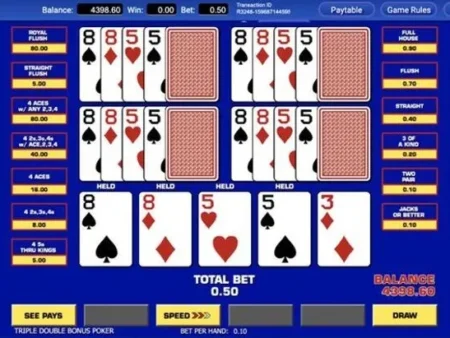
| Hand | Payout (5-coin bet) | Probability |
| Royal Flush | 4,000 (800 per coin) | 0.0025% |
| Straight Flush | 250 (50 per coin) | 0.011% |
| Four Aces + 2, 3, or 4 kicker | 2,000 (400 per coin) | 0.0062% |
| Four 2s, 3s, or 4s + Ace–4 kicker | 800 (160 per coin) | 0.0143% |
| Four Aces + 5–King kicker | 800 (160 per coin) | 0.0174% |
| Four 2s, 3s, or 4s + 5–King kicker | 400 (80 per coin) | 0.0384% |
| Four 5s through Kings | 250 (50 per coin) | 0.163% |
| Full House | 50 (10 per coin) | 1.086% |
| Flush | 30 (6 per coin) | 1.131% |
| Straight | 20 (4 per coin) | 1.274% |
| Three of a Kind | 15 (3 per coin) | 7.530% |
| Two Pair | 5 (1 per coin) | 12.312% |
| Jacks or Better | 5 (1 per coin) | 21.150% |
Notice the gap: a plain four-of-a-kind (5 through King, no useful kicker) pays 250 coins on a max bet, while four Aces with a 2, 3, or 4 kicker pays 2,000 — eight times as much, for what is otherwise the exact same hand rank. That gap is the entire strategic identity of this game.
RTP Comparison: How Pay Tables Actually Differ
Not every casino — online or land-based — offers the full pay version, and the difference between tables is bigger than most players assume. Here’s how the common variants stack up:
| Pay Table Variant | Full House / Flush Payout | Return with Optimal Play |
| 10/6 (Full Pay) | 10 / 6 | 100.067% |
| 9/6 | 9 / 6 | 98.98% |
| 9/5 | 9 / 5 | 97.87% |
| 8/6 | 8 / 6 | 97.89% |
| 8/5 | 8 / 5 | 97.86% |
That’s a swing of over two full percentage points between the best and worst commonly-offered tables — and on a game with this much volatility, that gap compounds fast over a long session. The golden rule for any serious double double bonus video poker player is the same one that applies across the whole video poker category: always check the pay table before you sit down. Two machines with an identical cabinet and identical game name can carry return percentages that differ by 2% or more, purely based on how the casino set the full house and flush payouts.
Why Quads Change Everything: The Kicker Rules
This is the part that trips up even experienced Jacks or Better players. In Double Double Bonus, if you’re dealt four Aces, four 2s, four 3s, or four 4s, the card sitting alongside them determines your payout tier:
- Ace, 2, 3, or 4 as the kicker on quad Aces → the maximum bonus tier (400 coins per coin bet)
- 5 through King as the kicker on quad Aces, or Ace through 4 as the kicker on quad 2s/3s/4s → the mid-tier bonus (160 or 80 coins per coin bet)
- Any other combination → paid at the standard quad rate
Because of this, correct strategy sometimes means discarding a card most players would never think to throw away. If you’re dealt four Aces and a King, standard instinct says “lock the whole hand — you’ve already won.” Optimal strategy actually says: hold your four Aces, but discard the King. You’ve already guaranteed at least the 160-coin payout, and drawing a new fifth card gives you a live shot at a 2, 3, or 4 landing to bump you into the 400-coin tier. The one-card draw doesn’t cost you anything you were guaranteed to keep, and it adds real expected value.
This same logic extends to pre-draw decisions too. Holding three of a kind in Aces, 2s, 3s, or 4s changes how you should treat your other two cards compared to holding three 7s or three Jacks, because the ceiling on what those quads can pay is so much higher.
Core Strategy Priorities (Simplified)
A full strategy chart runs to dozens of specific scenarios, but the priority order below covers the vast majority of hands you’ll see at the table:
- Royal flush, straight flush, or any four-of-a-kind dealt — always hold in full, except for the Aces/2s/3s/4s kicker-discard rule above.
- Four cards to a royal flush — always hold over a made straight, flush, or even a low-paying full house in most cases, because the royal’s payout dwarfs everything else.
- Three of a kind — hold the trips, discard the other two, with extra weight given if the trips are Aces, 2s, 3s, or 4s.
- Four cards to a flush — generally worth holding over a pair alone.
- Low pairs (2s through 10s) — hold as a pair rather than chasing a gutshot straight, unless you also hold four cards to a straight flush.
- High pairs (Jacks or better) — hold, but compare carefully against a four-card flush draw, since the flush draw sometimes carries slightly higher expected value depending on suited cards.
The single biggest mistake recreational players make isn’t misreading these priorities — it’s applying Jacks or Better logic wholesale to a DDB machine, which quietly costs a meaningful chunk of return over time without the player ever noticing why their bankroll erodes faster than it “should.”
Double Double Bonus vs. Other Video Poker Variants
| Game | Full Pay Return | Volatility | Best For |
| Jacks or Better (9/6) | 99.54% | Low | Steady, low-swing sessions |
| Double Bonus (10/7) | 100.17% | Medium-High | Bigger quad payouts with less kicker complexity |
| Double Double Bonus (10/6) | 100.067% | High | Players who want the biggest realistic jackpots and don’t mind swings |
| Deuces Wild (Full Pay) | 100.76% | Medium | Players comfortable with wild-card strategy |
DDB sits at the high-volatility end of the spectrum. You’ll hit fewer small, comfortable wins than you would on Jacks or Better, and your bankroll will swing harder in both directions — but the ceiling on a single hand is dramatically higher. It’s a genuinely different playing experience, not just a reskin of standard video poker, and it rewards players who come prepared with the right strategy rather than winging it.
Bankroll Considerations for a High-Variance Game
Because DDB’s return is loaded so heavily onto rare, high-paying quads, a bankroll built for Jacks or Better will run out faster on a DDB machine even at an identical bet size. A reasonable guideline is budgeting for at least 300–500 hands per session at your chosen coin denomination, since the gaps between meaningful hits can run longer than players expect. This isn’t a game to play on a tight bankroll expecting steady, grind-it-out returns, it’s built for players who understand and accept the swings in exchange for a higher ceiling.
Practice Before You Play for Real Money
If you’re new to the kicker system, the smartest first step isn’t a real-money session , it’s repetition. Playing free double double bonus poker lets you drill the hold/discard decisions on quad Aces, 2s, 3s, and 4s until they become automatic, without any of your practice costing you real expected value while you’re still learning the chart. Most players who skip this step end up making the same one or two kicker mistakes for months before they notice the pattern in their results.
Poker Club Games maintains a free-to-play Double Double Bonus trainer alongside a downloadable optimal strategy chart, built specifically around the 9/6 and 10/6 pay tables covered above, useful whether you’re prepping for a Vegas trip or just want to sharpen your online play before switching to real stakes.
FAQs
What is the best pay table for Double Double Bonus Poker?
The 10/6 “full pay” table is the strongest version, returning 100.067% with optimal strategy and a five-coin max bet. Look for full house payouts of 10-for-1 and flush payouts of 6-for-1 to confirm you’ve found it.
Why does the kicker matter so much in Double Double Bonus?
\Four Aces, 2s, 3s, or 4s pay a bonus rate based on the fifth card in your hand. A “good” kicker (Ace through 4 on quad Aces, for example) can pay up to eight times more than the same quad with an unhelpful kicker, which is why optimal strategy sometimes means discarding a card from an already-made four-of-a-kind.
Is Double Double Bonus Poker harder to win at than Jacks or Better?
It’s not harder to understand, but it is more volatile. DDB pays out less frequently on small hands (two pair and three of a kind pay the same as Jacks or Better) in exchange for much bigger top-end quad payouts, so sessions swing more in both directions.
Can you actually get a positive return playing Double Double Bonus?
Yes, on the full pay 10/6 table with perfect strategy and a five-coin bet, the theoretical return exceeds 100%. In practice, this requires finding a full-pay machine, which are less common than lower-paying 9/6 or 8/5 versions, and playing every hand with correct strategy.
Where can I practice Double Double Bonus video poker for free?
Free double double bonus poker trainers let you practice the full hold/discard decision tree, including the kicker-discard rule on quad Aces, 2s, 3s, and 4s, without risking real money while you build the habit.
How is Double Double Bonus different from Double Bonus Poker?
Double Bonus rewards big quad payouts based only on the rank of the four-of-a-kind, with no kicker consideration. Double Double Bonus adds the kicker layer specifically for quad Aces, 2s, 3s, and 4s, which is what makes its strategy chart meaningfully more complex.
Founder of PokerClubGames.com and a Poker Researcher with 10+ years of experience in SEO, WordPress development, and gaming content strategy. Specializes in researching online poker sites, poker apps, tournaments, bonuses, and poker strategies. Experienced in poker platform reviews, affiliate marketing, and creating SEO-focused poker content for global audiences.
For collaborations, media inquiries, or poker-related partnerships:
Contact: partnerships@pokerclubgames.com