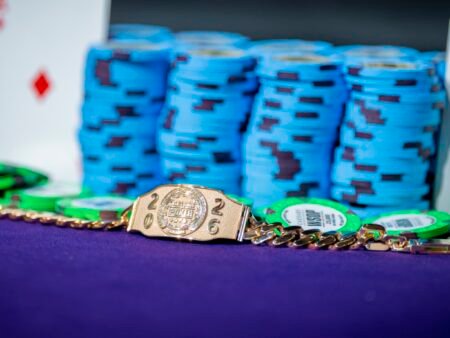

| Bracelet Events | 1st Place Prize | Bracelets Awarded* | Total Entries* | Main Event Dates |
| 100 | $10M | 17 | 44,381 | Jul 2–13 |
The 2026 World Series of Poker is already well underway. Seventeen bracelets have been awarded in just the first ten days, 44,381 entries have been logged across 21 events, and the $10,000 Main Event, the one everyone actually prepares for, doesn’t even begin until July 2. If you’re heading to Las Vegas this summer, or grinding satellites from home, this is your window to sharpen up.
This guide won’t waste your time on generic advice like “play tight in position.” Instead, we break down exactly what works in WSOP-format tournaments in 2026, from the first level through the final table, drawing on current tournament data, ICM fundamentals, and the strategic adjustments that separate cashing from contending.
| ★REAL-TIME CONTEXT | The 2026 WSOP runs May 26–July 15 at Horseshoe and Paris Las Vegas, featuring 100 bracelet events. The defending Main Event champion is Michael Mizrachi (2025), who earned $10 million. NSUS Group Inc., which acquired the WSOP brand for $500 million, has introduced fresh formats including the $1,000 Mystery Millions and the Battle of the Ages. Buy-ins span $300 to $250,000. |
1. Early Levels: Stack Preservation Is Not Passive Play
There’s a common misconception that playing tight in the early levels means playing scared. It doesn’t. At the WSOP, starting stacks are typically deep relative to the blinds — often 300–400 big blinds in the Main Event — which means the early stages are about gathering information, not gambling for chips you don’t need yet.
What you should be doing: playing profitable spots confidently, building reads on your table, and avoiding situations where you’re committing a significant portion of your stack without a major advantage. Set-mining is fine when the implied odds justify it. Speculative hands like suited connectors are worth playing from position. But three-bet bluffing with nothing, or calling off 40% of your stack with a marginal hand, those are leaks that end tournaments before the first break.
The Stack-to-Blind Ratio Rule
A practical guide: when you have more than 40 big blinds, you have room to play post-flop poker. Between 20–40 BBs, your decision tree simplifies, push-fold ranges start to matter more. Under 15 BBs, you’re in push-fold mode almost entirely. Know which game you’re playing at every moment of the tournament.
2. Understanding ICM , The Engine Behind Tournament Decisions
If cash game experience is your background, ICM will feel counterintuitive at first. In a cash game, a chip is always worth exactly one chip. In a tournament, that relationship breaks down the moment a payout structure exists.
The Independent Chip Model converts your chip count into real monetary value based on the remaining prize pool and the number of players left. Near the money bubble in the WSOP Main Event, where roughly 15% of a 10,000-player field cashes, the difference between busting 1,501st and finishing 1,500th can be over $10,000. That gap in real dollars changes how you should evaluate marginal all-in situations.
| ★ | ICM IN PRACTICEA leading ICM tip from GTO Wizard for 2026: big stacks should begin making ICM-based adjustments when approximately 50% of the field remains — not just at the bubble itself. Preparing early gives you a structured approach rather than a reactive one when the pressure peaks. |
The core principle: when ICM pressure is high, you need extra equity, a “risk premium”, on top of standard chip EV to justify a call. A spot that looks like a clear call in a cash game might be a clear fold near the bubble of the WSOP Main Event.
3. Bubble Play: Stack Size Dictates Your Strategy
The WSOP bubble is where fortunes are made and lost. Most recreational players tighten up, and that’s predictable. What separates strong tournament players is understanding that different stack sizes require completely different approaches on the bubble.
| Stack Size | BB Range | Bubble Approach | ICM Risk |
| Big Stack | 60+ BBs | Apply relentless pressure; steal blinds liberally; attack medium stacks | ✅ LOW |
| Medium Stack | 25–55 BBs | Tighten significantly; avoid marginal spots; protect equity at all costs | ⚠️ HIGH |
| Short Stack | Under 20 BBs | Find uncontested shove spots; can’t afford to blind out or fold to death | 🔴 URGENT |
The medium stack is actually the most psychologically difficult spot. You have enough chips to survive but not enough to bully anyone, and ICM penalizes you heavily for losing a flip. Surrender small pots, avoid marginal all-ins, and wait for spots where you’re a significant favourite.
4. Antes Change Everything Use Them
The 2026 WSOP Main Event uses a big blind ante format. Only the big blind posts the ante for the whole table, which speeds up play and keeps pot sizes meaningful. When blinds are 1,000/2,000 with a 2,000 BB ante, there’s already 5,000 in the middle before a single card is dealt.
This makes blind stealing from a late position significantly more profitable. A raise to 4,500 with a weak hand is risking 4,500 to win 5,000, that’s break-even before fold equity even enters the picture. Any reasonable fold percentage from the blinds makes it a profitable open. Players who don’t factor this in are leaving significant EV on the table every orbit.
5. Final Table Adjustments: When Every Chip Has a Price
Making the WSOP Main Event final table puts you among nine players sharing a payout structure where every elimination triggers a meaningful pay jump. In 2024, final table payouts ranged from roughly $1 million for 9th place to $10 million for 1st. That spread matters enormously for strategy.
1. Know the pay jump math — Understand exactly how much each remaining elimination is worth to you in real dollars before every key hand.
2. Target medium stacks looking to ladder — Players with 15–25 BBs who are clearly trying to move up the pay scale will fold to aggression very often. Apply constant pressure when you’re the bigger stack.
3. Study opponents before it begins — Most poker professionals review their opponents’ tendencies before the final table starts. Knowing who overvalues their hand and who folds to three-bets is exploitable information.
4. Widen ranges as the table goes short-handed — Short-handed play rewards high cards and pairs more than suited connectors. As you reach five- and four-handed, Ax hands and pairs increase sharply in value.
5. Don’t slow down when the chip lead feels comfortable — A chip lead at a final table is not a guarantee. Passivity lets opponents recover. Controlled aggression — not recklessness — is the right gear.
6. The Mental Game: WSOP Runs Long for a Reason
The WSOP Main Event is a multi-day grind. Day 1 through the final table spans nearly two weeks, and each day involves 8–10 levels of play. The mental demands are consistently underestimated by players who haven’t experienced it before.
The volume of hands is one thing. But what actually breaks players is decision fatigue — the erosion of sharp thinking after hours at the table. Maintaining sleep, eating properly between sessions, and having a structured post-session review process are not soft skills. They are competitive advantages that most recreational players ignore entirely.
| ★ | PRACTICAL ADVICEBetween tournament days, review no more than 3–5 key hands. Avoid over-analyzing every decision — it leads to paralysis at the table. Focus on spots where you were genuinely unsure, not spots where you already know the answer in hindsight. |
7. Satellite Strategy: Getting to the WSOP for Less
Not everyone is buying directly into the $10,000 Main Event. Satellite routes remain one of the most legitimate ways to access major WSOP events. GGPoker, the official online partner of the WSOP, runs satellite qualifiers year-round, and the 2024 WSOP Super Circuit Online Series alone offered $100 million in guaranteed prizes with buy-ins starting at $105.
Satellite strategy differs meaningfully from standard tournament play. The goal isn’t to accumulate chips, it’s to survive into a seat. Once a seat is essentially guaranteed by your chip count, the optimal play shifts dramatically toward risk avoidance, even passing up positive EV chip spots that aren’t necessary to lock up qualification.
8. WSOP 2026 Player of the Year A New Format Worth Understanding
For 2026, the WSOP Player of the Year race underwent its biggest structural change in years. Instead of being decided by a single summer in Las Vegas, the POY race now spans three live WSOP festivals across a full calendar year, and introduces a $1,000,000 prize pool shared among the top 100 finishers. The champion also receives a Main Event seat for the following year.
Only a player’s top 15 scores count toward the leaderboard, with winner points scaling by both field size and buy-in. This means one deep run in the Main Event, a field expected to approach 10,000 entries, can vault a player from outside the top 50 into serious contention overnight. For players targeting the POY race specifically, event selection matters as much as individual results.
FAQs
How much is the 2026 WSOP Main Event buy-in?
The buy-in is $10,000, though players can qualify through satellites for much less.
Can beginners play in the WSOP?
Yes. Any eligible player can enter by paying the buy-in or winning a satellite seat.
3: What games are featured at the 2026 WSOP?
Events include Texas Hold’em, Pot-Limit Omaha, Stud, H.O.R.S.E., Razz, and Mixed Games.
4: How many bracelet events are in the 2026 WSOP?
The series features 100 live bracelet events across various poker formats.
5.What is a good WSOP bankroll strategy?
Play within your bankroll, avoid chasing losses, and focus on events you can comfortably afford.