

Benedek Farkas Wins Triton ONE North Cyprus $10K 7-Max for $572K
On this page
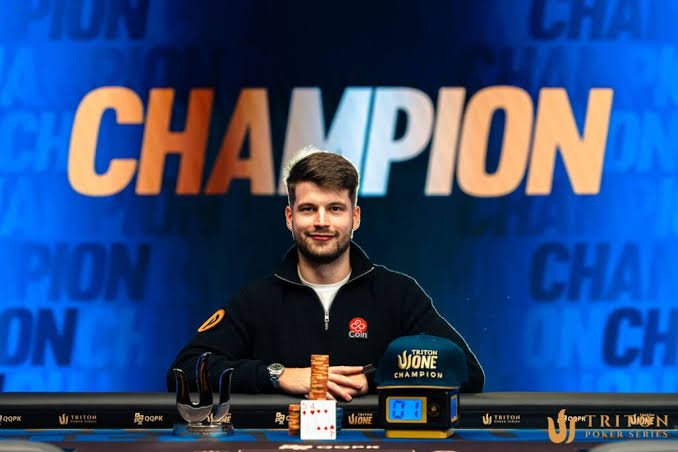
Every poker player has heard the line “a chip and a chair.” Very few get to live it on a Triton stream with more than half a million dollars on the line. On 11 November in Kyrenia, 22-year-old Hungarian Benedek Farkas did exactly that. He started heads-up with about seven big blinds against roughly a hundred and still finished as champion of the Triton ONE North Cyprus $10,000 7-Max.
The prize was $572,000, more than ten times his previous best result. Here’s how the comeback unfolded, why it matters, and what’s next as the $8,000 Main Event moves into Day 2 today.
Quick Facts
Event: #9 $10,000 No-Limit Hold’em 7-Handed
Field: 324 entries (101 re-entries)
Prize pool: $2,945,484
Winner: Benedek Farkas (Hungary, 22), $572,000
Runner-up: Dmitrii Kukhtarev, $362,000
The story: started heads-up behind 60,750,000 to 4,050,000, a 15:1 deficit
Career milestone: first six-figure live score; previous best was $52,238
Triton ONE North Cyprus Results: $10K 7-Max Final Table
The $10,000 7-Handed was the most expensive Triton ONE event of the festival’s first week, and the field showed up. It drew 324 entries, 101 of them re-entries, for a $2,945,484 prize pool. Until the Main Event finishes, that makes Farkas’s payday the biggest first prize of the festival.
Final table results:
- Benedek Farkas (Hungary) – $572,000
- Dmitrii Kukhtarev – $362,000
- Igor Provkin – $261,484
- Yu Zhang – $211,000
- Cedric Schwaederle – $168,000
- Lyudmil Ivanov – $128,000
- Wu Jun Hao – $96,000
Farkas started the final table third in chips, behind Kukhtarev. By three-handed play, Kukhtarev had more than three times the stack of anyone else and looked to be in total control. Provkin went out in third when his pocket fours lost a flip to Farkas’s ace-ten after a ten landed on the flop. That set up a heads-up match that, on paper, wasn’t much of a match at all.
The 15:1 Comeback, Hand by Hand
When heads-up began, Kukhtarev had 60,750,000 chips and Farkas had 4,050,000. That’s a 15-to-1 gap. A couple of outlets reported 12-to-1, which most likely reflects a different moment in the match. Card Player’s starting counts work out to exactly 15:1.
After the win, Farkas summed up his position simply: he had about seven big blinds against a hundred, and he knew he needed some luck. He got it, but he also played well enough to make it count.
Phase 1: Chipping back. With a seven-big-blind stack, you can’t wait for premium hands. Farkas won most of the early pots, and each one made his next shove more dangerous for Kukhtarev to call.
Phase 2: The swing pot. The biggest turning point came when Farkas made eights full of queens against Kukhtarev’s trip eights. Hands like that are cruel for the big stack. Kukhtarev held a strong hand with no real reason to slow down, and the chips flowed the other way.
Phase 3: Taking over. Farkas then picked off a pot with a bluff to take the lead for the first time, and kept building until he was ahead by roughly 5 to 1.
The final hand. Kukhtarev limped the button with 10♠7♣ and Farkas checked his option with 5♦4♥. On a 7♥5♠3♣ flop, Farkas had a pair plus an open-ended straight draw and chose to check. Kukhtarev bet 2,000,000 into 3,000,000 with top pair, and Farkas called. The 6♦ on the turn completed Farkas’s straight. He led for 1,300,000 and got a call. The 10♣ river gave Kukhtarev two pair, tens and sevens. When Farkas moved all-in, Kukhtarev called and was shown the straight.
What Beginners Can Take From This
Short stacks have fold equity, not just luck. At seven big blinds, every wrong call against an all-in costs the big stack something. Applying pressure forces mistakes.
Big stacks can lose focus. Leading by 15:1, it’s tempting to play every pot, and that’s how a short stack gets the doubles it needs.
Small bets can be traps. On the turn of the final hand, Farkas bet small with the nuts. Holding top pair, Kukhtarev found it very hard to fold. Then the river gave him two pair and made calling the shove even harder.
Farkas was gracious afterwards. He called it a battle, saying his opponent played well but ran poorly in heads-up. Triton’s own social channels nicknamed him “the comeback kid.”
A Career-Defining First Six-Figure Score
What makes this result special is the size of the jump. Before Kyrenia, Farkas’s largest live payout was $52,238, for finishing second in a €5,000 event at PokerStars Open Cannes in 2025. He had also built a steady record of smaller cashes on the Triton ONE circuit, including a 10th-place finish in Jeju last year.
Before and after Kyrenia:
Largest live cash: $52,238 → $572,000
Recorded live earnings: about $210,000 → $782,000+
Six-figure scores: 0 → 1
Triton titles: 0 → 1
In one tournament, Farkas nearly quadrupled his career earnings. That’s exactly what Triton ONE was designed to do. Triton launched the mid-stakes brand to give players below Super High Roller level a route onto the biggest stage in tournament poker. A 22-year-old with no previous six-figure score winning a $10K event is close to the ideal outcome.
It also continues a strong week for younger players in Kyrenia. Romania’s Alin Ivan, 26, won the opening $3,000 QQPK Genesis for $450,000 on his Triton debut, while China’s Quan Zhou picked up his first Triton ONE title in the $5,000 Mystery Bounty.
Triton ONE North Cyprus $8K Main Event Preview
All eyes now turn to the festival’s centrepiece. The $8,000 Triton ONE Main Event closed registration after Day 1c with 1,006 entries and a $7,316,638 prize pool. It’s Triton ONE’s first Main Event in Europe and only the third in the brand’s short history.
How North Cyprus compares:
Jeju, Sept 2025: 1,046 entries, $7,607,558 prize pool, won by Joshua Gebissa for $975,225
Jeju, March 2026: 1,230 entries, $8,945,790 prize pool, won by Zhao Wenjie for $1,160,000
North Cyprus, Nov 2026: 1,006 entries, $7,316,638 prize pool, final day 15 November
The field is about 18% smaller than March’s record in Jeju, which is no surprise. Getting to Northern Cyprus from Asia usually means connecting through Turkey, and some of the recreational players who make Triton ONE fields so attractive stayed home. Even so, 1,006 entries is only 40 short of the inaugural Main Event. The prize pool also landed inside the $6.6–7.6 million range we projected earlier this week. Based on the Jeju payout ladders, a first prize of roughly $900,000 to $1 million looks realistic before any deal.
Key dates:
Day 2: Friday 13 November, 12:00 local time (UTC+2). Survivors from all three flights combine, and levels move to 60 minutes.
Day 3: Saturday 14 November. Expect the bubble to burst early and the field to shrink towards a final table.
Final day: Sunday 15 November. Played to a winner, the same day the Super High Roller Series begins at the resort.
Who bagged big:
Day 1a leader: Damir Gabdullin (Russia), 4,515,000
Day 1b leader: Jingyao Yan (China), 4,130,000
Day 1c leader: Yue Zhao (China), 3,475,000
Gabdullin brings the biggest stack of the tournament into Day 2. Serious high-roller talent sits behind the leaders. Isaac Haxton and Mikita Badziakouski both bagged top-ten stacks across Days 1a and 1b, while the UK’s Benjamin Winsor and Canada’s Xuan Liu finished near the top on Day 1c. Jingyao Yan already has a trophy this week from the $4,000 Big Bounty, so he’s one to watch.
There’s also a side story on Day 2. The mystery bounty envelopes from Quan Zhou’s $5,000 event will be drawn during the Main Event’s dinner break, and the top envelope is worth $155,000.
Our Take
Results like Farkas’s are why people keep firing tournaments. Statistically, a 15:1 heads-up deficit should end within minutes. The short stack has to win several all-ins in a row, then outplay a strong opponent with no margin for error. Farkas did both. For a young player who had been grinding Triton ONE events for small cashes, it’s a breakthrough that changes his bankroll and probably his schedule.
In the Main Event, the smaller field compared with Jeju means a slightly smaller top prize. Still, the quality at the top of the chip counts points to a tough final table. If you’re following from home, the stream starts at noon in Kyrenia each day: 15:30 in India, 18:00 in China and Singapore, and 10:00 in London.
FAQs
Who won the Triton ONE North Cyprus $10K 7-Max?
Benedek Farkas, a 22-year-old from Hungary, won Event #9, the $10,000 NLH 7-Handed, on 11 November 2026. He beat Russia’s Dmitrii Kukhtarev heads-up and earned $572,000.
How big was Benedek Farkas’s heads-up comeback?
According to Card Player, heads-up began with Kukhtarev on 60,750,000 chips and Farkas on 4,050,000, a 15:1 deficit. Farkas said he had about seven big blinds against roughly 100. Some outlets put the gap at 12-to-1.
How many players entered the $10K 7-Max?
The event drew 324 entries, including 101 re-entries, and built a prize pool of $2,945,484.
Was this Benedek Farkas’s biggest win?
Yes. The $572,000 prize is his first six-figure live tournament score. His previous best was $52,238 for second place in a €5,000 event at PokerStars Open Cannes in 2025, and his recorded live cashes now exceed $782,000.
Disclosure: PokerClubGames may earn a commission when you use links to poker operators. This never changes the price you pay. 18+ (21+ where required). Gambling involves risk. How we make money