
Texas Hold’em Strategy: Tips to Win More in 2026
On this page
Last Updated on July 9, 2026 by Bala Kumar
Poker strategy has changed more in the last five years than in the previous fifty, and 2026 is proof of it. This summer’s World Series of Poker Main Event drew 9,208 entrants and built an $85.6 million prize pool, the fourth-largest field in the tournament’s 57-year history, and the players competing for that $10 million top prize are almost all studying the same way: with solvers, not just instinct. If you’re serious about improving your results, the best Texas Hold’em strategy in 2026 starts with understanding how the game is actually being played at the top, then adapting it to a level you can realistically execute.
Here’s what that looks like in practice.
1. Build Your Foundation on GTO, Then Learn to Deviate
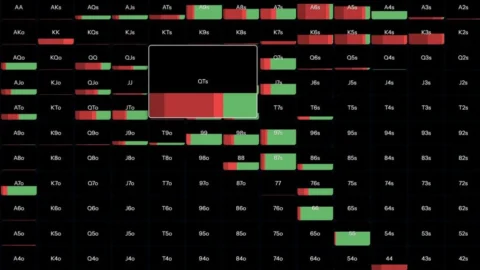
Game Theory Optimal (GTO) strategy is now the baseline every serious player studies from, and for good reason: a GTO strategy is mathematically balanced so that your opponents can’t exploit it, regardless of what they know about your tendencies. Modern solver-trained regulars now open pots at frequencies within just a few percentage points of GTO baselines, which means any deviation from that baseline needs to be earned with a real, specific read, not a hunch.
That doesn’t mean you need to memorize solver output for every spot. It means you should:
- Learn solid preflop opening and 3-betting ranges by position, since preflop is the one area where GTO play is close to fully solvable.
- Use GTO as your default game plan against unknown or strong opponents.
- Only deviate into exploitative play once you have a real sample — most strong players wait for at least 200 hands of data on an opponent before making a significant adjustment.
This “GTO first, exploit second” approach is the foundation of how modern winning players actually think through a hand: what’s the balanced baseline, where does this specific opponent deviate from it, and is my adjustment justified by what I’ve actually seen them do?
2. Respect Position More Than Almost Anything Else
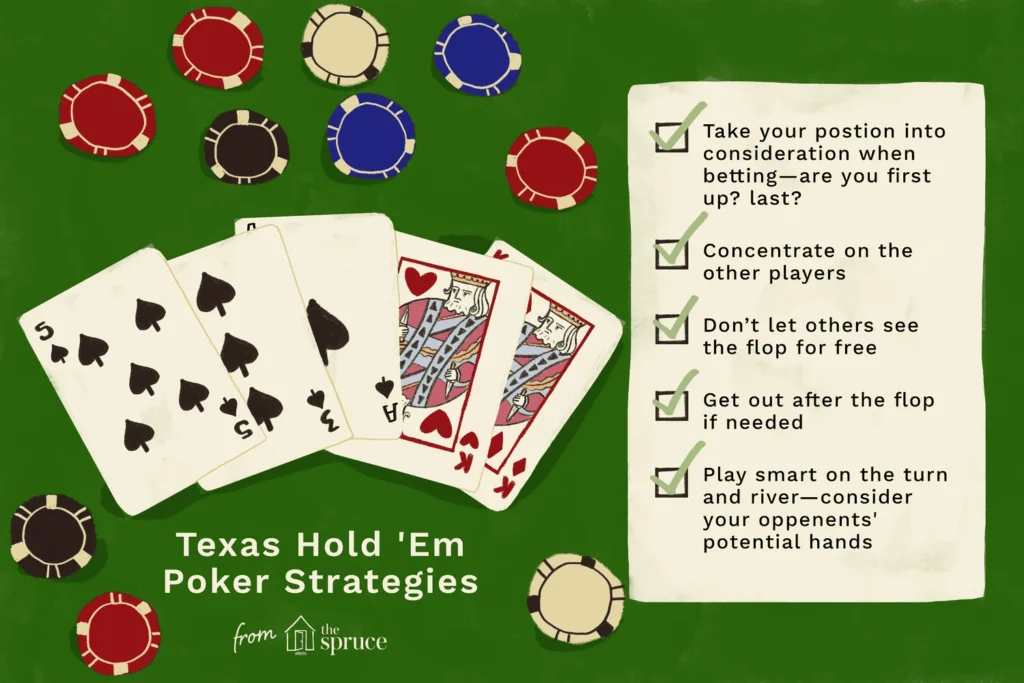
If there’s one Texas Hold’em tip that separates long-term winners from long-term losers, it’s positional discipline. Acting last on every postflop street gives you more information before you have to commit chips, and it compounds over thousands of hands. Practically, this means:
- Widening your opening range in late position (cutoff, button) and tightening it dramatically from early position.
- Being willing to fold hands from under-the-gun that you’d happily open from the button.
- Recognizing that positional advantage matters even more in multiway pots, where wider ranges and more players seeing the flop make information even more valuable.
3. Understand Bet Sizing as a Strategic Tool, Not a Habit
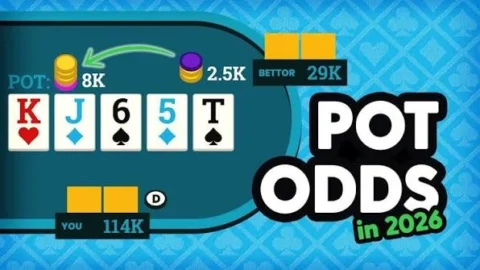
Newer players tend to use the same bet size regardless of the situation. Strong players size their bets based on what they’re trying to accomplish — protecting a made hand, building a pot with a strong holding, or applying maximum pressure with a bluff. Solvers have made this especially clear on multiway boards, where deep stacks and multiple live ranges create decision trees that were nearly impossible to study accurately until recently. New AI-driven multiway solvers released this year can now produce reliable solutions for these spots almost instantly, and the emerging lesson is consistent: the “correct” bet size shifts significantly once a third player is involved, and defaulting to a heads-up-sized bet in a multiway pot is a common, costly leak.
4. Study With the Same Tools the Pros Use
The gap between amateur and professional preparation has never been smaller — or more accessible to close. Tools like GTO Wizard now offer massive libraries of pre-solved spots across cash games, tournaments, and Spin & Gos, letting any player compare their in-game decision to the mathematically optimal one within seconds. A useful, low-cost starting routine looks like this:
- Review your own hands after a session and flag decisions you weren’t fully confident about.
- Run those spots through a solver or training tool to see where your actual play diverged from the balanced strategy.
- Focus study time on the situations that come up most often for your usual stakes and format, rather than rare, high-variance spots.
It’s worth noting that solvers are strictly a study tool — using one during a live hand is against the rules everywhere, from home games to the WSOP. Their value comes entirely from the work you put in away from the table.
5. Adjust Your Strategy for the Format You’re Actually Playing
“Best Texas Hold’em strategy” isn’t one-size-fits-all, cash games and tournaments reward different approaches.
Cash games reward patience and deep-stack discipline. Stacks reset every hand, so there’s less pressure to gamble for chips, and a tight-aggressive approach that avoids marginal spots tends to outperform over the long run.
Tournaments add a layer that cash games don’t have: ICM (Independent Chip Model) pressure, where the value of your chips changes based on payout structure, not just chip count. This is why tournament specialists lean heavily on ICM-focused training tools to understand when survival is worth more than raw chip accumulation, a dynamic that becomes especially sharp near the money bubble or a final table, exactly the situations that defined the closing stages of this year’s WSOP Main Event.
6. Don’t Skip the Mental and Bankroll Fundamentals
Strategy advice means little if you’re playing scared or playing stakes you can’t afford to lose. Two non-negotiables:
- Bankroll management: A common guideline is keeping at least 20–30 buy-ins for the cash game stakes you play, or 50–100 buy-ins for tournaments, given their higher variance.
- Tilt control: Solver study helps here too — when you trust that your default strategy is sound, it’s easier to accept short-term variance without spiraling into bad decisions after a tough beat.
The Bottom Line
The best Texas Hold’em strategy for 2026 isn’t a secret trick — it’s a combination of a solid GTO foundation, disciplined positional play, smart bet sizing, deliberate study using modern tools, and format-specific adjustments for cash games versus tournaments. The players competing for millions at this year’s WSOP got there by treating study as seriously as play. You don’t need a $10 million prize pool on the line to benefit from doing the same — just a consistent routine and the willingness to let the data correct your instincts when they’re wrong.
FAQs
1. What is the best Texas Hold’em strategy in 2026?
The best strategy combines GTO fundamentals, strong positional play, smart bet sizing, and regular study using modern poker tools.
2. Why is position important in Texas Hold’em?
Playing in late position gives you more information before acting, helping you make better betting and folding decisions.
3. Should beginners use GTO strategy?
Yes. Beginners should learn basic GTO principles first, then gradually make exploitative adjustments based on opponents’ tendencies.
4. How can I improve my Texas Hold’em game?
Review your hands, study with solver tools, manage your bankroll, and practice consistently in the formats you play most.
5. Does the same strategy work for cash games and tournaments?
No. Cash games focus on deep-stack play, while tournaments require adjustments for changing stack sizes and ICM pressure.
Disclosure: PokerClubGames may earn a commission when you use links to poker operators. This never changes the price you pay. 18+ (21+ where required). Gambling involves risk. How we make money