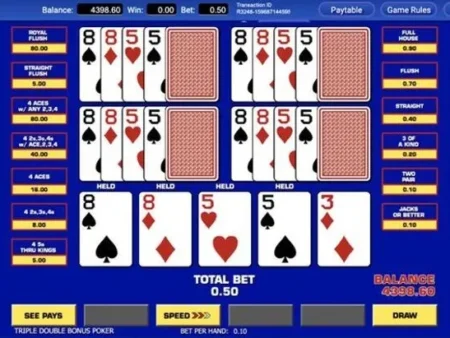
If you’ve spent any real time at the video poker machines, you’ve probably noticed that not every “bonus” game rewards you the same way. Triple double bonus poker strategy is a different animal from the low-volatility games most players learn on , it swings harder, pays bigger on the right hands, and punishes lazy decisions faster than almost anything else on the video poker floor. This guide breaks down exactly how the game works in 2026, what the current paytables actually return, and how to make the right hold-or-discard call every single time, whether you’re playing at a Vegas locals casino or on a licensed online site.
What Makes Triple Double Bonus Poker Different
Triple double bonus poker is part of the Bonus Poker family, the same lineage as Jacks or Better, Double Bonus, and Double Double Bonus, but it takes the “bonus for quads” concept to its most extreme version. Instead of spreading decent bonuses across a wide range of four-of-a-kind hands, this game concentrates almost all of its extra value into a small handful of premium quads: four Aces, four 2s, four 3s, and four 4s, especially when paired with the right kicker card.
The trade-off is real, though. To fund those massive top-end payouts, the game trims returns elsewhere. Two pair pays just 1-for-1 instead of the more common 2-for-1, and three of a kind drops to 2-for-1 instead of the usual 3-for-1. That’s the defining tension of the game: smaller, more frequent hands pay less, while the rare premium quads pay enormously — up to the same 4,000-coin jackpot as a royal flush on a max five-coin bet.
Current 2026 Paytables and Real-World RTP
Paytables for this game vary more than most video poker variants, and the version you sit down at makes a massive difference to your long-run return. Below is the current breakdown of the most common paytables found in casinos and licensed online rooms in 2026, based on a 5-coin max bet.
| Paytable (Full House / Flush) | Full House | Flush | Theoretical RTP | Where You’ll Typically Find It |
| 9/7 | 9 | 7 | 99.58% | Select Las Vegas locals casinos, top-tier BetOnSoft rooms |
| 9/6 | 9 | 6 | 98.15% | Most common land-based and online version |
| 9/5 | 9 | 5 | 97.02% | Regional casinos, some online platforms |
| 8/5 | 8 | 5 | ~95.9% | Lower-paying regional machines |
| 7/5 | 7 | 5 | ~94.9% | Bottom-tier machines — best avoided |
The full 5-coin payout structure on the top 9/7 version looks like this:
| Hand | Payout (per coin) | Payout (5-coin max bet) |
| Royal Flush | 800 | 4,000 |
| Four Aces + 2, 3, or 4 kicker | 800 | 4,000 |
| Four 2s, 3s, or 4s + kicker | 400 | 2,000 |
| Straight Flush | 50 | 250 |
| Four Aces (no kicker) | 160 | 800 |
| Four 2s, 3s, or 4s (no kicker) | 80 | 400 |
| Four 5s through Kings | 50 | 250 |
| Full House | 9 | 45 |
| Flush | 7 | 35 |
| Straight | 4 | 20 |
| Three of a Kind | 2 | 10 |
| Two Pair | 1 | 5 |
| Jacks or Better | 1 | 5 |
Notice the gap between four Aces with a kicker (4,000 coins) and four Aces without one (800 coins). That 5x difference is the single biggest strategic lesson in the entire game, and it’s the first thing separating players who understand triple double bonus poker from those who are just clicking buttons.
Online availability in 2026 is thinner than for standard Jacks or Better — the game shows up primarily on platforms running BetOnSoft or IGT software, and it’s rarely offered on multi-hand video poker machines. When it is available on multi-hand formats, the paytable is almost always the weaker 9/5 version or worse, so single-hand play is usually the better choice if a full-pay table is on offer.
Triple Double Bonus vs. Double Double Bonus Poker Strategy
It’s worth being upfront about this because it trips up a lot of players: you cannot use a double double bonus poker strategy chart on triple double bonus, and vice versa. They look similar on the surface, but the payout structures diverge enough that optimal decisions change in several common spots.
| Feature | Triple Double Bonus | Double Double Bonus |
| Best available RTP | 99.58% (9/7) | 98.98% (9/6) |
| Four Aces + kicker | 4,000 coins (5-coin bet) | 2,000 coins (5-coin bet) |
| Two Pair payout | 1-for-1 | 1-for-1 |
| Three of a Kind payout | 2-for-1 | 3-for-1 |
| Volatility | Higher | High, but slightly less extreme |
| Kicker sensitivity | Extreme — changes many hold decisions | Significant, but less pronounced |
The three-of-a-kind payout is the clearest difference. Because DDB still pays 3-for-1 on trips, it’s a slightly gentler game to grind through variance-wise. TDB’s drop to 2-for-1 means you’re leaning even harder on hitting the big kicker quads to keep your session RTP where the math says it should be. If you enjoy DDB’s bonus structure but want bigger spikes and are prepared for rougher stretches between them, TDB is the natural next step up the volatility ladder.
Core Strategy: The Hands That Actually Matter
Perfect strategy in TDB follows a hand-ranking hierarchy — you compare what you were dealt against a list ordered by expected value, and play the highest-ranked option available. You don’t need to memorize the entire 40-plus line chart to play well, but understanding the priority order below will get you 95%+ of the way to optimal play.
Always keep, in this general order of priority:
- Royal flush, straight flush, or any four of a kind (pat hands)
- Four to a royal flush
- Three of a kind with a 2, 3, or 4 kicker attached (this is a bigger deal in TDB than in almost any other video poker variant — never toss that kicker automatically)
- Full house, flush, or straight (pat hands)
- Three of a kind without a valuable kicker
- Four to a straight flush
- Two pair
- High pair (Jacks or better)
- Three to a straight flush (no gaps, ideally with high cards)
- Four to a flush
- Low pair (2s through 10s)
- Four to an outside straight
- Two suited high cards
- Three to a straight flush with one or two gaps
Practical adjustments most players get wrong:
- Don’t break a made full house or flush chasing a kicker quad. The math doesn’t support it — the pat hand’s guaranteed return beats the long-shot upgrade in the vast majority of cases.
- A-A-2 beats a suited King-Queen. This feels wrong to players raised on Jacks or Better, where you’d usually keep the suited high cards. In TDB, the kicker potential on that pair of Aces dominates the expected value math.
- Low pairs are fine to hold, but never at the expense of a three-card straight flush draw or a strong four-card flush. Volatility-chasing works both ways — sometimes the “boring” pair is actually correct.
- Three of a kind should almost always keep its kicker if that kicker is a 2, 3, or 4. Discarding it to draw for quads without the kicker attached is a common and costly mistake.
Bankroll and Variance: What to Actually Expect
This is the part beginners underestimate the most. Even with perfect strategy on a full-pay 9/7 table, triple double bonus poker’s return is concentrated in a handful of rare, enormous hands rather than spread evenly across frequent small wins. That means longer dry stretches between meaningful payouts than you’d experience on Jacks or Better, punctuated by the occasional spike that can double or triple your session bankroll in a single hand.
Practical bankroll guidance:
- Budget two to five times the bankroll buffer you’d use for a standard 9/6 Jacks or Better session at the same denomination.
- Play the highest denomination you can comfortably afford at max coins — the royal flush and kicker-quad jumps only pay their full multiplier on a 5-coin bet, so betting fewer coins quietly destroys your long-run RTP.
- Set a defined stop-loss and a defined win goal before you sit down. Because variance runs so high, “playing it by feel” is a fast way to give back a big early hit.
- Track your sessions. Short-term results in high-variance games can look wildly different from the theoretical RTP over any single sitting — sometimes for dozens of sessions in a row.
Where to Practice and Play in 2026
Because full-pay 9/7 tables are genuinely rare, it’s worth comparing before you commit real money to a session.
| Option | Best For | Notes |
| Free strategy trainers | Learning the hand-ranking chart without risking money | Look for trainers that let you set the exact paytable you’ll be playing live |
| Licensed online casinos (BetOnSoft/IGT) | Convenience and paytable transparency | Confirm the exact paytable in the game info screen before playing — 9/6 is the realistic online standard |
| Las Vegas locals casinos | Best available paytables | Some properties still spread genuine 9/7 machines |
| Regional and tribal casinos | Accessibility | Paytables vary widely — always check before sitting down |
Before playing anywhere, it’s worth running the exact paytable through a return calculator rather than assuming — a single coin’s difference on the flush payout can swing theoretical RTP by more than a full percentage point.
Common Mistakes to Avoid
- Treating it like Jacks or Better. The strategy overlap is real but incomplete, and applying JoB instincts to TDB’s kicker-heavy hands will bleed edge out of your play.
- Chasing quads by breaking a made hand. It rarely pays off mathematically, no matter how tempting the 4,000-coin number looks.
- Ignoring the paytable before playing. The gap between a 9/7 and a 7/5 table is nearly five full percentage points of RTP — that’s the difference between a strong long-term game and a poor one.
- Betting less than max coins. This single habit does more damage to your expected return than almost any in-hand decision you’ll make.
- Playing multi-hand versions without checking the paytable first. Multi-hand TDB machines are almost always weaker-paying than single-hand versions.
FAQs
What is the best paytable for triple double bonus poker?
The 9/7 paytable is the strongest widely available version, returning 99.58% with perfect strategy. The far more common 9/6 version returns 98.15%, still a solid game if 9/7 isn’t available.
Is triple double bonus poker strategy the same as double double bonus poker strategy?
No. The two games share a family resemblance, but three-of-a-kind payouts and kicker-quad values differ enough that a dedicated triple double bonus poker strategy chart is necessary for optimal play.
How volatile is triple double bonus poker compared to Jacks or Better?
Significantly more volatile. Two pair and three of a kind pay less than in Jacks or Better, while top-end quad hands pay dramatically more, concentrating returns into rarer, bigger hits.
Do I need to bet max coins to get the best return?
Yes. The royal flush and the top kicker-quad payouts only reach their full multiplier on a 5-coin max bet. Betting fewer coins reduces your effective RTP even if you play perfect strategy otherwise.
Where can I find triple double bonus poker online in 2026?
It’s available on a limited number of licensed platforms, mainly those running BetOnSoft or IGT software. Always confirm the specific paytable in the game’s info screen, since online versions frequently default to 9/6 or lower.
Founder of PokerClubGames.com and a Poker Researcher with 10+ years of experience in SEO, WordPress development, and gaming content strategy. Specializes in researching online poker sites, poker apps, tournaments, bonuses, and poker strategies. Experienced in poker platform reviews, affiliate marketing, and creating SEO-focused poker content for global audiences.
For collaborations, media inquiries, or poker-related partnerships:
Contact: partnerships@pokerclubgames.com