
Last Updated on July 21, 2026 by Bala Kumar
Every poker player you’ve ever watched on TV, streamed on Twitch, or sat across from at a casino table learned the game the same way: by starting with Texas Hold’em rules. It’s the version of poker that built the modern game, the one behind the World Series of Poker Main Event, the one every online room defaults to, and the one that’s simple enough to learn in ten minutes but deep enough to study for a lifetime.
If you’ve searched for how to play Texas Holdem and landed here, good news: this isn’t going to be a wall of jargon. We’re going to walk through the actual mechanics, how a hand unfolds, what beats what, and the small details beginners usually get wrong, the same way an experienced player would explain it to a friend before their first home game.
What Is Texas Hold’em, Exactly?
Texas Hold’em is a community card poker game. Each player gets two private cards (called “hole cards”), and the table shares five cards face-up in the middle. Your job is to make the best possible five-card hand using any combination of your two hole cards and the five shared community cards.
It’s played with 2 to 10 players around a table, using a standard 52-card deck. No wild cards, no special exceptions, just cards, betting, and reading your opponents.
The Basic Setup Before a Hand Starts
Before any cards are dealt, a few structural things happen that trip up almost every beginner:
- The dealer button rotates clockwise after every hand, marking who’s “the dealer” for that round (even in casinos where a real dealer handles the cards).
- Blinds are forced bets posted by the two players to the left of the button, the small blind and the big blind. These exist so there’s always something in the pot worth playing for, even before anyone chooses to bet.
- Position matters enormously. Acting later in the betting order gives you more information than acting early, which is why the same starting hand can be a fold from one seat and a raise from another.
Understanding this setup is really where Texas Holdem rules for beginners should start, because most confusion in someone’s first live session comes from not knowing who’s supposed to act next, not from misunderstanding the hand rankings.
How to Play Texas Hold’em: The Four Betting Rounds
Here’s the actual structure of a hand, step by step.
1. Pre-flop. Every player is dealt two hole cards face-down. Starting with the player left of the big blind, each player can fold, call the big blind amount, or raise.
2. The Flop. Three community cards are dealt face-up in the middle of the table. A new round of betting begins, starting with the first active player left of the button.
3. The Turn. A fourth community card is dealt. Another round of betting follows the same pattern.
4. The River. The fifth and final community card is dealt, followed by the last round of betting.
5. Showdown. If two or more players remain after the river betting round, hands are revealed and the best five-card combination wins the pot. If everyone folds except one player at any point before showdown, that player wins the pot automatically, no need to show their cards.
That’s genuinely the whole structure. What makes Hold’em complex isn’t the number of steps, it’s the decision-making within each one, how much to bet, when to fold a hand that “looks” good but probably isn’t, and how to read betting patterns.
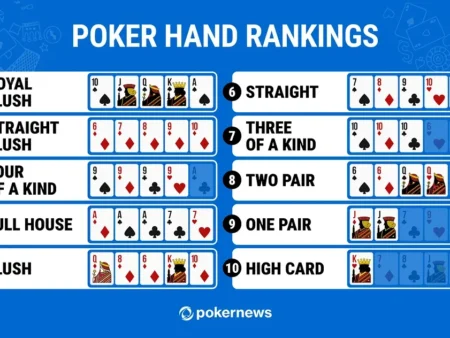
Texas Hold’em Poker Hands: The Full Ranking List
This is the part every beginner needs memorized before sitting down. From strongest to weakest:
- Royal Flush — A, K, Q, J, 10, all the same suit
- Straight Flush — Five consecutive cards, same suit
- Four of a Kind — Four cards of the same rank
- Full House — Three of a kind plus a pair
- Flush — Five cards of the same suit, not in sequence
- Straight — Five consecutive cards, mixed suits
- Three of a Kind — Three cards of the same rank
- Two Pair — Two separate pairs
- One Pair — Two cards of the same rank
- High Card — No matching cards; highest card plays
A quick real-world tip: new players often overvalue a single pair or a “pretty” hand like two suited cards. In practice, a big pair (like Aces or Kings) before the flop is strong, but the moment the community cards come out, hand strength is relative, a pair that looked great pre-flop can easily become the third-best hand at the table by the river.
How to Deal Texas Hold’em (If You’re Running the Game)
If you’re hosting a home game, someone needs to know how to deal Texas Hold’em properly, even without a casino dealer button system:
- Shuffle thoroughly, then deal one card at a time, clockwise, starting with the player to the dealer’s left, until everyone has two hole cards.
- Burn one card (place it face-down, unused) before dealing the flop, the turn, and the river each — this is standard procedure to prevent any player from having seen the next card in advance.
- Deal the flop as three cards at once, then a single card for the turn, then a single card for the river, with a betting round after each.
- Rotate the dealer button clockwise after every hand, even if a non-playing dealer is handling the actual cards.
It sounds like a small detail, but a home game with an inconsistent dealing process is one of the fastest ways to create disputes at the table, get this part right and everything else runs smoothly.
Texas Hold’em for 2 Players: How Heads-Up Changes the Rules
Texas Hold’em 2-player games, known as heads-up poker, follow the same core rules with one structural twist: the button also acts as the small blind, and posts first pre-flop, while the other player is the big blind and acts first on every round after the flop.
Heads-up poker is a completely different animal strategically. With only one opponent, hand values shift dramatically, a hand you’d fold in a full ring game might be a clear heads-up, simply because there are far fewer hands that can beat you. It’s also the format used to determine a winner once a tournament gets down to the final two players, so it’s worth understanding even if you mostly play full tables.
Choosing a Texas Hold’em Poker Set for Home Games
If you’re planning regular home games, a decent Texas Hold’em poker set makes a real difference — and not just for aesthetics. Look for:
- Clay or clay-composite chips rather than cheap plastic — they stack better and feel closer to what you’d use in a cardroom.
- A dealer button, at minimum — even casual games benefit from a clear marker for position.
- A sufficient chip count and denominations — a set with only two or three chip values will make it hard to run proper blind structures as the game progresses.
- A durable case if you’re hosting regularly — chips scattered in a drawer get lost fast.
None of this is required to play, a deck of cards and some coins technically works, but a proper set removes friction and keeps the game moving, which matters more than people expect once you’re four hours into a home session.
Common Beginner Mistakes Worth Knowing Early
- Playing too many starting hands. Folding is a skill, not a failure, most hands simply aren’t worth playing from most positions.
- Ignoring position. The same hand has different values depending on when you act.
- Overvaluing a single pair post-flop. Community cards change hand strength constantly; reassess every street.
- Forgetting the betting order changes after pre-flop. Post-flop action starts with the first active player left of the button, not the same player who acted first pre-flop.
Wrapping Up
Texas Hold’em’s rules are simple enough to explain in a single sitting, but the game itself rewards a lifetime of learning. Once the basic structure, blinds, betting rounds, hand rankings, becomes second nature, everything else you’ll study (position, pot odds, reading opponents) builds on this exact foundation. Get comfortable with these fundamentals first, and the rest of the game opens up a lot faster than most beginners expect.
FAQs
1. What are the basic rules of Texas Hold’em?
Each player receives two private hole cards, and five community cards are dealt face-up on the table. Players use any combination of these seven cards to make the best possible five-card poker hand.
2. What is the order of betting in Texas Hold’em?
Texas Hold’em has four betting rounds: Pre-flop, Flop, Turn, and River. If more than one player remains after the final betting round, the hand goes to a showdown.
3. What is the best starting hand in Texas Hold’em?
The strongest starting hand is Pocket Aces (A♠ A♥), followed by Pocket Kings and Pocket Queens. However, the best hand can still lose depending on the community cards and opponents’ holdings.
4. Can beginners learn Texas Hold’em easily?
Yes. Texas Hold’em is easy to learn but takes time to master. Understanding hand rankings, betting rounds, table position, and basic poker strategy will help beginners improve quickly.
5. Where can I learn more about Texas Hold’em strategy?
PokerClubGames offers beginner-friendly guides on Texas Hold’em rules, poker hand rankings, poker odds calculators, bankroll management, and online poker strategy to help players build confidence and improve their game.
Founder of PokerClubGames.com and a Poker Researcher with 10+ years of experience in SEO, WordPress development, and gaming content strategy. Specializes in researching online poker sites, poker apps, tournaments, bonuses, and poker strategies. Experienced in poker platform reviews, affiliate marketing, and creating SEO-focused poker content for global audiences.
For collaborations, media inquiries, or poker-related partnerships:
Contact: Info@hugecount.com