
Play Jacks or Better Free: Video Poker Practice Guide
On this page
If you’ve ever walked past a row of video poker machines in Las Vegas, you’ve seen Jacks or Better. It’s the original video poker game, the one every other version is built on, and still the best place to start. You get five cards, you choose which to keep, you draw, and any pair of Jacks or higher gets your money back.
That sounds almost too simple. But behind the simple rules sits one of the few casino games where your decisions actually change your results. Play a full-pay Jacks or Better video poker game with perfect strategy and the house edge drops below half a percent. Play it on gut feel and you can easily hand the casino 3–4% instead.
That’s why free Jacks or Better is so useful. You can practice without risking a cent, make your mistakes on play money, and only move to real stakes once the right holds feel automatic. This guide covers everything you need for that: how the game works, how to read a pay table, the odds of each hand, a strategy chart you can actually remember, and a practice routine that works.
What Is Jacks or Better Video Poker?
Jacks or Better (players often shorten it to JoB) is a single-player video poker game based on five-card draw. There’s no dealer to beat and no other players at the table. It’s just you, the machine and the pay table.
Here’s how a hand plays out:
- Place your bet: Online and on most machines, you choose 1 to 5 coins.
- Get five cards: The deck is a standard 52 cards and is reshuffled every hand.
- Choose your holds: Tap the cards you want to keep. You can keep all five or none.
- Draw: The cards you didn’t hold are replaced with new ones.
- Get paid: Your final hand is checked against the pay table.
The lowest paying hand is a pair of Jacks or better (Jacks, Queens, Kings or Aces). A pair of tens or lower pays nothing, and that one rule explains most of the strategy.
The Jacks or Better Pay Table (and Why 9/6 Matters)
Before you play any Jacks or Better video poker game, free or real money, check the pay table. Two machines can look identical and still have very different paybacks.
This is the full-pay 9/6 Jacks or Better table, the version every serious player looks for:
| Hand | 1 Coin | 5 Coins |
| Royal Flush | 250 | 4,000 |
| Straight Flush | 50 | 250 |
| Four of a Kind | 25 | 125 |
| Full House | 9 | 45 |
| Flush | 6 | 30 |
| Straight | 4 | 20 |
| Three of a Kind | 3 | 15 |
| Two Pair | 2 | 10 |
| Jacks or Better | 1 | 5 |
The “9/6” name comes from the full house (9) and flush (6) payouts. Casinos lower those two numbers to increase their edge, and most players never notice.
How the Pay Table Changes Your Return
With perfect play:
| Version | Full House / Flush | Return to Player |
| 9/6 (full pay) | 9 / 6 | 99.54% |
| 9/5 | 9 / 5 | 98.45% |
| 8/6 | 8 / 6 | 98.39% |
| 8/5 | 8 / 5 | 97.30% |
| 7/5 | 7 / 5 | 96.15% |
| 6/5 | 6 / 5 | 95.00% |
One unit off the full house costs you more than a full percent. On a 6/5 machine you’re giving up almost 5% before you’ve made a single decision. If the game you’re practicing on doesn’t show 9 and 6 on those two lines, keep in mind that the real-money version will play worse.
Always play max coins for real money. The Royal Flush jumps from 1,250 (250 × 5) to 4,000 at five coins. That bonus makes up roughly 2% of the game’s total return, so playing fewer than five coins throws most of it away. In free play it doesn’t matter, but practice the habit anyway.
Jacks or Better Odds: How Often Each Hand Hits
Knowing how often each hand comes up helps you stay calm through losing streaks. These are approximate figures for 9/6 Jacks or Better played with optimal strategy:
| Final Hand | Probability | Roughly 1 in… |
| Royal Flush | 0.0025% | 40,000 hands |
| Straight Flush | 0.011% | 9,150 hands |
| Four of a Kind | 0.236% | 423 hands |
| Full House | 1.15% | 87 hands |
| Flush | 1.10% | 91 hands |
| Straight | 1.12% | 89 hands |
| Three of a Kind | 7.44% | 13 hands |
| Two Pair | 12.93% | 8 hands |
| Jacks or Better | 21.46% | 5 hands |
| Nothing | 54.55% | — |
Here’s what that means in practice. You’ll lose more than half your hands, and about one hand in five just gets your bet back. The game’s high payback comes from regular two pairs and trips, plus the rare big hits. A Royal arrives about once every 40,000 hands, which can mean weeks of steady play. Free Jacks or Better is a good way to get a feel for this before real money is involved.
Jacks or Better Strategy Chart (Simplified)
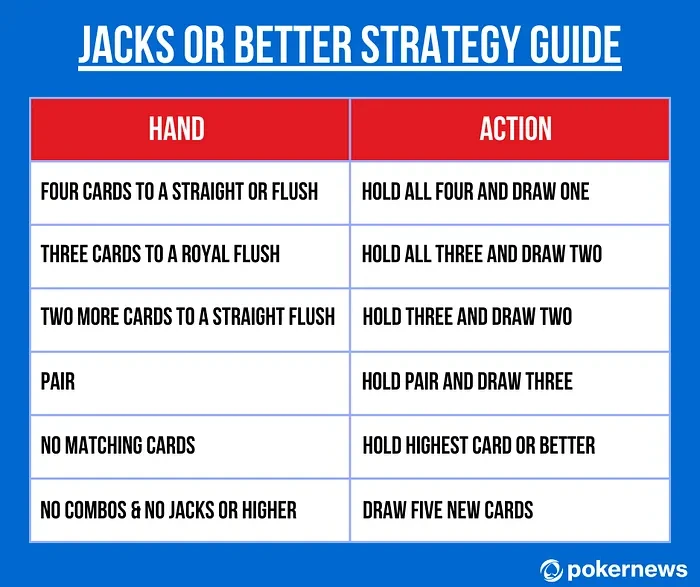
This is the part that matters most. Look at your five cards, then go down the list and hold the first hand that matches. It’s a simplified version of the full optimal strategy, and following it will get you within a few hundredths of a percent of perfect play.
What to Hold: Strategy Priority
- Royal Flush, Straight Flush, Four of a Kind, Full House: hold all.
- 4 to a Royal Flush (yes, even if it means breaking a flush or a straight).
- Three of a Kind, Straight, Flush.
- 4 to a Straight Flush.
- Two Pair.
- High Pair (Jacks, Queens, Kings, Aces).
- 3 to a Royal Flush.
- 4 to a Flush.
- Unsuited 10-J-Q-K.
- Low Pair (2s through 10s).
- 4 to an Outside Straight (for example 5-6-7-8).
- 3 to a Straight Flush.
- Two suited high cards (for example Q♥ J♥).
- 4 to an Inside Straight with 3 or more high cards.
- Unsuited K-Q-J.
- Unsuited J-Q or J-K or Q-K (two high cards, keep the lowest two if you have more).
- Suited 10 with a J, Q or K.
- One high card.
- Nothing: draw five new cards.
The Holds Beginners Get Wrong Most Often
- Keeping a “kicker”: Holding a pair of Kings plus an Ace “just in case” is a mistake. Hold the pair only. The extra card lowers your chances of improving.
- Holding a 4-card flush over a high pair: Pair of Jacks plus four hearts? Keep the Jacks. The high pair is already paying and has more ways to improve.
- Holding a low pair over a 4-card flush: This one goes the other way. Pair of 6s plus four clubs? Go for the flush. The 4-flush is worth more.
- Breaking a pat flush for 4 to a Royal: It feels wrong to throw away a guaranteed 6-coin win, but going for the 4,000-coin jackpot is the right play every time.
- Drawing to inside straights with no high cards: Something like 4-5-7-8 isn’t worth holding. Throw it away and draw five.
- Holding three cards of two pair: With two pair, keep all four cards and draw one. Never break it up.
JoB Practice Play: How to Train Like a Pro
Free play is only useful if you practice properly. Clicking through a few hundred hands won’t teach you much. Here’s a routine that helps:
Week 1: Learn the Chart
Play free Jacks or Better with the strategy chart open next to you. Before every draw, find your hand on the list. Go slowly. Speed comes later.
Week 2: Use a Trainer Mode
Many free video poker games have a “strategy advisor” or trainer that warns you when you make a sub-optimal hold. Turn it on and keep track of your mistakes. Most players find they keep making the same three or four errors, and those are the ones to fix.
Week 3: Play Without Help
Hide the chart and play 500 hands from memory. Then check the hands you weren’t sure about. If you’re still getting more than one hand in a hundred wrong, go back to Week 2.
Week 4: Feel the Swings
Play long free sessions, 1,000 hands or more, and watch your balance. You’ll go through stretches of 30 or 40 hands without anything better than Jacks. Getting used to that in free play makes you a much calmer real-money player.
A Few Practice Habits That Help
- Practice on a 9/6 pay table so your instincts match the best real-money games.
- Slow down on the hands that feel close, like a low pair versus a 4-flush or two high cards versus three to a royal. That’s where most money is lost.
- Don’t change your strategy because of a hot or cold streak. Every hand is a new shuffle.
Free Jacks or Better vs Real Money: What Changes?
| Factor | Free Play | Real Money |
| Cost | Nothing | Your bankroll |
| Pay tables | Usually 9/6 | Often 8/5 or worse, so check |
| Pressure | None | Real decisions feel heavier |
| Best for | Learning strategy, testing variance | Using a strategy you’ve already learned |
When you do switch to real money, a common rule of thumb is to bring a bankroll of several hundred bets for a session. Video poker swings more than people expect, even in a game paying back 99.54%. Set a loss limit before you start and stick to it.
Jacks or Better vs Other Video Poker Games
Once you’re comfortable with JoB, the other games make much more sense because they all use the same core strategy:
- Bonus Poker pays more for four of a kind, so slightly different holds work best.
- Double Bonus and Double Double Bonus have even bigger quad payouts, but two pair often only pays 1-for-1. That means more swings.
- Deuces Wild makes every 2 wild and needs a completely different strategy.
- Tens or Better pays on a pair of 10s, but the pay table is cut elsewhere to make up for it.
Jacks or Better is still the best game for learning. It has the lowest variance of the common versions, the simplest strategy and one of the highest returns.
FAQs
Can I play Jacks or Better free without downloading anything?
Yes. Most free Jacks or Better video poker games run in your browser on desktop or mobile, with no download or sign-up needed.
What is the best Jacks or Better pay table?
Full-pay 9/6, which pays 9 for a full house and 6 for a flush. With perfect strategy it returns 99.54%.
What does JoB mean in video poker?
JoB is short for Jacks or Better, the classic video poker game where a pair of Jacks or higher is the lowest winning hand.
Is Jacks or Better a game of skill?
Partly. The cards are random, but your hold decisions decide your long-term return. Perfect strategy can be worth several percent compared with guessing.
How often do you hit a Royal Flush in Jacks or Better?
About once every 40,000 hands with optimal strategy.
Should I hold a low pair or four to a flush?
Four to a flush. In 9/6 Jacks or Better, a 4-flush is worth more than a pair of 2s through 10s.
Should I always bet max coins?
In real-money play, yes. The Royal Flush pays 4,000 coins at five coins instead of 1,250, and that bonus is a big part of the game’s return. In free play, it’s still a good habit to practice.
Disclosure: PokerClubGames may earn a commission when you use links to poker operators. This never changes the price you pay. 18+ (21+ where required). Gambling involves risk. How we make money