
Short Deck Poker Rules: Why a Flush Beats a Full House
On this page
The first time you play Short Deck, there’s a moment that catches almost everyone. You make a full house, push your chips in with confidence, and your opponent turns over a flush. And the dealer pushes the pot to them.
That’s not a mistake. In Short Deck Hold’em, also called Six Plus Hold’em or 6+ Hold’em, a flush really does beat a full house. Once you understand why, the whole game starts to make sense.
This guide covers the full Short Deck poker rules, the new hand rankings, the simple maths behind them, how the betting works, and the biggest changes you need to make if you’re coming from Texas Hold’em. If you’d like to try it as you read, you can play Short Deck Hold’em free on PokerClubGames, with no download or sign-up.
What Is Short Deck Poker?
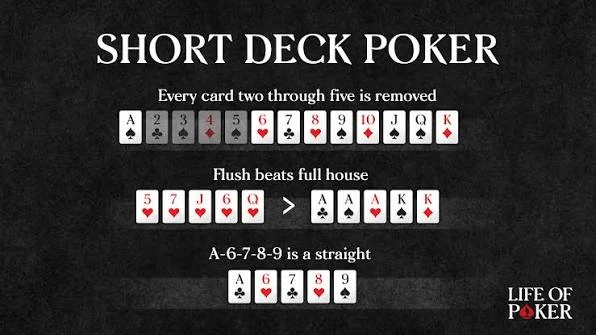
Short Deck is a version of No-Limit Texas Hold’em played with a smaller deck. You take a normal 52-card deck and remove all the 2s, 3s, 4s and 5s. That leaves 36 cards, from 6 up to Ace in each suit.
Everything else works the way Hold’em players already know:
- Each player gets two private cards.
- Five shared cards come out: the flop (three cards), the turn (one) and the river (one).
- You make your best five-card hand from your two cards and the five shared cards.
- There are betting rounds before the flop and after each new street.
The game first appeared in high-stakes games in Macau around 2014. It then spread worldwide through the Triton Super High Roller Series, which has featured a Short Deck Main Event at every stop since 2019. (Triton also hosts some of the biggest buy-in tournaments ever played.)
Short Deck vs Texas Hold’em at a glance
| Texas Hold’em | Short Deck (6+) Hold’em | |
| Cards in the deck | 52 | 36 (6 to Ace) |
| Lowest straight | A-2-3-4-5 | A-6-7-8-9 |
| Flush vs full house | Full house wins | Flush wins |
| Usual betting structure | Small and big blinds | Antes, with a “button ante” |
| Chance of a pocket pair | About 5.9% | About 8.6% |
| Chance of being dealt aces | About 1 in 221 | About 1 in 105 |
| Overall feel | Patient, lots of folding | Fast, big hands, lots of action |
Short Deck Hand Rankings
Here are the standard Short Deck hand rankings, from best to worst:
- Royal flush – A-K-Q-J-10, all the same suit
- Straight flush – five cards in a row, same suit (for example 6-7-8-9-10 of hearts)
- Four of a kind – four cards of the same rank
- Flush – any five cards of the same suit ⬆ moves up
- Full house – three of a kind plus a pair ⬇ moves down
- Straight – five cards in a row, any suits
- Three of a kind
- Two pair
- One pair
- High card
Two other rules matter:
- The ace plays low in A-6-7-8-9. With no 2s to 5s in the deck, the ace “jumps” down to connect with the 6. This is the lowest possible straight, sometimes called the Short Deck wheel.
- Straight vs three of a kind depends on the game. In most games today, including Triton events and the big online sites, a straight beats three of a kind, just like in Hold’em. Some home games and older rule sets flip this so that trips beat a straight. Always check before your first hand.
Why Does a Flush Beat a Full House in Short Deck?
In poker, the rarer a hand is, the higher it ranks. That’s the only rule behind the whole ranking system. In a normal 52-card deck, a full house is harder to make than a flush, so it ranks higher. Short Deck flips that.
The suit problem
Think about how many cards of each suit there are:
- In a normal deck, there are 13 cards of each suit.
- In Short Deck, there are only 9 cards of each suit.
Removing the low cards takes away almost a third of every suit. Flushes need five cards of one suit, so they suddenly become much harder to make.
The pair problem
Now think about full houses. You still have four cards of every rank, but there are only nine ranks instead of thirteen. With fewer ranks to go around, cards pair up much more often. More pairs mean more three of a kinds, and more full houses.
The numbers
We counted every possible five-card hand in a 36-card deck. There are 376,992 of them. Here’s how often each hand shows up:
| Hand | Number of five-card combinations | How often (approx.) |
| Straight flush (incl. royal) | 24 | 1 in 15,708 |
| Four of a kind | 288 | 1 in 1,309 |
| Flush | 480 | 1 in 785 |
| Full house | 1,728 | 1 in 218 |
| Straight | 6,120 | 1 in 62 |
| Three of a kind | 16,128 | 1 in 23 |
| Two pair | 36,288 | 1 in 10 |
| One pair | 193,536 | About 51% |
| High card | 122,400 | About 32% |
Source: PokerClubGames calculation of all five-card hands from a 36-card deck.
There it is. A flush (480 ways) is more than three and a half times rarer than a full house (1,728 ways). Because it’s rarer, it ranks higher. Compare that with a normal 52-card deck, where there are 5,108 flushes and only 3,744 full houses. The deck change completely reverses the order.
How Betting Works: The Button Ante
Short Deck can be played with normal blinds, but the most popular format is ante-only. If you’ve played Caribbean Stud or other ante games in our free poker games section, the idea will feel familiar, but here you’re playing against other players, not the dealer. Here’s how it works:
- Every player posts an ante before the cards are dealt.
- The player on the button posts a bigger ante, usually double. This is called the button ante or button blind.
- There are no small or big blinds.
- Action starts with the player to the left of the button. They can fold, call (by matching the button ante) or raise.
- After the flop, play continues just like normal Hold’em.
Why do antes matter so much? Because there’s dead money in every pot before anyone acts. That means it’s worth fighting for more pots, and you’ll see far more players stay in to see a flop than in a typical Hold’em game.
Short Deck Odds: What Changes From Hold’em
Fewer cards change the odds of almost everything. These are the numbers that matter most at the table:
| Situation | Texas Hold’em | Short Deck |
| Flopping a set with a pocket pair | About 11.8% | About 17.1% |
| Hitting a flush draw by the river (from the flop) | About 35% | About 30% |
| Hitting an open-ended straight draw by the river | About 31.5% | About 45.6% |
| Being dealt a pocket pair | About 5.9% | About 8.6% |
Source: PokerClubGames calculations. Draw odds assume you see both the turn and river.
Two big lessons jump out:
- Flush draws are weaker. With only 9 cards in a suit, a four-card flush draw has just 5 outs instead of 9. It’s still a good hand, but it’s no longer the monster it is in Hold’em.
- Straight draws are much stronger. An open-ended straight draw still has 8 outs, but in a much smaller deck. It hits almost half the time by the river. That’s why connected cards like 9-10 or J-Q are so valuable in Short Deck.
Short Deck Strategy Tips for Beginners
If you play Short Deck like regular Hold’em, you’ll lose chips fast. Here are the key adjustments:
1. Play more hands before the flop
Because of the antes and the smaller deck, hands run closer together. Hands you’d fold in Hold’em, like suited connectors or small pairs, become playable. Even A-6 suited has value, since it can make the A-6-7-8-9 straight as well as high straights. Because more hands are in play, the swings are bigger too, so it’s worth checking your stakes with our poker bankroll calculator.
2. Value straight draws over flush draws
Open-ended straight draws and double gutshots are some of the best drawing hands in the game. Flush draws still have value, but don’t overpay to chase them.
3. Don’t fall in love with one pair
Two pair and better show up much more often, a bit like in Pot-Limit Omaha, where big hands are also common. A hand like top pair, top kicker is often only a middle-strength hand by the river, especially in a multi-way pot.
4. Watch out for “the nuts” changing
With fewer cards, the best possible hand changes quickly from street to street. Always ask yourself, “What’s the best hand right now, and can my opponent have it?”
5. Remember the ranking flip
It sounds obvious, but it’s the most common mistake. If three cards of one suit are on the board, a flush beats your full house. Don’t pay off big bets with a full house when a flush is likely.
6. Practise before you play for real
Short Deck feels very different for the first few hundred hands. The fastest way to learn is to play free first. Our free Short Deck game includes hints and an equity overlay, so you can see how often your hand wins as you play.
Short Deck in 2026: Where the Big Games Are
Short Deck is still a regular part of the high-stakes calendar. At Triton Jeju in March 2026, the series ran several Short Deck events:
| Event | Entries | Prize pool | Winner | 1st prize |
| $25,000 Short Deck Ante-Only | – | – | Rene van Krevelen | – |
| $50,000 Short Deck | 60 | $3,000,000 | Kiat Lee | $840,000 |
| $100,000 Short Deck | 46 | $4,600,000 | Daniel Dvoress | $1,380,000 |
The $100,000 event was a headline moment. Daniel Dvoress beat Jason Koon heads-up, stopping Koon from winning a record-extending 13th Triton title. In the $50,000 event, Malaysia’s Kiat Lee beat Triton founding player Paul Phua heads-up.
Triton’s recent results show how strong the fields are. You can read our reports on Christopher Nguyen’s $100K Main Event win and Paulius Plausinaitis’s $200K Invitational win at Triton North Cyprus 2026.
You don’t need a six-figure buy-in to play, though. Short Deck tables also run on major online sites, and it’s a great game for home poker nights with friends when only four to six people turn up.
Final Thoughts
Short Deck takes everything you know about Hold’em and gives it a shake. Removing just 16 cards makes flushes rarer than full houses, turns straight draws into powerhouses and pushes far more players into every pot. That’s exactly why so many players, from Triton high rollers to casual home games, love it.
The good news is that the rules are easy to learn. Remember the 36-card deck, the A-6-7-8-9 straight and the flush-over-full-house flip, and check whether trips or straights rank higher before you sit down. Then play a few hundred hands free to get a feel for the new odds. You’ll pick it up faster than you think. Once you’re comfortable, try other twists on Hold’em like Pineapple and Irish Poker, or browse all our Hold’em and Omaha variants.
FAQs
Why does a flush beat a full house in Short Deck?
Because a flush is rarer. Removing the 2s to 5s leaves only nine cards in each suit, so flushes become hard to make. In a 36-card deck there are 480 possible five-card flushes but 1,728 full houses, and in poker the rarer hand always ranks higher.
What cards are removed in Short Deck poker?
All the 2s, 3s, 4s and 5s are removed, leaving a 36-card deck from 6 to Ace.
Does a straight beat three of a kind in Short Deck?
In most games today, including Triton events and major online sites, yes. Some home games and older rule sets rank three of a kind above a straight, so check the house rules before you play.
What is the lowest straight in Short Deck?
A-6-7-8-9. The ace plays low and connects with the 6, because the 2 to 5 are not in the deck.
Disclosure: PokerClubGames may earn a commission when you use links to poker operators. This never changes the price you pay. 18+ (21+ where required). Gambling involves risk. How we make money