
6-Max Poker Strategy: Short-Handed Adjustments That Win
On this page
If you learned poker at a full-ring table, your first few sessions of 6-max can feel strange. Hands you’d happily fold at nine-handed suddenly look playable. Opponents raise more often. The blinds seem to come around every couple of minutes. And if you stick to the same tight strategy that worked before, you’ll slowly lose money without quite knowing why.
6-max is now the default format for online cash games on almost every major site, and it’s become common in live tournaments too. So learning to play short-handed well isn’t optional anymore. This guide explains what changes when you remove three players from the table, and the specific adjustments that turn a full-ring player into a winning 6-max player.
Why 6-Max Is a Different Game
The biggest change is simple maths. In a nine-handed game, you pay the blinds (1.5 big blinds) once every nine hands. In a six-handed game, you pay them once every six.
| Format | Hands per orbit | Blinds per orbit | Cost per 100 hands if you never play |
| Full ring (9-handed) | 9 | 1.5 bb | ~16.7 bb |
| 6-max | 6 | 1.5 bb | 25 bb |
That’s a 50% increase in how much it costs you to sit and wait. If you fold everything except premium hands in 6-max, the blinds will eat you alive. You have to play more hands just to break even on the blinds.
Three other things change at the same time:
- Hand strength goes up. With fewer opponents, the chance that someone has a big hand drops. A hand like ace-ten is often the best hand at a six-handed table, while at nine-handed it’s frequently dominated.
- Position matters more. A bigger share of the hands you play will be in position or out of position against just one player. Being on the button or in the cutoff becomes a huge advantage.
- Aggression wins more pots. With fewer people left to act, raises and bets fold everyone out more often. The player who takes the initiative takes down a lot of pots without a showdown.
Know the Six Seats
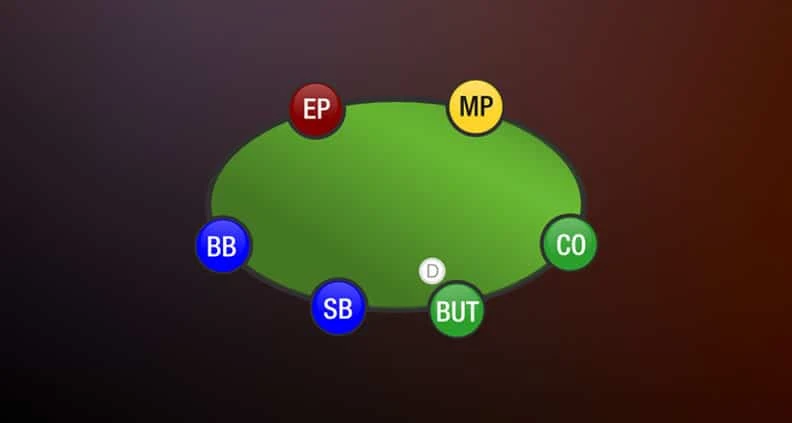
At a 6-max table, the positions are:
- UTG (Under the Gun): first to act preflop. It’s like the middle position at a full-ring table.
- HJ (Hijack): second to act.
- CO (Cutoff): one seat before the button.
- BTN (Button): the best seat at the table. You act last on every postflop street.
- SB (Small Blind): the worst seat. You’ve put money in, but you’ll be out of position against everyone.
- BB (Big Blind): you’ve already paid a full bet, so you get a good price to defend.
Notice that there’s no “early position” at a 6-max table in the full-ring sense. Even UTG at six-handed is only facing five players, which is why your opening ranges get wider across the board.
Opening Ranges by Position
Here’s a practical starting point for raising first in (when everyone before you has folded). These are approximate percentages of all starting hands for a standard 100-big-blind cash game:
| Position | Open-raise about | Example of the weakest hands you might open |
| UTG | 15–18% | 55+, A9s+, ATo+, KTs+, KQo, QTs+, JTs, T9s |
| HJ | 19–23% | 33+, A5s+, A9o+, K9s+, KJo+, Q9s+, J9s+, 98s |
| CO | 26–30% | 22+, A2s+, A8o+, K7s+, KTo+, Q9s+, QJo, 87s, 76s |
| BTN | 40–50% | Any pair, any suited ace, most suited kings, K8o+, Q9o+, J9o+, most suited connectors |
| SB | 35–45% (raise or fold) | Similar to the button, slightly tighter |
Don’t treat these as rules carved in stone. They’re a baseline. Tighten up if the players behind you are very aggressive and three-bet a lot. Open wider if the blinds fold too often.
Two practical points:
- From the small blind, prefer raising to limping. Limping lets the big blind see a cheap flop in position. Most winning players either raise or fold from the small blind when it folds to them.
- Open to a sensible size. Around 2.5 big blinds is standard online. From the small blind, 3 big blinds is common. Live games often play bigger, so adjust to what works at your table.
Three-Betting: Your Most Important Weapon
In full ring, many players only three-bet with very strong hands like queens, kings, aces and ace-king. In 6-max that approach is too predictable. Good opponents will simply fold to your three-bets unless they have a monster, and you’ll never get paid.
A better approach is a mix of value hands and bluffs:
- Value three-bets: hands that are ahead of your opponent’s opening range and happy to get more money in, like QQ+, AK, and sometimes JJ, TT and AQ against wide openers.
- Bluff three-bets: hands that play well if called but don’t mind folding to a four-bet. Suited aces like A5s and A4s are the classic choice. They block your opponent’s best hands (because you hold an ace) and can make straights and flushes.
As a rough guide, you should three-bet more often against openers in late position (who have wide ranges) than against UTG openers (who are stronger).
Sizing matters too. Three-bet to about 3 times the open when you’re in position, and around 3.5 to 4 times when you’re out of position (from the blinds). The bigger size out of position makes it harder for your opponent to call and use their positional advantage.
Defending the Blinds
At a 6-max table, you’ll often face a button or cutoff raise when you’re in the big blind. Folding too much here is one of the most common leaks for players moving over from full ring.
Think about the price. If the button opens to 2.5 big blinds and the small blind folds, you need to call 1.5 big blinds to win a pot of 4 big blinds. That means you only need to win the pot about 27% of the time (1.5 ÷ 5.5) to make a profitable call, before even counting your future betting options.
That’s why you should defend your big blind with a wide range against late-position opens: most suited hands, most pairs, connected cards and plenty of offsuit broadway hands. Against an early-position open, defend more tightly, because their range is stronger.
The small blind is different. You’re out of position and the big blind is still behind you, so calling is often a mistake. From the small blind, three-bet or fold most of the time.
Postflop Play: Pressure and Position
C-betting
A continuation bet (c-bet) is a bet on the flop by the player who raised preflop. In 6-max, you’ll often c-bet with a wide range, but not automatically.
- C-bet more often on dry, high-card boards that suit your raising range, like K-7-2 rainbow. Your opponent rarely has a strong hand, and a small bet (around one-third of the pot) can win a lot of pots.
- C-bet less often on low, connected boards like 8-7-6 with two suits, especially against the big blind. These boards hit the caller’s range much more than yours.
Play more pots in position
You’ll make most of your money in 6-max from the button and the cutoff. Being in position lets you see what your opponent does before you decide, control the size of the pot, and bluff more effectively. When you’re unsure whether to play a marginal hand, position should often decide it.
Don’t fall in love with one pair
Yes, hand values go up in 6-max. But that doesn’t mean top pair is always good. When a tight player raises the turn or makes a big river bet, one pair is often beaten. The key is to value bet hands like top pair, good kicker against weaker players who call too much, and to slow down against strong, aggressive regulars. Our stack-to-pot ratio guide explains how stack size affects how much you should commit with one pair.
Using Stats to Spot Problems
If you play online with a tracking tool, these stats give you a quick health check. These are approximate ranges for a solid winning 6-max regular, not strict targets:
| Stat | What it measures | Typical winning range |
| VPIP | How often you put money in preflop | 22–28% |
| PFR | How often you raise preflop | 18–23% |
| 3-Bet | How often you three-bet when you can | 7–10% |
| Fold to 3-Bet | How often you fold after opening and getting three-bet | 40–55% |
| BB defence vs BTN | How often you defend the big blind against a button open | 55–70% |
If your VPIP is 15% and your PFR is 12%, you’re playing a full-ring style at a six-handed table, and the blinds are probably costing you money. If your VPIP is much higher than your PFR (for example 35% and 15%), you’re calling too often instead of raising.
Common Mistakes When Moving from Full Ring to 6-Max
1. Playing too tight. The blinds cost 50% more per hand in 6-max. Folding 85% of hands is a slow way to lose.
2. Calling instead of three-betting. Flat-calling a lot preflop, especially out of position, leads to tough spots after the flop. In 6-max, the player who raises usually wins more.
3. Limping from the small blind. It gives the big blind a free look in position. Raise or fold.
4. Overvaluing weak aces out of position. A hand like A7 offsuit from UTG often loses to better aces. It plays much better from the button.
5. Tilting against aggressive players. 6-max regulars will three-bet and barrel you often. Don’t take it personally, and don’t call down out of frustration. Adjust: four-bet a little lighter against them, and call down more often with your good hands.
6-Max in Tournaments
Many online and live tournaments now use six- or seven-handed tables. The same principles apply, with one difference: stacks get shorter as blinds go up.
With 20 to 40 big blinds, you’ll lose the option to call and play postflop with many hands. Raising first in and re-shoving all in over late-position opens become your main tools. The short-handed format also means blinds pass quickly, so you can’t afford to wait for premium hands for long.
If you play fast-fold cash games such as Zoom or Rush & Cash, those are also usually 6-max. They play a little tighter than regular tables because players can fold and move to a new hand instantly. See our fast-fold poker strategy guide for the adjustments.
A Simple 6-Max Game Plan
If you want to put all this into practice at your next session, start here:
- Open more from the cutoff and the button. Aim for roughly a quarter of hands from the cutoff and close to half from the button.
- Raise or fold from the small blind. Stop limping.
- Defend your big blind more against late-position openers.
- Add a few bluff three-bets with suited aces and suited broadway hands.
- Use small c-bets on dry boards and check more on boards that favour the caller.
- Review your VPIP and PFR after a few thousand hands, and fix the biggest gap first.
Final Thoughts
6-max poker rewards the player who’s willing to take the initiative. You’ll play more hands, see more marginal spots and face more aggression than in full ring. That can feel uncomfortable at first. But once you understand why the blinds force you to open up, and why position and aggression matter so much, the game becomes far more profitable and a lot more fun.
Start with the baseline ranges above, watch your stats, and adjust to the players at your table. That’s how short-handed winners are made.
FAQs
What is 6-max poker?
6-max poker is a game where a maximum of six players sit at the table, instead of the nine or ten in full-ring games. It’s the most common format for online cash games and is used in many tournaments.
How many hands should I play in 6-max?
Most winning 6-max cash players voluntarily put money in the pot with around 22–28% of hands, and raise preflop with around 18–23%. You should play the most hands from the button and cutoff, and the fewest from UTG.
Is 6-max harder than full ring?
It’s usually more aggressive and requires more decisions, because you play more hands and face more raises. But it can also be more profitable, since good players can win many pots with position and aggression.
Why do the blinds matter more in 6-max?
You pay the blinds once every six hands instead of once every nine. That makes waiting for premium hands 50% more expensive, about 25 big blinds per 100 hands compared with around 16.7 at a full-ring table.
Should I limp in 6-max poker?
In most cases, no. Raising first in gives you the chance to win the pot immediately and the initiative after the flop. From the small blind in particular, a raise-or-fold strategy is usually better than limping.
Disclosure: PokerClubGames may earn a commission when you use links to poker operators. This never changes the price you pay. 18+ (21+ where required). Gambling involves risk. How we make money