
Last Updated on July 10, 2026 by Bala Kumar
Ask ten poker players to rank hands from memory under pressure, and you’ll be surprised how many hesitate on at least one matchup. Does a flush beat a straight? Is three of a kind stronger than two pairs? These aren’t trick questions, but they’re exactly the kind of split-second doubts that cost real chips at the table.
If you’ve ever second-guessed yourself mid-hand, you’re not alone. This guide breaks down the complete, official poker hand rankings from highest to lowest, clears up the matchups people get wrong most often, and gives you a simple way to lock the order into memory for good.
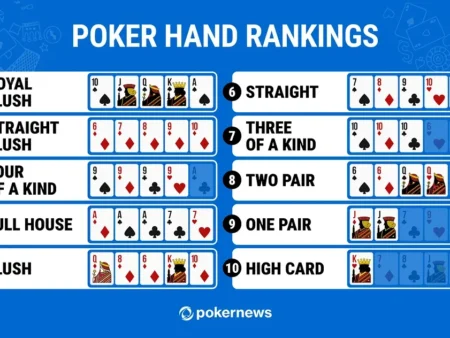
The Complete Poker Hand Ranking Chart
Here’s the full poker hands order, from strongest to weakest, used in standard games like Texas Hold’em and Omaha:
| Rank | Hand | Example |
| 1 | Royal Flush | A♠ K♠ Q♠ J♠ 10♠ |
| 2 | Straight Flush | 9♥ 8♥ 7♥ 6♥ 5♥ |
| 3 | Four of a Kind | 8♣ 8♦ 8♥ 8♠ 2♣ |
| 4 | Full House | K♦ K♣ K♥ 4♠ 4♦ |
| 5 | Flush | A♣ J♣ 8♣ 6♣ 3♣ |
| 6 | Straight | 10♦ 9♣ 8♠ 7♥ 6♦ |
| 7 | Three of a Kind | 7♠ 7♥ 7♦ K♣ 2♠ |
| 8 | Two Pair | Q♠ Q♦ 5♣ 5♥ 9♦ |
| 9 | One Pair | J♣ J♦ 9♠ 6♥ 3♦ |
| 10 | High Card | A♦ Q♣ 8♠ 5♥ 2♣ |
This ranking system is the backbone of poker hand rankings explained in nearly every major variant of the game, and it’s the first thing any serious beginner poker guide should cover before diving into strategy.
The Hand Rankings People Get Wrong Most Often
Most mistakes don’t happen at the extremes — nobody confuses a high card with a royal flush. The confusion lives in the middle of the chart, where hands look deceptively close in strength.
Flush vs. Straight
This is the single most common mix-up in the game. A flush beats a straight every time — no exceptions in standard hand rankings. It’s an easy one to blank on mid-hand simply because both hands “feel” similarly strong when you’re holding them.
Full House vs. Flush
A full house is stronger than a flush, even though a flush requires five cards of a single suit and can feel more visually striking. The full house’s combination of three-of-a-kind plus a pair makes it statistically rarer — and rarity is exactly what hand rankings are built around.
Three of a Kind vs. Two Pair
Newer players sometimes assume two pairs are stronger simply because it “uses more pairs.” In reality, three of a kind beats two pairs, since matching three cards is harder to hit than matching two separate pairs.
Straight vs. Three of a Kind
A straight beats three of a kind. This one trips up beginners because three of a kind feels more powerful on the surface, but five sequential cards are statistically less likely to land than three matching ones.
Understanding these specific matchups is often what separates a solid beginner poker guide from a truly useful one, since these are the exact spots where real money is lost at low-stakes tables.
Why Hand Rankings Are Based on Odds, Not “Feel”
Every hand’s position on the chart comes down to one thing: probability. The rarer a hand is to make, the higher it ranks. This is also why so many best poker strategies for beginners start with memorizing rankings before anything else, you can’t make a good decision about betting, calling, or folding if you’re not instantly certain whether your hand is actually good.
Here’s a quick look at how rare some of these hands really are, based on a standard 52-card deck and 5-card hand combinations:
- Royal Flush: roughly 1 in 649,740 hands
- Straight Flush: roughly 1 in 72,193 hands
- Four of a Kind: roughly 1 in 4,165 hands
- Full House: roughly 1 in 694 hands
- Flush: roughly 1 in 509 hands
- Straight: roughly 1 in 255 hands
- Three of a Kind: roughly 1 in 47 hands
- Two Pair: roughly 1 in 21 hands
- One Pair: roughly 1 in 2.4 hands
Seeing the numbers laid out like this makes it obvious why a flush outranks a straight, or why a full house edges out a flush, the math simply doesn’t lie, even when a hand “feels” strong in the moment.
Poker Hand Rankings in Different Games
While the core order stays consistent across most games, it’s worth knowing that poker hand rankings for different games can shift slightly depending on the variant:
- Texas Hold’em & Omaha: use the standard ranking chart above
- Short Deck (6+ Hold’em): removes cards 2 through 5, which flips the flush and full house rankings, a full house beats a flush in this format
- Lowball variants (like Razz): invert the entire chart, rewarding the lowest hand instead of the highest
- High-Low split games (like Omaha Hi-Lo): award half the pot to the best high hand and half to the best qualifying low hand
If you’re moving between game types, double-checking the specific ranking rules before you sit down can save you from a costly assumption.
How to Actually Memorize the Order
Reading the chart once won’t make it stick. A few methods that actually work:
- Group hands by pattern, pairs-based hands (one pair, two pair, three of a kind, full house, four of a kind) versus sequence/suit-based hands (straight, flush, straight flush, royal flush)
- Use the rarity logic, instead of memorizing “flush beats straight,” remember that flushes are statistically harder to make than straights
- Practice with a poker hand rankings chart open during low-stakes or play-money games until the order becomes automatic
- Quiz yourself on the tricky matchups specifically, flush vs. straight, full house vs. flush, three of a kind vs. two pair, since those are the ones that actually get misplayed
Final Thoughts
Poker hand rankings aren’t just trivia, they’re the foundation every other decision at the table is built on. You can study bluffing patterns, position play, and bankroll management all you want, but if you’re not instantly certain whether your hand is actually the best one, none of that strategy matters.
Whether you’re brand new to the game or just want a refresher, bookmarking a clear poker hand rankings chart and running through the tricky matchups above is one of the simplest ways to immediately play smarter, no matter which table, app, or online poker room you sit down at next.
FAQs
1. What is the highest-ranking hand in poker?
The highest-ranking hand in standard poker is a Royal Flush, consisting of A, K, Q, J, and 10 of the same suit. It is the rarest and strongest possible hand.
2. Does a flush beat a straight in poker?
Yes. In standard poker games like Texas Hold’em and Omaha, a Flush always beats a Straight because it is statistically more difficult to make.
3. What is the correct order of poker hand rankings?
From highest to lowest, the order is: Royal Flush, Straight Flush, Four of a Kind, Full House, Flush, Straight, Three of a Kind, Two Pair, One Pair, and High Card.
4. Are poker hand rankings the same in every poker variant?
No. While Texas Hold’em and Omaha use the standard rankings, variants like Short Deck Hold’em, Razz, and Omaha Hi-Lo have different hand-ranking rules, so it’s important to check the format before playing.
5. What’s the easiest way to memorize poker hand rankings?
The best way is to study a poker hand ranking chart, group similar hands together, understand that rarer hands rank higher, and practice with low-stakes or free-play games until the order becomes second nature.
Founder of PokerClubGames.com and a Poker Researcher with 10+ years of experience in SEO, WordPress development, and gaming content strategy. Specializes in researching online poker sites, poker apps, tournaments, bonuses, and poker strategies. Experienced in poker platform reviews, affiliate marketing, and creating SEO-focused poker content for global audiences.
For collaborations, media inquiries, or poker-related partnerships:
Contact: Info@hugecount.com