

Poker Equity Tools: How to Run Hand-vs-Hand & Hand-vs-Range
On this page
Every poker player has had a hand that kept them up at night. You called off your stack with ace-king, lost to a smaller pair, and kept asking yourself whether the call was right or you just got unlucky. A poker equity tool answers that question in seconds. It won’t make you a winning player by itself. But it shows you how hands really perform against each other, and once you understand that, your decisions at the table get much better.
This guide explains what equity is and which poker equity tools are worth using in 2026. Then it walks you step by step through the two calculations that matter most: hand vs hand and hand vs range. All the equity numbers in this article were calculated by the PokerClubGames team for this guide. Hand-vs-hand and flop spots were enumerated exactly. Preflop hand-vs-range spots used a 400,000-trial simulation, accurate to within about ±0.2%.
What Is Poker Equity?
Equity is your share of the pot based on how often you would win if all the cards were dealt out with no more betting. If you have 60% equity in a $100 pot, your “fair share” is $60 over the long run.
Two things matter here:
- Equity is not the same as winning. A hand with 80% equity still loses one time in five.
- Equity assumes the hand goes to showdown. In real games, players fold, bluff and get bluffed, so the equity a hand actually “realises” can be higher or lower than the raw number.
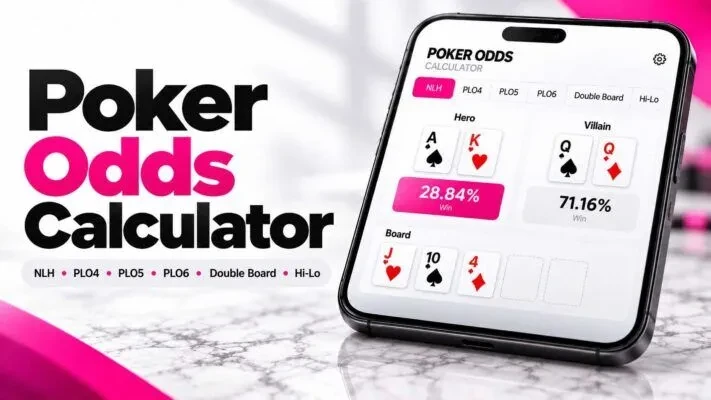
An equity tool in poker does the math that would take you hours by hand. It runs through every possible board, or a huge random sample of them, and tells you how often each hand wins, loses or ties.
The Best Poker Equity Tools in 2026
You don’t need to spend money to get started. These are the tools most players actually use right now:
| Tool | Platform | Cost | Best for |
| PokerStrategy Equilab | Windows desktop | Free | Most players: hand vs range, range builder, equity trainer |
| Power-Equilab | Windows desktop | Paid (14-day free trial) | Equity graphs, hand-history import, equity realisation |
| Equilab Omaha | Windows desktop | Free | PLO hand and range equity |
| PokerStove | Desktop | Free | Simple, classic hand and range calculations |
| Flopzilla / Flopzilla Pro | Windows desktop | Paid, one-time licence | How ranges hit flops, plus hand-reading practice |
| Poker Academy Equity Calculator | Browser | Free, no sign-up | Quick checks on Mac, phone or any device, up to 9 players |
| GTO Wizard | Browser / app | Freemium subscription | Range-vs-range equity alongside solver strategy |
My recommendation: if you’re on Windows, start with Equilab. It’s free, it’s been the standard study tool for years, and it handles hand vs range with a clickable range grid. If you’re on Mac or mobile, a free browser calculator like Poker Academy’s does the same core job without installing anything. Pay for something like Flopzilla Pro or a solver only once you know which questions you’re trying to answer.
A note on fair play: use these tools for study away from the table. Most online poker sites ban real-time assistance software, and running an equity calculator during a live online hand can get your account closed.
How to Run a Hand-vs-Hand Calculation
Hand vs hand is the simplest calculation and the best place to start. It answers questions like “how big a favourite is AA over KK?”
Step by step (Equilab and most calculators work the same way):
- Enter Player 1’s hand. Click the card slots or type the hand, for example As Ah.
- Enter Player 2’s hand. For example Kc Kd. Use exact suits, because suits change the result.
- Leave the board empty for a preflop all-in, or add the flop, turn or river cards.
- Click Evaluate. With only two hands, a good tool enumerates every possible board, so the answer is exact.
- Read the output. Most tools show Equity, Win % and Tie %. Equity counts half of each tie as yours.
Real Preflop Hand-vs-Hand Numbers
| Matchup | Equity of first hand | Tie % | What it teaches |
| A♠A♥ vs K♣K♦ | 81.3% | 0.4% | Even the biggest favourite loses about 1 in 5 |
| A♠K♠ vs Q♥Q♦ | 46.2% | 0.4% | The classic “coin flip” isn’t quite 50/50 |
| A♠K♦ vs 2♥2♣ | 47.0% | 0.6% | Any pair is a slight favourite over two overcards |
| 8♠8♦ vs A♥K♣ | 55.6% | 0.3% | Middle pairs are a 55/45 favourite, not a lock |
| A♠K♦ vs J♥T♥ | 58.8% | 0.4% | Suited connectors keep real equity against big cards |
| A♠K♠ vs A♦Q♣ | 75.6% | 4.4% | Domination: you share the ace, so you’re drawing to three queens |
The last row is the one beginners underestimate. A hand that is “dominated” by a better hand with the same high card sits around 25% equity. That’s barely better than drawing to a flush.
Postflop Hand-vs-Hand Examples
Add the board and things change fast:
| Hand | vs | Board | Equity |
| J♥T♥ (open-ended straight + flush draw) | A♠K♦ | 9♥ 8♣ 2♥ | 69.7% |
| A♥K♦ (top pair, top kicker) | Q♠Q♣ | K♣ 7♠ 2♦ | 91.2% |
| A♥Q♥ (nut flush draw + overcard) | 9♠9♦ | K♥ 7♥ 2♣ | 55.1% |
| Same A♥Q♥ after a blank turn | 9♠9♦ | K♥ 7♥ 2♣ 4♠ | 34.1% |
Notice how much equity a draw loses when the turn bricks. On the flop, the nut flush draw is actually the favourite over a pair. One blank card later, it’s down to about a third of the pot. That turn number is the one you compare against your pot odds.
Quick pot-odds check: your opponent bets $50 into a $100 pot on that turn. You must call $50 to win $200 in total, so you need 25% equity to break even. With 34.1%, calling is profitable on raw equity alone. Facing a pot-sized bet you would need 33.3%, so it becomes very close.
How to Run a Hand-vs-Range Calculation
Here’s the honest truth: hand vs hand is mostly a learning exercise, because at the table you almost never know your opponent’s exact cards. What you can estimate is their range, meaning all the hands they would play the same way. Hand vs range is where an equity tool becomes a real study tool.
Step by step:
- Enter your exact hand in Player 1, for example Ah Kd.
- Open the range editor for Player 2. In Equilab, click the small button next to the hand box to open the 13×13 grid.
- Build the range. Either click hands on the grid or type range notation (see below). You can also use the percentage slider for a quick “top X%” range, but a range you build yourself for a real opponent is always better.
- Add the board if you’re studying a postflop spot.
- Evaluate. Small ranges and postflop spots run exactly. Large preflop ranges usually run as a Monte Carlo simulation, which finishes in seconds.
- Check the combos count. Card removal matters. Holding an ace means your opponent has fewer AA and AK combos, and the tool accounts for that automatically.
Range Notation in 30 Seconds
- QQ+ = QQ, KK, AA
- AKs = ace-king suited (4 combos). AKo = ace-king offsuit (12 combos)
- ATo+ = ATo, AJo, AQo, AKo
- 22+ = every pocket pair (78 combos)
- A2s+ = every suited ace
Real Hand-vs-Range Numbers
| Your hand | Opponent’s range | Range size | Your equity |
| A♥Q♦ | QQ+, AK (tight 3-bet) | 24 combos | 24.3% |
| 9♠9♦ | QQ+, AK | 34 combos | 35.7% |
| 9♠9♦ | TT+, AQs+, AKo, A5s, A4s (3-bet with some bluffs) | 58 combos | 37.6% |
| A♥K♦ | ~17% open: 22+, A2s+, KTs+, QTs+, JTs, ATo+, KJo+ | 180 combos | 58.5% |
| 7♠6♠ | Same ~17% open | 214 combos | 37.3% |
| J♥J♦ | ~22% shove: 22+, A2s+, K9s+, Q9s+, J9s+, T9s, A9o+, KTo+, QJo | 241 combos | 65.6% |
| A♠5♠ | Same ~22% shove | 241 combos | 44.5% |
Range sizes are the combos remaining after removing the cards in your hand.
What these numbers tell you:
- AQo against a tight 3-bet range is in bad shape. At 24%, it’s worse than many draws. If your opponent only 3-bets QQ+ and AK, folding AQ isn’t weak. It’s correct.
- Bluffs in the range matter, but less than you’d think. Adding A5s and A4s plus a few more value hands moved 99 from 35.7% to 37.6%. Better, but still not enough to call off a big 4-bet profitably.
- JJ against a wide shove is a clear call. About 66% equity against a ~22% range. A5s, a hand many players happily shove, only has 44.5% against the same range, which shows why calling ranges should be tighter than shoving ranges.
Same Hand, Different Answer: Why Ranges Matter
Look at A♥K♦ on a K♣ 7♠ 2♦ flop:
- Against exactly Q♠Q♣: 91.2%
- Against the range QQ+, AK: 54.4%
Same hand, same board. The only difference is honesty about what your opponent can have. Against that range, your top pair is crushing QQ but losing to the sets (KK, AA) and splitting with AK. That 54% is the real number, and it’s why experienced players think in ranges, not single hands.
Common Mistakes When Using an Equity Tool
- Giving your opponent a range that’s too wide or too narrow. The output is only as good as your input. If you put villain on a range they would never play, you’ll get a precise answer to the wrong question.
- Ignoring position and playability. 76s and AKo can have similar raw equity in some spots, but they play very differently after the flop. Equity is a starting point, not the final verdict.
- Forgetting realised equity. A hand out of position with a weak draw rarely gets to see all five cards cheaply. Tools like Power-Equilab let you apply equity realisation factors for this reason.
- Not checking suits. A♠K♠ vs Q♠Q♥ is a different calculation from A♠K♠ vs Q♥Q♦, because a shared suit reduces your flush outs.
- Studying results instead of decisions. Use the tool to decide whether a call was correct, not whether it won.
A Simple Weekly Study Routine
- Pick three hands from your last session where you were unsure.
- Write down the opponent’s range before opening the tool. This trains your hand reading.
- Run hand vs range on the street where the big decision happened.
- Compare the equity with your pot odds. Was the call or fold correct?
- Adjust one assumption. Tighten or widen the range and see how sensitive the answer is.
Fifteen minutes a week of this is worth more than hours of watching other people’s videos.
Final Verdict
A poker equity tool is the cheapest real edge in poker study. Most of the best ones are free, and the skill they build, which is estimating a range and knowing your equity against it, is useful in every format from home games to big tournaments. Start with hand vs hand to learn the key numbers, then move to hand vs range as quickly as you can. That’s where your study starts to pay off at the table.
Disclosure: PokerClubGames may earn a commission when you use links to poker operators. This never changes the price you pay. 18+ (21+ where required). Gambling involves risk. How we make money