

US Midterm Elections 2026: Gambling Expansion Rejected in 3 States, While Texas Opens a Door
On this page
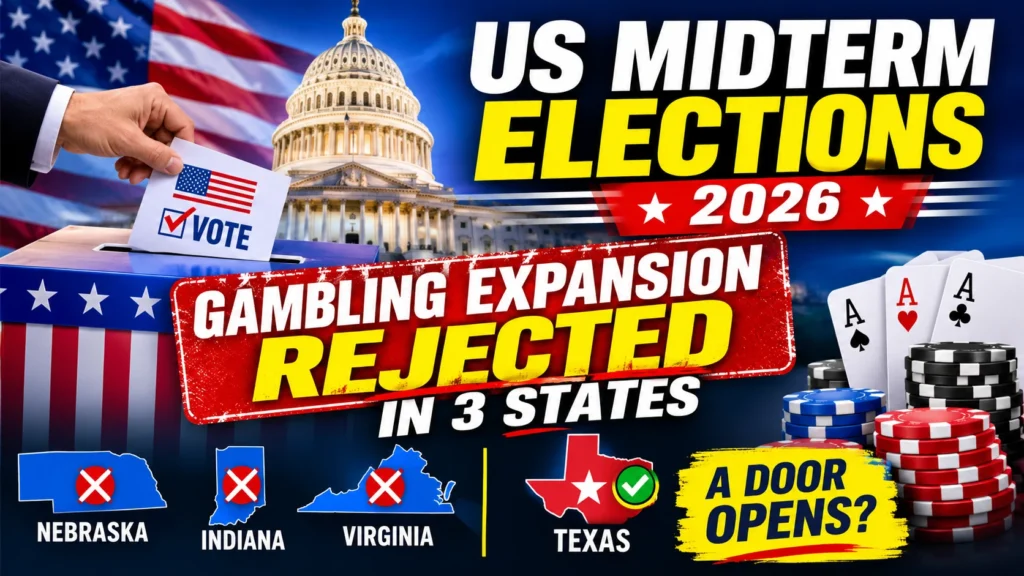
The gambling industry went into Election Day on November 3 with real money on the table and reasonable hopes. It came out with a split result. In Nebraska, Indiana and Virginia, voters turned down every gambling expansion on the ballot. That ran from statewide mobile sports betting down to a single horse-racing slot parlour in a small Virginia town. But in Texas, the biggest US market without legal casinos or sports betting, voters removed the politician who has blocked gambling bills for a decade.
If you follow the gambling ballot measures 2026 results because you care about where poker is heading in the US, this is the full picture: the numbers, why the “no” side won, and an honest look at what the Texas result does and doesn’t change for poker rooms.
Quick Summary
- Nebraska: About 54–55% of voters rejected online sports betting (Initiatives 440 and 441), despite a campaign that spent roughly $22.5 million.
- Indiana: A new inland casino was rejected in all three eligible counties: Allen, DeKalb and Steuben.
- Virginia: Rosie’s Gaming Emporium referendums failed in Amherst County (by 183 votes) and in the town of Pulaski.
- Texas: Democrat Vikki Goodwin beat Lt. Gov. Dan Patrick. She backs a public vote on casinos and sports betting, but no law has changed yet.
- Texas poker rooms: They still run on the same membership and seat-fee model.
2026 Gambling Ballot Results at a Glance
| State / Area | Proposal | Result | Vote Against |
| Nebraska (statewide) | Initiative 440: constitutional amendment for online sports betting | Rejected | ~54.5–55% |
| Nebraska (statewide) | Initiative 441: rules, licensing and tax for mobile sportsbooks | Rejected | ~54–54.5% |
| DeKalb County, IN | Permit inland casino gambling | Rejected | 64.6% (7,374 to 4,043) |
| Allen County, IN | Permit inland casino gambling | Rejected | 59.6% (61,310 to 41,625) |
| Steuben County, IN | Permit inland casino gambling | Rejected | ~58.7% |
| Town of Pulaski, VA | Satellite pari-mutuel wagering (Rosie’s) | Rejected | ~56.5% |
| Amherst County, VA | Satellite pari-mutuel wagering (Rosie’s) | Rejected | 50.7% (7,057 to 6,874) |
All figures are unofficial until each state certifies its results.
Nebraska: $22 Million Couldn’t Buy Mobile Betting
Nebraska was the headline race for the betting industry. Two linked measures had to pass together. Initiative 440 would have changed the state constitution to allow online sports betting. Initiative 441 would have set the rules. Betting apps would have partnered with the state’s licensed racetrack casinos and been regulated by the Nebraska Racing and Gaming Commission. 70% of the tax money would have gone to property tax relief.
Both failed by close to ten points. Unofficial counts on Wednesday had Initiative 440 at about 296,000 yes to 354,000 no. The campaign, run by Tax Relief Nebraska, spent close to $22.5 million, and DraftKings and FanDuel each reportedly put in about $10.4 million. Support was strongest around Omaha, where Douglas and Sarpy counties narrowly voted yes. The rest of the state outvoted them.
The opposition was organised and had a famous face. Former Cornhuskers coach Tom Osborne urged voters to say no, arguing that betting on phones would feed addiction. After the vote, the Nebraska Family Alliance said voters simply didn’t believe a betting app would lower their property taxes.
What it means: Nebraska keeps its current system. Adults 21 and over can bet on sports, but only in person at a racetrack casino. Missouri approved sports betting at the ballot in 2024, but Nebraska shows that big spending and good polling don’t guarantee a win when voters get the final say.
Indiana: A Clean Sweep for “No”
Earlier this year, Indiana lawmakers passed House Enrolled Act 1038, which created one new inland casino licence for northeast Indiana. The catch was that the licence could only go to Allen, DeKalb or Steuben County, and only if local voters approved it first. The winning operator would have needed to spend at least $500 million.
Supporters had a decent economic case. An Indiana Gaming Commission study projected that an Allen County casino could bring in around $204 million in revenue and $61 million in state taxes each year. Fort Wayne’s mayor and local business groups backed it, and Steuben County pitched itself as the ideal spot to draw players from Ohio and Michigan.
None of it worked. DeKalb voted no by almost two to one, and Allen and Steuben both rejected it with close to 60%. The law also adds a hard stop: once a county says no, it can’t hold a second vote on the same question. With no host county left, any future casino in that corner of the state would have to start again at the legislature in Indianapolis.
Poker angle: A new $500 million casino in Fort Wayne would almost certainly have had a poker room. Players in northeast Indiana will keep driving to existing casinos in Indiana, Michigan or Ohio for live games.
Virginia: Rosie’s Turned Away Twice
Virginia’s votes were smaller but tell the same story. Churchill Downs wanted to open Rosie’s Gaming Emporium venues in Amherst County and the town of Pulaski. Rosie’s runs historical horse racing (HHR) machines. They look and play like slots, but the outcome is tied to the results of past horse races. Before that could happen, each locality first had to approve pari-mutuel wagering at satellite facilities.
Pulaski’s town manager supported the plan, partly because the town faces a $25 million water treatment project and the Rosie’s tax money could have helped. Voters still said no, by about 56% to 44%. Under Virginia law, the question can’t return to the Pulaski ballot for three years.
Amherst was a nail-biter. The county had already rejected Rosie’s in 2021, by more than 1,000 votes. This time the proposal lost by just 183 votes, 7,057 to 6,874. Supporters pointed to about $2 million a year in tax revenue and 83 full-time jobs. The local opposition told voters to respect the 2021 result, and that message held, barely.
To be clear, these were not poker or table-game proposals. Virginia’s poker games are in its commercial casinos, and this vote didn’t affect them.
Texas: The Result That Actually Moves the Needle
Texas didn’t have a gambling question on the ballot, yet it’s the result the industry is most excited about. Democrat Vikki Goodwin defeated Lieutenant Governor Dan Patrick, roughly 52% to 46%, according to the Associated Press count. Patrick conceded after midnight. Democrat Gina Hinojosa also beat Governor Greg Abbott.
Why does a lieutenant governor matter so much? In Texas, that office runs the state Senate. It appoints committee chairs and largely decides which bills reach the floor. Patrick used that power to keep casino and sports betting bills from ever getting a Senate vote. That included a sports betting amendment the House passed 101–42 in 2023. Goodwin, by contrast, has said many times that Texans should decide at the ballot box whether to allow casinos and online sports betting.
What Still Stands in the Way
This is where you need to stay realistic. No Texas gambling law has changed. Goodwin won’t take office until January, and even then:
- Casinos or sports betting need a constitutional amendment. That takes two-thirds of both chambers: 100 House votes and 21 Senate votes.
- Republicans still hold a majority in the Senate, so many Republican senators would have to vote yes.
- Governor-elect Hinojosa voted against both 2023 gambling amendments and didn’t campaign on the issue. Constitutional amendments go to voters without a governor’s signature, but her position still matters for any regular bills.
- Voters then have to approve it. The earliest realistic date is November 2027.
Texas Gambling Timeline: What to Watch
- November 9, 2026: Bill pre-filing opens for the 2027 session.
- January 12, 2027: The 90th Texas Legislature convenes, and Goodwin presides over the Senate.
- January 2027: The Senate votes on its rules, which set how much power the lieutenant governor has.
- Spring 2027: Any gambling amendment needs 100 House votes and 21 Senate votes.
- November 2027 (earliest): A possible statewide vote on casinos and/or sports betting.
What This Means for Texas Poker Rooms
Texas has become one of the busiest live poker states in the country, but its poker rooms operate in a legal grey area. The clubs don’t take rake, because that would clearly be illegal under state law. Instead, they charge membership and hourly seat fees and rely on the “private place” defence in the gambling law. Clubs like Texas Card House and The Lodge have built huge player bases this way. The Texas Supreme Court’s refusal to hear Dallas’s case against Texas Card House gave this model some breathing room.
The risk hasn’t gone away, though. In March 2026, state authorities raided The Lodge in Round Rock, and cities like Dallas have fought card rooms for years.
So what does the election change? On day one, nothing. If you sit down at a Texas card room this weekend, you pay the same seat fee under the same rules. The bigger picture is different. With Patrick in charge, any gambling bill was unlikely to get a Senate hearing, including one to properly license and regulate poker clubs. Under Goodwin, that door is at least open. A bill that simply writes the current poker-club model into law could even be an easier ask than full casinos, because it may not need a constitutional amendment. That’s a possibility, not a promise.
My read as a poker writer: Watch the bills filed from November 9 onwards. A bill to regulate poker clubs would matter more to everyday Texas players than any casino resort proposal. Until something actually passes, treat any headline claiming “Texas legalises poker” as wrong.
The Bigger Picture
Put the four states together and a pattern shows up. When voters were asked directly about new gambling in their own community, they said no, even when the industry outspent the opposition many times over. Local worries about addiction, crime and changing the character of a town beat promises of tax relief. Where change does look possible, in Texas, it’s coming the slow way: through elected officials and a possible future referendum.
For poker players, the short version is simple. This election doesn’t make anything worse, and Texas is now the market to watch through 2027.
FAQs
Did Nebraska legalize online sports betting in 2026?
No. Voters rejected both Initiative 440 and Initiative 441 by roughly 54–55% in unofficial returns. Sports betting in Nebraska is still in person only, at licensed racetrack casinos.
Will a new casino be built in northeast Indiana?
Not under the current law. All three eligible counties voted no, and the law bars a second vote in any county that rejected the question.
What did Virginia vote on in Amherst and Pulaski?
Whether to allow pari-mutuel wagering at satellite facilities. A yes vote would have let Churchill Downs open Rosie’s Gaming Emporium venues with historical horse racing machines. Both said no, and Amherst’s margin was fewer than 200 votes.
Has Texas legalized casinos, sports betting or poker after the election?
No. Vikki Goodwin’s win makes a future public vote more likely, but legalization still needs a two-thirds vote in both chambers and then voter approval. The earliest realistic vote is November 2027.
Are Texas poker rooms affected by the election?
Not right now. The clubs keep operating on the membership and seat-fee model with no rake. The change in Senate leadership from January 2027 could help poker-club legislation get a hearing.
When does the next Texas legislative session start?
January 12, 2027. Bill pre-filing opens on November 9, 2026.
Disclosure: PokerClubGames may earn a commission when you use links to poker operators. This never changes the price you pay. 18+ (21+ where required). Gambling involves risk. How we make money