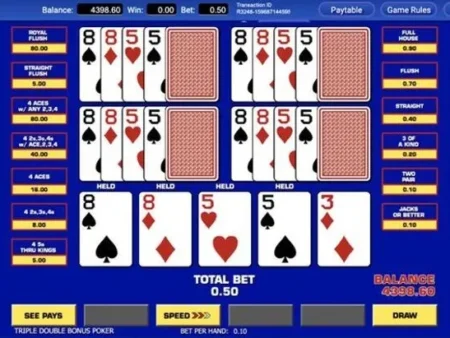

Jacks or Better is the foundation of every other video poker variant on the casino floor. No wild cards, no bonus multipliers, no gimmicks, just five cards, one decision, and a payout table that rewards precision. That simplicity is exactly why it’s the right game to learn jacks or better video poker strategy properly: master the hold-and-draw logic here, and it transfers directly to Bonus Poker, Double Bonus, Deuces Wild, and nearly every other draw-poker machine you’ll encounter.
This page is built as a complete reference. Use the chart to make real-time decisions, use the data tables to understand why those decisions are correct, and bookmark it as your working video poker strategy card.
2026 Jacks or Better RTP Data (Verified)
Before any strategy matters, the paytable matters more. Two numbers determine everything: the full house payout and the flush payout, expressed as a ratio like “9/6.” Below are the current, independently verified return-to-player figures for the most common paytable variations found on casino floors and licensed online platforms in 2026.
| Paytable | Payout (Full House / Flush) | Return to Player (RTP) | House Edge |
| 9/6 (Full Pay) | 9 coins / 6 coins | 99.54% | 0.46% |
| 9/5 | 9 coins / 5 coins | 98.45% | 1.55% |
| 8/6 | 8 coins / 6 coins | 98.39% | 1.61% |
| 8/5 | 8 coins / 5 coins | 97.30% | 2.70% |
| 7/5 | 7 coins / 5 coins | 96.15% | 3.85% |
| 6/5 | 6 coins / 5 coins | 95.00% | 5.00% |
All figures assume max-coin (5-credit) wagers and mathematically optimal play. Source-verified against Wizard of Odds optimal-strategy analysis, last cross-checked May 2026.
Why this matters for strategy: The 9/6 full-pay version is the industry benchmark and the version this entire guide’s chart is built around. Even small paytable reductions compound significantly, dropping from 9/6 to 8/5 cuts your theoretical return by more than two full percentage points. Always check the paytable screen before you commit to a machine or table.
2026 Strategy Precision Data
How closely you follow the chart directly changes your real return. This is one of the most overlooked facts in basic strategy for video poker, most players lose value not from bad luck, but from small, repeated strategy deviations.
| Strategy Level | RTP (9/6 Full Pay) | Cost vs. Optimal | Approx. Error Rate |
| Simple strategy | 99.46% | -0.08% | ~1 misplay per 1,178 hands |
| Intermediate strategy | 99.52% | -0.03% | ~1 misplay per 3,805 hands |
| Optimal strategy | 99.54% | 0.00% | Theoretical maximum |
For context, a royal flush under optimal play occurs roughly once every 40,391 hands — which is exactly why consistent, disciplined hold decisions on the far more common hands (pairs, two pair, four-card draws) matter more to your long-term results than chasing the rare jackpot hand.
The Complete Jacks or Better Strategy Chart
This is your working video poker strategy card. Compare your dealt hand to the list below from top to bottom. The first line that matches your hand is the correct play — hold those cards and discard the rest.
| Priority | Hand to Hold |
| 1 | Royal flush |
| 2 | Straight flush |
| 3 | Four of a kind |
| 4 | Four cards to a royal flush |
| 5 | Full house |
| 6 | Flush |
| 7 | Straight |
| 8 | Three of a kind |
| 9 | Four cards to a straight flush |
| 10 | Two pair |
| 11 | High pair (Jacks, Queens, Kings, or Aces) |
| 12 | Three cards to a royal flush |
| 13 | Four cards to a flush |
| 14 | Low pair (2s through 10s) |
| 15 | Four cards to an outside straight (open on both ends) |
| 16 | Two suited high cards (both from J-Q-K-A) |
| 17 | Three cards to a straight flush |
| 18 | Two unsuited high cards |
| 19 | One high card (J, Q, K, or A) |
| 20 | Draw five new cards (no qualifying hand) |
Reading the Chart Correctly
A few rules make this chart reliable in practice:
- Always compare from the top down. If your hand qualifies for more than one line, the higher-priority line wins. A low pair that’s also three cards to a straight flush, for example, is held as the pair (line 14 beats line 17).
- “High card” specifically means Jack, Queen, King, or Ace. Tens and below don’t count toward high-card lines.
- An “outside straight” draw is four consecutive cards missing one on either end (e.g., 5-6-7-8 needs a 4 or 9). An “inside straight” (needing an internal card, like 5-6-8-9 needing a 7) is intentionally excluded from this chart — inside straight draws are lower value than a single high card in most cases and are correctly folded in optimal play.
- When in doubt, keep fewer cards. A common beginner mistake is holding an extra “kicker” card alongside a pair. Under 9/6 Jacks or Better, holding a lone kicker next to a pair actually reduces expected value — always draw three fresh cards to a pair rather than holding a kicker.
Common Hand Scenarios Explained
Charts are only useful once you understand the reasoning behind them. Here’s the logic behind the decisions players get wrong most often.
Jack-pair vs. three cards to a flush. A pair of Jacks (a “high pair”) is always held over three cards to a flush, even though the flush draw feels more exciting. The pair guarantees you’re already in a paying hand, with real upside toward trips, a full house, or four of a kind. A three-card flush draw completes only about 4.5% of the time.
Low pair vs. four-card flush draw. This is a genuinely close decision, and it’s one of the few spots where the two lines sit near each other in EV. The chart resolves it in favor of the low pair specifically under 9/6 paytables — but on lower-paying tables (8/5 or worse), the answer can flip toward the flush draw. This is a good example of why paytable identification always comes before strategy application.
Two pair vs. going for trips. Always hold both pairs. Breaking up two pair to draw for a single pocket pair chasing quads is a significant, well-documented mistake — the guaranteed two-pair payout combined with the small chance of improving to a full house outperforms the low probability of hitting quads from a broken pair.
Four to a straight vs. a low pair. Hold the low pair. An open-ended four-card straight looks tempting, but the math consistently favors the pair’s higher combined probability of landing a paying hand across multiple outcomes (pair improvement, two pair, trips) versus the straight’s single completion path.
Bankroll and Session Guidance
Strategy determines your theoretical return, but variance determines what actually happens across a real session. Full-pay 9/6 Jacks or Better carries a standard deviation of roughly 4.42 units per hand, meaning short-term swings, both up and down, are a completely normal part of correct play, not a sign that the strategy chart failed.
Practical guidelines that pair well with the chart above:
- Play at your intended max-coin level whenever possible; five-coin bets unlock the disproportionately higher royal flush payout that anchors the 99.54% RTP figure.
- Set a session bankroll of at least 200–300 max-coin bets to reasonably absorb normal variance without prematurely ending a session on a downswing.
- Track paytables across machines or platforms before playing, a 9/6 game a few seats away from a 6/5 game can represent a 4.5-percentage-point swing in long-run return for identical strategy.
Why Perfect Play Matters More Than Luck
Video poker is one of the only casino games where your decisions, not just your bets, directly change the house edge. Slot machines offer zero player input. Blackjack rewards strategy but caps out well below video poker’s best returns. Jacks or Better, played with full discipline on a 9/6 paytable, sits among the lowest house edges available anywhere in a casino, 0.46%, which is why serious players treat the strategy chart as a non-negotiable part of the game rather than an optional add-on.
The gap between casual play and correct video poker jacks or better strategy isn’t small over time. A player using only rough intuition typically operates several percentage points below the optimal 99.54% figure, a difference that compounds meaningfully across thousands of hands.
Explore More at PokerClubGames
This chart is one piece of a broader strategy library available at pokerclubgames.com. Whether you’re building toward a full understanding of video poker paytables, comparing Deuces Wild against Jacks or Better, or looking for a printable strategy card to keep at hand, PokerClubGames covers the full range of poker and video poker strategy content built on verified, current data.
Explore related guides:
- Jacks or Better vs. Deuces Wild: Which Game Has the Better Player Edge?
- How to Spot a Full-Pay Machine in Under 10 Seconds
- Video Poker Bankroll Management for Long Sessions
FAQs
What is the best strategy for Jacks or Better video poker?
The optimal jacks or better video poker strategy follows a fixed priority order, always hold the highest-ranking qualifying hand from the chart above, starting with premium made hands (royal flush, straight flush, four of a kind) down through drawing hands (pairs, suited high cards). Following this order consistently produces the maximum theoretical return of 99.54% on a full-pay 9/6 machine.
What does “9/6” mean in Jacks or Better?
“9/6” refers to the payout ratio for a full house (9 coins per coin bet) and a flush (6 coins per coin bet) under a single-coin wager. It’s the standard shorthand used to identify a full-pay machine, which returns 99.54% with optimal strategy.
How much does basic strategy improve my odds in video poker?
Following even a simplified basic strategy for video poker gets you within 0.08% of the optimal return on a 9/6 machine. Playing with no strategy at all, pure intuition, typically costs players several percentage points of return over time.
Should I hold a kicker next to a pair in Jacks or Better?
No. Under 9/6 Jacks or Better strategy, holding a kicker alongside a pair reduces your expected value compared to drawing three fresh cards. Always discard the kicker.
Founder of PokerClubGames.com and a Poker Researcher with 10+ years of experience in SEO, WordPress development, and gaming content strategy. Specializes in researching online poker sites, poker apps, tournaments, bonuses, and poker strategies. Experienced in poker platform reviews, affiliate marketing, and creating SEO-focused poker content for global audiences.
For collaborations, media inquiries, or poker-related partnerships:
Contact: partnerships@pokerclubgames.com