

WSOP Main Event by the Numbers: Field Sizes & Prize Growth Since 1970
On this page
Last Updated on October 21, 2026 by Bala Kumar
In 1970, seven poker players sat down in Benny Binion’s Horseshoe casino in Las Vegas, and the “champion” was picked by a vote. In 2026, 9,208 entries paid $10,000 each, and a 22-year-old from Spokane took home $10 million.
That gap tells the story of how poker changed in 57 years. This guide covers the numbers that matter: how big the fields got, when they jumped, how the prize money changed, and what the latest results say about where the World Series of Poker Main Event is heading.
The Latest Main Event at a Glance (2026)
| Detail | Figure |
| Event | #82 – $10,000 No-Limit Hold’em World Championship |
| Entries | 9,208 (4th-largest ever) |
| Prize pool | $85,634,400 |
| Places paid | 1,383 |
| Champion | Lucas Jumalon (Spokane, Washington, USA) |
| First prize | $10,000,000 |
| Runner-up | Lauri Saaskilahti (Finland), $6,000,000 |
| Final table | August 3–5, 2026 |
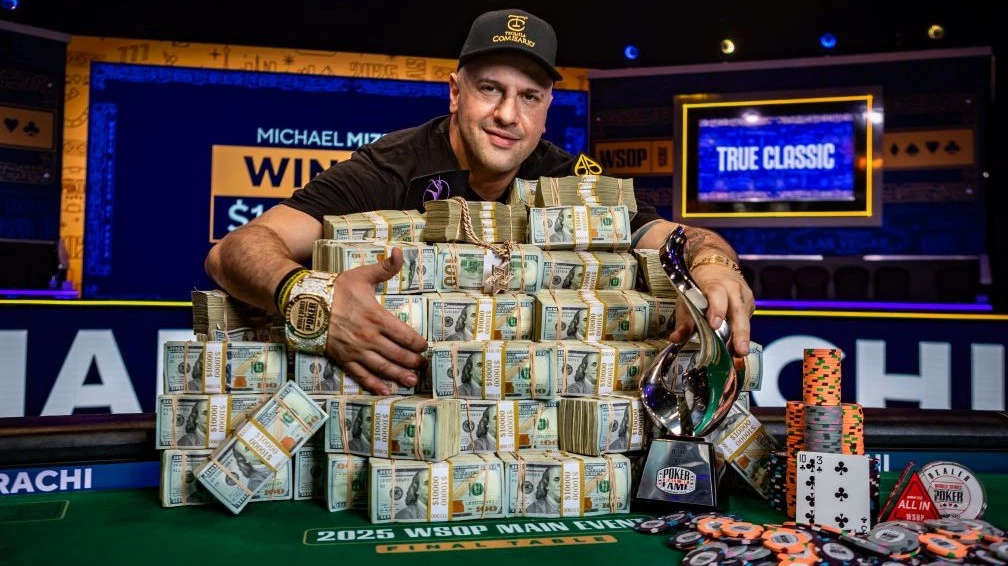
Jumalon, 22, held the chip lead through the whole final table and closed it out in a 17-hand heads-up match. In the final hand, his king-six made trips against Saaskilahti’s ace-seven. He became the fourth American champion in a row, after Daniel Weinman (2023), Jonathan Tamayo (2024) and Michael Mizrachi (2025).
2026 Final Table Payouts
| Place | Player | Country | Prize |
| 1 | Lucas Jumalon | USA | $10,000,000 |
| 2 | Lauri Saaskilahti | Finland | $6,000,000 |
| 3 | Greg Mueller | Canada | $3,750,000 |
| 4 | Michael Gagliano | USA | $2,750,000 |
| 5 | Han Feng | USA | $2,250,000 |
| 6 | Rami Hammoud | Canada | $1,750,000 |
| 7 | Jamie Shaevel | USA | $1,500,000 |
| 8 | Mario Boos | France | $1,250,000 |
| 9 | Evagoras Evagorou | Cyprus | $1,000,000 |
Every finalist earned at least $1 million. That floor shows how deep the modern payout structure goes, compared with the winner-take-all era.
Field Size by Decade
Looking at averages makes the eras easy to compare.
| Decade | Avg. entrants per year | Smallest field | Largest field |
| 1970s | 22 | 6 (1971) | 54 (1979) |
| 1980s | 127 | 73 (1980) | 178 (1989) |
| 1990s | 273 | 194 (1990) | 393 (1999) |
| 2000s | 3,926 | 512 (2000) | 8,773 (2006) |
| 2010s | 7,064 | 6,352 (2013) | 8,569 (2019) |
| 2020s (2020–26) | 7,970 | 1,379 (2020) | 10,112 (2024) |
Leave out 2020, when COVID-19 forced a smaller online and live hybrid event, and the 2020s average rises to about 9,069 entries a year. That is the highest of any decade.
What stands out:
- The 1970s to 1990s grew slowly and steadily, roughly doubling each decade.
- The 2000s were a different world. The average field was 14 times larger than in the 1990s.
- The 2010s settled into a stable 6,300 to 8,600 range.
- The 2020s pushed past 10,000 entries for the first time.
The Moneymaker Boom: Three Years That Changed Poker
No moment in the Main Event’s history compares with 2003 to 2006.
| Year | Entrants | Change vs. previous year | Champion | First prize |
| 2002 | 631 | – | Robert Varkonyi | $2,000,000 |
| 2003 | 839 | +33% | Chris Moneymaker | $2,500,000 |
| 2004 | 2,576 | +207% | Greg Raymer | $5,000,000 |
| 2005 | 5,619 | +118% | Joe Hachem | $7,500,000 |
| 2006 | 8,773 | +56% | Jamie Gold | $12,000,000 |
Chris Moneymaker, an accountant from Tennessee, won his seat through an $86 online satellite and then won the whole event. His win was broadcast on ESPN, and millions of viewers suddenly believed they could do the same.
Within three years, the field grew more than tenfold, from 839 to 8,773. Online poker sites ran satellites in huge numbers, which fed the boom. A satellite is a cheaper tournament whose prize is a seat in a bigger one.
The 2006 record of 8,773 entries stood for 17 years. Then the US government’s crackdown on online poker (UIGEA, passed late in 2006) cut off much of that satellite pipeline, and fields fell to 6,358 in 2007.
The Modern Record Era (2017–2026)
| Year | Entrants | Est. prize pool | Champion | First prize |
| 2017 | 7,221 | – | Scott Blumstein | $8,150,000 |
| 2018 | 7,874 | – | John Cynn | $8,800,000 |
| 2019 | 8,569 | – | Hossein Ensan | $10,000,000 |
| 2020 | 1,379 | – | Damian Salas | $2,550,969 |
| 2021 | 6,650 | – | Koray Aldemir | $8,000,000 |
| 2022 | 8,663 | – | Espen Jørstad | $10,000,000 |
| 2023 | 10,043 | ≈$93.4M | Daniel Weinman | $12,100,000 |
| 2024 | 10,112 | ≈$94.0M | Jonathan Tamayo | $10,000,000 |
| 2025 | 9,735 | ≈$90.5M | Michael Mizrachi | $10,000,000 |
| 2026 | 9,208 | $85.6M | Lucas Jumalon | $10,000,000 |
Estimated prize pools assume $9,300 of each 10,000buy-ingoestotheprizepool.Thatmatchestheofficial2026figureexactly(85,634,400 ÷ 9,208).
Three records worth knowing:
- Largest field ever: 10,112 entries in 2024.
- Largest first prize ever: $12.1 million to Daniel Weinman in 2023, just ahead of Jamie Gold’s $12 million in 2006.
- Smallest modern field: 1,379 in 2020, a pandemic-era exception.
The 2026 trend: entries have fallen for two straight years, from 10,112 to 9,735 to 9,208, a drop of about 9% from the peak. That is still the fourth-largest field ever, and only the 2023–2025 boom years beat it. The 2026 WSOP as a whole drew 251,901 entries across 100 bracelet events, so the overall series is clearly healthy. The Main Event looks to be settling around 9,000 to 10,000 players rather than shrinking sharply.
How Prize Money Has Grown
The first prize tells its own story.
| Milestone | Year | First prize |
| First cash prize (Main Event) | 1971 | $30,000 |
| $10,000 buy-in introduced | 1972 | $80,000 |
| First $1 million first prize | 1991 | $1,000,000 |
| First $5 million first prize | 2004 | $5,000,000 |
| First $10 million first prize | 2006 | $12,000,000 |
| Record first prize | 2023 | $12,100,000 |
From 1991 to 1999 the first prize was a flat $1 million, even as fields grew from 215 to 393. Since 2019, the WSOP has mostly kept first place at a round $10 million. Instead of making the top prize bigger, it uses larger fields to pay more people.
The Winner’s Share Keeps Shrinking
| Year | Entrants | First prize as share of prize pool |
| 1972 | 8 | 100% (winner-take-all) |
| 2006 | 8,773 | about 14.5% |
| 2023 | 10,043 | about 13.0% |
| 2026 | 9,208 | about 11.7% |
The winner still earns life-changing money, but a smaller slice goes to first place. In 2026, 1,383 players cashed, roughly the top 15% of the field. Ninth place alone paid $1 million, which is more than the first prize of any Main Event before 1991.
What $10,000 Was Worth in 1972
The buy-in has stayed at $10,000 since 1972. Adjusted for US inflation, that 1972 buy-in would be roughly $75,000 to $80,000 in today’s money.
In real terms, the Main Event has become about seven to eight times cheaper to enter. That lower real cost, along with online satellites and much wider awareness of poker, explains much of the field growth.
Practical Takeaways for Players
- You don’t need $10,000 to play. Most Main Event players now win their seats through satellites, both online and live. That is exactly how Moneymaker got in.
- Expect a huge field and a long event. With roughly 9,000 to 10,000 entries, even a min-cash means outlasting about 85% of the field over several days.
- Cashing is realistic, and winning is a lottery. About 1 in 7 players cash, while the winner beats odds of roughly 1 in 9,000.
- Watch the trend lines. A slightly smaller field slightly improves your odds of a deep run, but the prize pool shrinks with it.
FAQs
How many players entered the 2026 WSOP Main Event?
The 2026 WSOP Main Event drew 9,208 entries, the fourth-largest field in its history, creating a prize pool of $85,634,400.
Who won the 2026 WSOP Main Event?
Lucas Jumalon, a 22-year-old from Spokane, Washington, won the 2026 Main Event and $10,000,000. He beat Finland’s Lauri Saaskilahti heads-up.
What is the largest WSOP Main Event field ever?
The record is 10,112 entries, set in 2024 when Jonathan Tamayo won. The 2023 event (10,043) is the only other field above 10,000.
What is the biggest WSOP Main Event first prize?
Daniel Weinman won $12,100,000 in 2023, the largest Main Event first prize ever. Jamie Gold’s $12,000,000 in 2006 is second.
How many players were in the first WSOP Main Event?
Seven players took part in 1970, and Johnny Moss was voted champion by his fellow players. The $10,000 buy-in began in 1972 with eight entrants.
Why did the WSOP Main Event grow so quickly after 2003?
Chris Moneymaker won in 2003 after qualifying through an $86 online satellite. His televised win set off the poker boom, and entries grew from 839 in 2003 to 8,773 in 2006.
Disclosure: PokerClubGames may earn a commission when you use links to poker operators. This never changes the price you pay. 18+ (21+ where required). Gambling involves risk. How we make money