
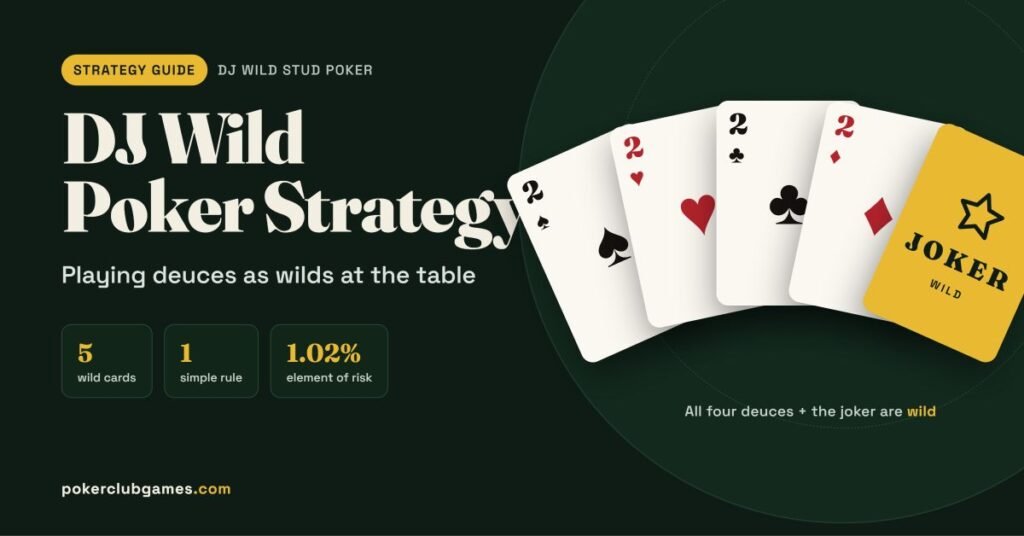
DJ Wild Poker Strategy: Playing Deuces as Wilds at the Table
On this page
Last Updated on October 17, 2026 by Bala Kumar
The first time most players sit down at a DJ Wild table, they make the same mistake: they treat it like Caribbean Stud with a few jokers sprinkled in. It isn’t. When five cards in the deck are wild, the value of every hand shifts. A pair of sixes that you’d happily raise in a normal stud game is suddenly a pretty ordinary holding, and a hand with a deuce in it is almost never a fold.
The good news? DJ Wild has one of the simplest correct strategies of any poker-based table game. Learn one sentence, understand why it works, and you’re playing within a hair of perfect. With that strategy, the house keeps about 3.47% of your ante — or roughly 1.02% of everything you actually bet. That’s a better deal than Caribbean Stud or Three Card Poker.
This guide explains the strategy, the wild-card math behind it, the Blind bet trap, and which side bet paytables are worth a look.
How DJ Wild Stud Poker Works
DJ Wild (often listed as DJ Wild Stud Poker) is a Light & Wonder table game, originally from Shuffle Master. You play only against the dealer, never against other players.
- The deck has 53 cards: a standard 52 plus one joker.
- All four deuces and the joker are wild — five wild cards in total.
- You place equal bets on the Ante and Blind, plus an optional Trips side bet.
- You and the dealer each get five cards. All dealer cards are face down.
- You either fold (losing Ante and Blind) or make a Play bet of 2× the Ante.
- Hands are compared. There’s no dealer qualifier — the dealer always plays.
- Dealer wins → you lose Ante, Blind and Play.
- Tie → everything pushes.
- You win → Ante and Play pay even money; the Blind pays by the table below.
Because there are so many wilds, two hands sit above a royal flush in the rankings: five of a kind (between royal and straight flush) and five wilds at the very top.
Blind bet pay table (you must beat the dealer to collect):
| Your winning hand | Blind pays |
|---|---|
| Five wilds | 1,000 to 1 |
| Royal flush | 50 to 1 |
| Five of a kind | 10 to 1 |
| Straight flush | 9 to 1 |
| Four of a kind | 4 to 1 |
| Full house | 3 to 1 |
| Flush | 2 to 1 |
| Straight | 1 to 1 |
| Three of a kind or less | Push |
The One-Sentence DJ Wild Poker Strategy
Here it is — the rule first worked out by game mathematician Elliot Frome and later confirmed by the Wizard of Odds:
Make the Play bet with a pair of fours or better. Fold everything else — with one exception: fold a pair of fours if your hand also contains a single three.
That’s the whole thing. No dealer upcard to read, no hand charts with 40 lines. Follow it and you’ll make the Play bet about 69% of the time.
Why the odd exception? A pair of fours mostly loses to the dealer’s pairs, and the most likely pair it does beat is a pair of threes (deuces are wild, so threes are the lowest natural pair). If you’re holding a three yourself, the dealer is less likely to have that pair of threes — which tips 4-4 with a 3 kicker from a thin raise into a fold.
How Wild Cards Change Your Decisions
The sentence above is easy to memorise, but it helps to understand what it means in practice. Here’s what I find most players don’t realise until someone points it out.
Any hand containing a wild card is a Play bet. Think about it: a single wild pairs with your highest card. Your other four cards can’t include a deuce (that’d be a second wild), so the lowest possible holding is 3-4-5-6 plus a wild — which is already a straight. Every other one-wild hand is at least a pair of sixes. Two wilds give you trips or better. So the moment you see a deuce or the joker, you can stop thinking and push out the Play bet.
That means the only real decisions happen on hands without wilds:
| Your hand (no wilds) | Decision |
|---|---|
| Two pair, trips, or any made hand | Play |
| Natural pair of 5s through Aces | Play |
| Pair of 4s, no 3 in your hand | Play |
| Pair of 4s with a single 3 | Fold |
| Pair of 3s | Fold |
| No pair (even A-K high) | Fold |
That last row trips people up. In Caribbean Stud, Ace-King is a borderline hand you often raise. In DJ Wild, the dealer has a wild card in about 4 out of 10 hands, which means the dealer starts with at least a pair much more often. Ace-high is just a loser here. Fold it without regret.
How often do wilds show up? With five wilds in a 53-card deck, the odds for any five-card hand work out like this (calculated for this article):
| Wild cards in a 5-card hand | Probability |
|---|---|
| None | ~59.7% |
| Exactly one | ~33.9% |
| Exactly two | ~6.0% |
| Three or more | ~0.4% |
So roughly 40% of your hands contain at least one wild — and every one of them is an automatic Play bet. The same 40% applies to the dealer, which is exactly why weak no-pair hands are such poor bets.
The Blind Bet: Where the House Edge Hides
The Blind is a forced bet, and it’s where the casino earns its money. It only pays when you beat the dealer with a straight or better. Win with trips or a pair and the Blind just pushes; lose the hand and it’s gone.
According to the Wizard of Odds analysis, the Blind wins only about 6% of the time and carries an expected loss of roughly 38% on its own. The Ante and Play bets are what claw that back. This is also why folding costs you two units (Ante + Blind), not one — which makes the “pair of fours” bar lower than you’d expect from instinct.
The practical lesson: you can’t avoid the Blind, so don’t fight it. Play correct strategy on the Ante/Play decision and let the Blind ride as the price of the seat.
DJ Wild vs Other Poker Table Games
How does the house edge compare with games you might see on the same casino floor or in the same online lobby?
| Game | House edge (vs ante) | Element of risk* | Strategy difficulty |
|---|---|---|---|
| DJ Wild Stud Poker | 3.47% | 1.02% | Very easy (one rule) |
| Caribbean Stud Poker | 5.22% | ~2.56% | Easy |
| Three Card Poker (Ante/Play) | 3.37% | 2.01% | Easy (Q-6-4) |
| Oasis Poker (standard) | 1.04% | 0.475% | Moderate (switching) |
*Element of risk is the expected loss divided by the average total amount you bet per hand. In DJ Wild, your average total wager is about 3.39 units (Ante + Blind + Play when you raise), so it’s the fairer comparison.
DJ Wild sits in a sweet spot: it’s simpler than almost anything else on this list while costing less, per dollar wagered, than Caribbean Stud or Three Card Poker. Online versions from Light & Wonder are listed at around 98.99% RTP, which lines up with that ~1% element of risk.
The Trips Side Bet: Paytable Is Everything
Trips pays on your own five cards only — the dealer doesn’t matter. You need three of a kind or better, and natural hands (no wild used) pay far more than wild ones.
The catch is that four different paytables are in circulation, and the house edge swings wildly between them:
| Trips paytable (natural quads – flush – trips) | House edge |
|---|---|
| 90-25-7 | 0.59% |
| 90-30-6 | 1.19% |
| 90-25-6 | 3.16% |
| 60-25-6 | 6.16% |
The quick check: look at what a natural three of a kind pays. If it’s 7 to 1, the Trips bet is one of the better side bets in the casino. If natural four of a kind pays only 60, skip it. Some tables also offer a “bad beat” upgrade — read its paytable before you assume it’s worth it.
Practical Tips Before You Sit Down
- Budget for 3.4 units per hand, not 2. A $10 Ante and $10 Blind turns into about $34 of average action once you count Play bets. Size your bankroll for that.
- Don’t overvalue Ace-King. Caribbean Stud habits are the most common leak at this table.
- Stop thinking when you see a wild. Play bet, every time.
- Watch the volatility. Results swing a lot — the standard deviation is about 3.4 units per hand relative to the Ante. Short losing runs are normal even with perfect play.
- Keep your cards to yourself. Seeing other players’ wilds would genuinely help your decisions, which is exactly why casinos forbid sharing hand information.
- Practise free first. If an online casino offers a demo version, run a few hundred hands until the “pair of fours” rule is automatic.
Quick Cheat Sheet
- Holding a deuce or joker? Play.
- Natural pair of 5s or higher, two pair, or better? Play.
- Pair of 4s? Play — unless you also hold a single 3.
- Pair of 3s or no pair (including A-K)? Fold.
- Trips side bet: only on tables paying 7 to 1 (or at least 6 to 1 with flush at 30) for natural trips.
Frequently Asked Questions
What is the best DJ Wild poker strategy? Make the Play bet with a pair of fours or better and fold everything else. The one exception: fold a pair of fours when your hand also contains a single three. This simple rule is essentially optimal.
How many wild cards are in DJ Wild Stud Poker? Five. All four deuces plus a single joker in a 53-card deck. About 40% of five-card hands contain at least one wild.
Should I always play a hand that has a wild card? Yes. A single wild guarantees at least a pair of sixes or a straight, which is always above the pair-of-fours threshold.
Should I raise Ace-King in DJ Wild? No. Unlike Caribbean Stud, Ace-King high is a fold in DJ Wild because the dealer has a wild card so often and there’s no qualifying hand.
What is the house edge in DJ Wild poker? About 3.47% of the Ante, or 1.73% of the combined Ante and Blind. Measured against everything you bet, the element of risk is roughly 1.02%.
Is the DJ Wild Trips bet worth playing? It depends on the paytable. The best version (natural trips pays 7 to 1) has a house edge of just 0.59%, while the worst common version runs at 6.16%.
Gamble responsibly. House-banked games carry a built-in edge no strategy can fully remove — play with money you can afford to lose. 18+ (or the legal age in your jurisdiction).
Disclosure: PokerClubGames may earn a commission when you use links to poker operators. This never changes the price you pay. 18+ (21+ where required). Gambling involves risk. How we make money