
Brett Murray Wins RGPS Bay Area $800 Main Event for $67,000: Unfinished Business Settled at Graton
On this page
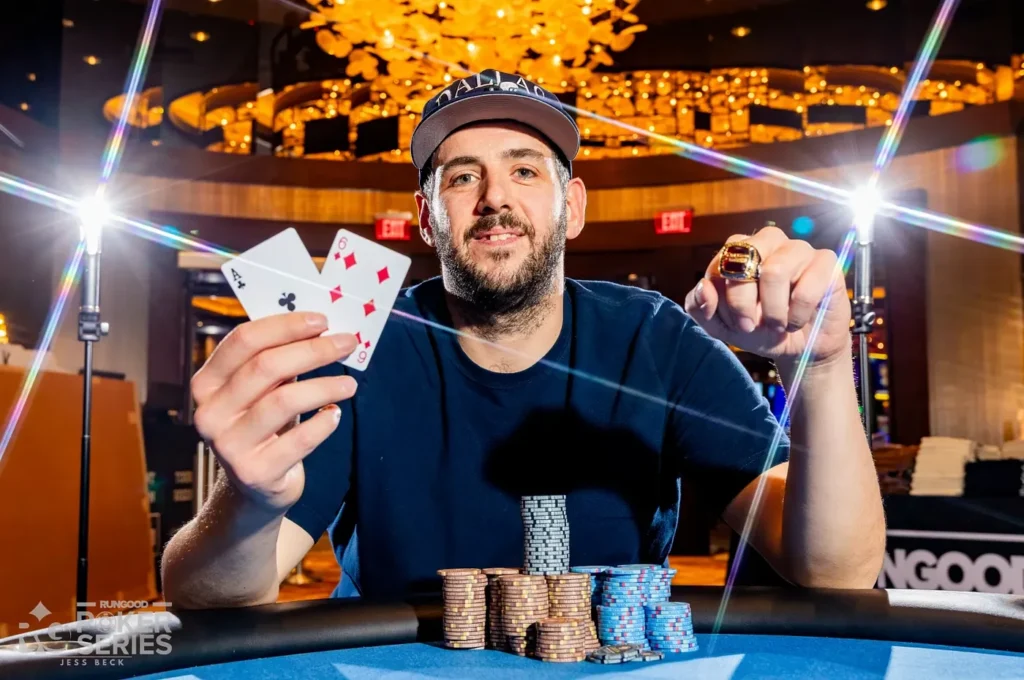
Third place in a big Main Event pays well, but players rarely remember it fondly. Brett Murray finished third in the RunGood Poker Series (RGPS) Passport Bay Area Main Event at Graton Resort & Casino in March 2026. In November he went back to the same room and won it.
Murray beat a field of 567 entries to win the RGPS Golden Expedition Bay Area $800 Main Event. He took home $67,000, the top share of a $369,900 prize pool, plus a second RunGood Main Event ring.
He had a lot of help from the cards along the way, including two suckouts against the man he ended up playing heads-up.
Final Table Results & Payouts
| Place | Player | Country | Prize |
| 1 | Brett Murray | United States | $67,000 |
| 2 | Edwin Pautin | United States | $44,000 |
| 3 | Manjunath Mulinti | United States | $32,500 |
| 4 | Leeroy Francisco | United States | $24,400 |
| 5 | Toan Nguyen | United States | $18,400 |
| 6 | Peter Pep | United States | $14,000 |
| 7 | Michael Hubbard | United States | $10,800 |
| 8 | Norman Yeung | United States | $8,400 |
| 9 | Nicholas Elder | United States | $6,600 |
Event snapshot
- Buy-in: $800
- Guarantee: $300,000
- Entries: 567
- Prize pool: $369,900, which is $69,900 (about 23%) over the guarantee
- Series dates: November 12–22, 2026 (18 ring events)
- Winner’s share of the prize pool: about 18%
How the Bay Area Main Event Compares
This stop had a slightly different feel from the last two Bay Area Main Events. RunGood dropped the buy-in from $1,100 in March to $800 this time but kept the $300,000 guarantee. As a result, about the same number of players turned up but the prize pool was smaller.
| Graton Main Event | Buy-in | Entries | Prize Pool | Winner’s Prize |
| RGPS Bay Area (May 2025) | $800 | 773 | $541,100 | n/a |
| RGPS Passport Bay Area (Mar 2026) | $1,100 | 578 | $563,550 | $94,050 |
| RGPS Golden Expedition Bay Area (Nov 2026) | $800 | 567 | $369,900 | $67,000 |
Compared with other Golden Expedition Main Events this fall, Graton was in the middle of the pack. The Dallas $600 Main Event drew 1,058 entries for $529,000, and the first Kentucky $800 Main Event drew 606 entries for $424,200. The interesting number is the field size: dropping the buy-in by $300 didn’t bring in more players. That suggests Bay Area players are fairly loyal to this stop whatever it costs.
What this means for players: At 800,Gratongivesyouroughlya1-in-567shotatfivefigures,witha9th-placeprize(6,600) worth more than eight times the buy-in. If you play in Northern California, it’s one of the best-value regional Main Events on the West Coast calendar.
Day 2: Two Big Suckouts
Murray started Day 2 as the overnight chip leader. He came in with a long tournament record and a big stack, and most of the field expected him to make a deep run.
It didn’t go to plan at first. Early on, Murray picked up pocket kings and ran into Leeroy Francisco’s pocket aces. Kings against aces is a cooler: you can’t fold them preflop and you’re about an 80/20 underdog. Murray lost most of his lead in that one hand.
After that he was in danger. Short on chips, he got all in for his tournament against Edwin Pautin’s pocket jacks, and Murray was behind. He hit a three-outer on the turn to double up and got back to roughly the stack he had started the day with.
About 30 minutes later the same two players clashed again. This time Murray had nines against Pautin’s tens, which is another big underdog spot. He flopped a set of nines and doubled again.
Practical insight: Even the best runs need some luck. Murray was behind twice in about half an hour and survived both times. Nobody controls that part, but you can control how you play once you’re back in the game. Murray didn’t treat the doubles as a reason to start gambling. He went back to playing patient poker, which is what turned two lucky moments into a title.
Pautin didn’t go away either. He got his chips back and reached the final table as chip leader, with Murray third in chips.
The Final Table: Waiting, Then Attacking
Murray explained his final-table approach to PokerNews in a post-event interview. With a mid-sized stack, he played tight early and moved up the payouts while others took the risks. Pautin was playing a lot of hands and putting pressure on the table, so Murray felt he could fold more and let the aggressive players knock each other out. Once the table got short-handed, he started opening more hands and attacking.
This is a good lesson for players at their first final table:
- Mid stack, aggressive chip leader? Every pay jump is real money. If someone else is busting players, let them.
- Short-handed means a new game. Hand values go up with fewer players, so the tight ranges that worked nine-handed lose money four-handed.
- Watch who is reckless. A loose chip leader makes the other big stacks risk their tournament. Be ready for that.
How the eliminations played out
Manjunath Mulinti knocked out the most players early. He sent NorCal Poker Champion Nicholas Elder out in 9th. Francisco then eliminated Norman Yeung in 8th. Michael Hubbard busted in 7th in a three-way all-in won by Mulinti, and Mulinti added another knockout when Peter Pep fell in 6th.
Murray waited through all of that, then made his first big move. He eliminated former RGPS Main Event champion Toan Nguyen in 5th.
Then he got his revenge on Francisco, the player who had cracked his kings earlier. This time Murray had aces, they held up, and he took over the chip lead. He then knocked Francisco out in 4th and Mulinti in 3rd.
Heads-Up: Murray vs. Pautin Again
The heads-up match fitted the story. Murray’s opponent was Edwin Pautin, the player he had outdrawn twice earlier that day.
Murray started heads-up with the chip lead and used it. Instead of looking for one big all-in, he kept winning small pots. Each small pot reduced Pautin’s options and made his stack shorter.
Eventually Pautin got his stack in with pocket deuces. Murray flopped a six to make a better pair, and the board didn’t help Pautin. Pautin won $44,000 for second place, and Murray won the title.
Afterwards Murray told PokerNews that winning is so rare that it “always feels amazing.” Anyone who has finished third and gone home thinking about it will understand.
Why This Win Matters
- Second RGPS Main Event ring: This puts Murray among the most consistent players on the RunGood circuit. He has a third-place finish and a win at the same venue in the same calendar year.
- Player of the Year points: The Bay Area stop counts toward the 2026/27 RunGood Player of the Year race, so a Main Event win gives Murray a strong position early in the Golden Expedition season.
- Regional poker is healthy: Northern California players keep showing up in big numbers at about the same level each time. That’s good news for affordable live poker outside Las Vegas.
FAQs
Who won the RGPS Bay Area Main Event in November 2026?
Brett Murray won the RGPS Golden Expedition Bay Area $800 Main Event at Graton Resort & Casino. He beat 567 entries and won $67,000.
How big was the RGPS Bay Area 2026 prize pool?
The $800 Main Event had a $369,900 prize pool, about $69,900 above its $300,000 guarantee.
Who finished second in the RGPS Bay Area Main Event?
Edwin Pautin finished runner-up for $44,000. Manjunath Mulinti was third for $32,500.
Where is the RGPS Bay Area stop held?
At Graton Resort & Casino in Rohnert Park, California, about an hour north of San Francisco.
What is the RGPS Golden Expedition?
It’s the 2026/27 season of the RunGood Poker Series, a tour of affordable regional festivals around the U.S. Each stop awards rings and counts toward the RunGood Player of the Year race.
Has Brett Murray won an RGPS Main Event before?
Yes. This was his second RunGood Main Event title. He had also finished third at the March 2026 RGPS Passport Bay Area Main Event at the same casino.
Disclosure: PokerClubGames may earn a commission when you use links to poker operators. This never changes the price you pay. 18+ (21+ where required). Gambling involves risk. How we make money