
GGPoker Breaks All-Time Poker Tournament Record as $5 Ocean KO Draws 420,084 Entries
On this page
Last Updated on October 13, 2026 by Bala Kumar
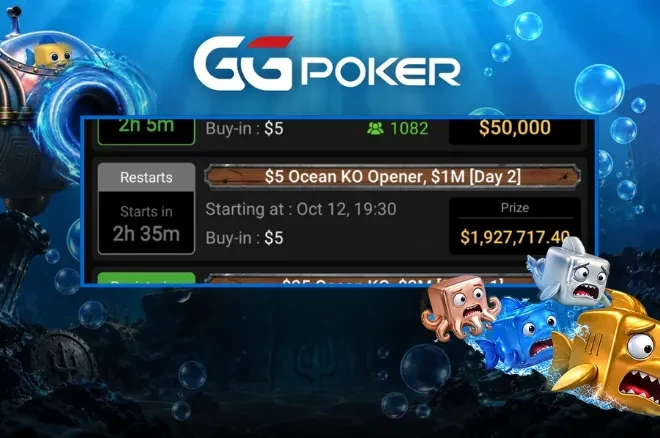
Poker has a new biggest tournament in history. GGPoker‘s $5 Ocean KO Opener closed registration with 420,084 entries. That wiped out a field-size record PokerStars had held since October 2015, when 253,692 players entered a single event.
The tournament ran through dozens of Day 1 flights from October 2. At least 24,134 players bagged chips for Day 2 on Monday, October 12. The final count beat the old mark by more than 166,000 entries, so the new record is roughly two-thirds bigger than the one it replaced.
The record that fell was an unusual one. PokerStars’ “Common Cents” tournament cost just one cent to enter. Austria-based Simon “DaDumon” Grabenschweiger won it and turned that penny into a $10,000 payday. Nothing came close for eleven years. It took a $5 tournament with a brand-new twist to finally move the line.
The money matched the turnout. GGPoker had put up a $1 million guarantee, and the field pushed the total prize pool beyond $1.9 million, nearly double the guarantee. The champion is in line for $43,938 in regular prize money. The bigger story is the bounties: more than $1.05 million of the pool was set aside for knockouts, because the event used a progressive knockout (PKO) structure.
| Ocean KO Opener | Figure |
| Buy-in | $5 |
| Total entries | 420,084 |
| Previous record | 253,692 (PokerStars, Oct 2015) |
| Guarantee | $1,000,000 |
| Total prize pool | $1.9 million+ |
| Bounty money | $1.05 million+ |
| First-place prize (excluding bounties) | $43,938 |
| Day 2 field | 24,134+ players |
Figures reported October 12, 2026. Final-table results had not been published at the time of writing.
Why a $5 Tournament Pulled In 420,000 Entries
Price helped, but the real draw was the format. GGPoker only launched Ocean KO on October 2, and this was one of its first flagship events.
If you’ve played a normal PKO, the basics will feel familiar. Every player starts with a bounty worth half their buy-in. When you knock someone out, you take half of their bounty as cash, and the other half is added to your own bounty. Ocean KO adds one extra step. Before that split happens, the bounty goes through a random multiplier wheel that can land anywhere from 0.4x to 400x.
On a $5 entry, the money breaks down roughly like this:
- About $2.50 goes on your head as a bounty.
- Around $2.10 goes into the regular prize pool.
- $0.40 is the house fee.
Multiply that across 420,084 entries and you get almost exactly the reported numbers. That shows how bounty-heavy this tournament was.
Here’s the part many newcomers don’t realise. Over the long run, the wheel averages out to exactly 1x, so a bounty is worth its face value, just like in a standard PKO. GGPoker takes no extra cut from the multipliers. What changes is how that value reaches you. About 72% of knockouts pay less than face value, and the 400x hits only once in roughly 50,000 eliminations. You get lots of small knockouts, the occasional decent one, and a very rare jackpot.
With a field this size, though, “rare” stops meaning “never.” We used the published odds and assumed close to one knockout per entry. On that basis, our estimate puts the Opener on course for around eight 400x hits and more than 300 hits of 100x or above. Stories like that pull casual players into a $5 game.
The “Lottery” Argument
Not everyone is celebrating. Since Ocean KO went live, a vocal group of players has argued online that jackpot-style multipliers shift bounty tournaments too far toward luck. Their worry is simple. When one lucky knockout can be worth more than winning the whole event, the tournament starts to feel less like poker and more like a scratch card.
The other side has a fair case too. Skill still decides who survives the early levels, who builds a stack big enough to cover the dangerous bounties, and who makes Day 2. The multiplier doesn’t turn bad decisions into good ones; it just makes the swings wilder. Formats that attract recreational players also tend to create softer fields, which is good news for anyone who studies the game.
Both views can be true at once. On paper, Ocean KO is no less fair than a regular PKO, but it’s far more volatile, and players should know that going in.
A Format Borrowed From France
GGPoker didn’t invent the idea. French operator Winamax introduced its jackpot-style Space KO tournaments in December 2024, and they quickly became the most-played format on that site. Betclic followed with its own version, Smash KO, in March 2026. Both sites only operate in ring-fenced European markets. Until GGPoker added one, most of the world’s players had never seen a jackpot PKO.
GGPoker kept the core mechanics but made the payouts far more extreme:
| Format | Top multiplier | Chance of 10x+ | Knockouts under 1x | Available in |
| GGPoker Ocean KO | 400x | 2.48% | 72.32% | Global (where licensed) |
| Winamax Space KO | 100x | 0.60% | 60.00% | France, Spain |
| Betclic Smash KO | 50x | 0.60% | 49.85% | France |
The French version has already shown how dramatic these events can get. In September, a Winamax player collected a record €838,000 from a single knockout in a €100 Space KO. They finished with more than €927,000 in total, even though first place in the regular payouts was worth only around €5,000. Moments like that explain why GGPoker moved in, and why other networks are reportedly building similar formats.
What Comes Next
The Opener won’t be the last test. The $25 Ocean KO, with a $2 million guarantee, plays its Day 2 on October 19. Both events are part of GGPoker’s $100 million Bounty Hunters Series, which runs until October 27. The series is headlined by a $5 million guaranteed Mystery Bounty Main Event, with Day 2 on October 26.
Given GGPoker’s player pool, a second record-sized field wouldn’t be a surprise. The platform crossed 900,000 concurrent players for the first time in May 2026. No other site can currently bring that many players into a single global tournament.
Thinking of Playing? A Few Quick Tips
- Expect long dry spells. Seven in ten knockouts pay below face value. Size your bankroll as you would for jackpot sit-and-gos, not standard PKOs.
- Watch who’s carrying a big bounty. Ocean KO shows each player’s tier, from Egg up to Shark and beyond. A short stack holding a large bounty is the most valuable target at the table.
- Play fewer tables. Big bounties change your correct calling ranges, and they’re easy to miss when you’re spread too thin.
- Don’t call just to spin the wheel. The multiplier is random. Risking your tournament on a weak hand for a shot at 400x is still a losing play.
FAQs
What is the biggest poker tournament ever played?
GGPoker’s $5 Ocean KO Opener, with 420,084 entries in October 2026. It replaced PokerStars’ one-cent Common Cents event from October 2015, which had 253,692 entries.
How big was the prize pool for the $5 Ocean KO Opener?
More than $1.9 million against a $1 million guarantee. Over $1.05 million was bounty money, and the winner’s regular prize was $43,938 before bounties.
How does Ocean KO work?
It’s a progressive knockout with a random multiplier. Each eliminated player’s bounty is multiplied by between 0.4x and 400x. Half goes to you as cash and half is added to your own bounty.
How often does the 400x multiplier hit in Ocean KO?
About 0.002% of the time, or once in roughly 50,000 knockouts. A 10x or better lands about once every 40 knockouts.
Why do some players criticise Ocean KO?
Critics say random multipliers make tournaments feel like a lottery. Supporters note that the multipliers average 1x, skill still decides who survives, and the format attracts recreational players.
When is the next big Ocean KO tournament?
The 25OceanKO(2M GTD) plays Day 2 on October 19, 2026, during GGPoker’s $100 million Bounty Hunters Series.
Disclosure: PokerClubGames may earn a commission when you use links to poker operators. This never changes the price you pay. 18+ (21+ where required). Gambling involves risk. How we make money