

Rokas Asipauskas Wins KPC Final Coronation for $300,800
On this page
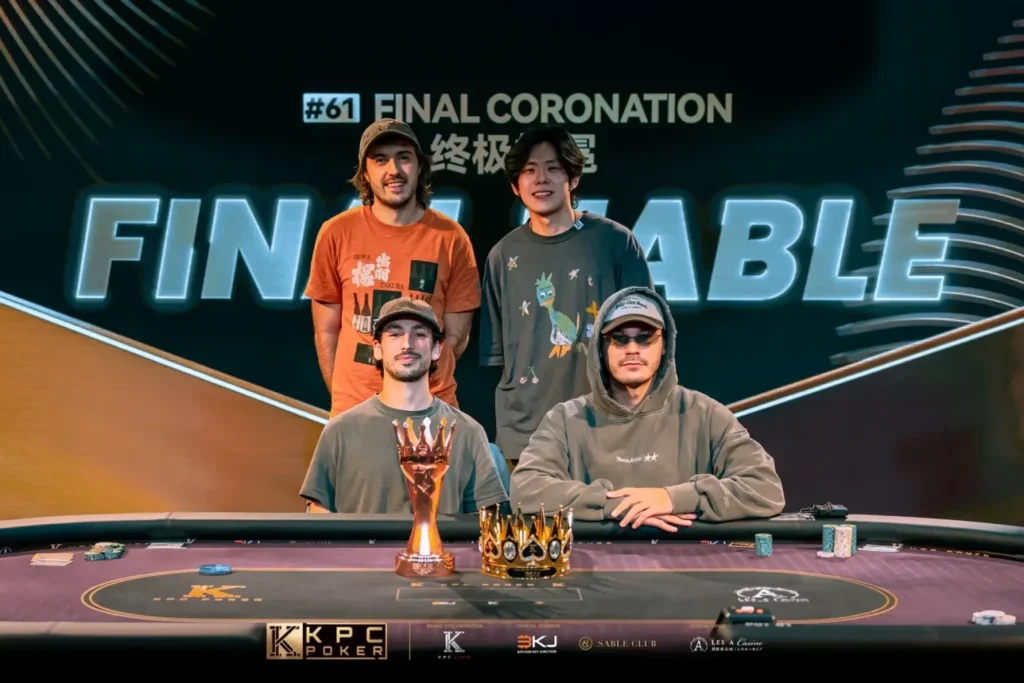
Some tournaments are won over hours of careful chip accumulation. The $30,000 Final Coronation at the KPC Poker October Series turned in a handful of hands, one of which went from hopeless to perfect in the space of two cards. When the dust settled at LES A Casino on Jeju Island, Lithuania’s Rokas Asipauskas had the trophy, the crown and $300,800.
It was the closing event of a 12-day series, and it capped a remarkable 24 hours for Lithuanian poker. The day before, countryman Marius Kudzmanas had won the King’s Main Event for $533,800. That made two flagship trophies and two bracelet winners from one small Baltic nation. Here’s how it happened, what the numbers actually tell us, and why it matters if you play tournaments yourself.
Final Coronation at a Glance
Series: KPC Poker October Series 2026
Dates: October 20–21, 2026 (series ran Oct 10–21)
Venue: LES A Casino, Jeju Shinhwa World, South Korea
Buy-in: $30,000
Entries: 25
Prize pool: $702,000
Places paid: 4 (16% of the field)
Starting stack: 500,000 chips, 40-minute levels
Winner: Rokas Asipauskas (Lithuania), $300,800
Final Coronation Payouts
1st – Rokas Asipauskas (Lithuania) – $300,800 (10.0x buy-in)
2nd – Dingxiang Ong (Singapore) – $190,000 (6.3x buy-in)
3rd – Paulius Plausinaitis (Lithuania) – $127,000 (4.2x buy-in)
4th – Mehdi Chaoui – $84,200 (2.8x buy-in)
Notice how steep that structure is. The winner took roughly 43% of the entire prize pool, and Jimmy Guerrero finished fifth and walked away with nothing after investing $30,000. That’s the nature of small-field high rollers: when only a handful of places are paid, the bubble becomes brutal.
How the Final Table Was Set
Play began on October 20, and the field of 25 took its time thinning out. Kudzmanas, fresh off his Main Event win, couldn’t carry the momentum. He fell in 15th when his queen-jack didn’t improve against Gytis Lazauninkas’s ace-ten. Nevan Chang (11th) and Candy Lin (10th) followed, leaving a nine-handed final table.
Plausinaitis led the final nine with 3,845,000 chips. Asipauskas sat right behind him with 3,355,000. That was a healthy stack, but nowhere near safe in a field this strong.
Tony Lin went out first, in ninth. After that, Ong became the table’s enforcer. He busted Wai Kiat Lee in eighth by making two pair with jack-five, then picked off Lazauninkas in seventh with pocket kings against ace-queen. Plausinaitis then made jack-nine work twice. First he filled up to eliminate Thi Xoa Nguyen in sixth. Then he rivered a straight on the button to burst Guerrero on the money bubble.
The Hand That Changed Everything
Four-handed, the flop came six, queen, ace with three hearts. Asipauskas moved all in with K♠ 9♠. Mehdi Chaoui called with nine-six, which gave him a pair of sixes plus a flush draw, and he was roughly an 89% favourite.
The turn was a nine. That gave Chaoui two pair, but it also paired Asipauskas. Now Asipauskas needed something very specific: a king, and only two remained in the deck. The K♣ landed on the river, giving him the better two pair and sending Chaoui out in fourth for $84,200.
What beginners can learn from this: an 89% favourite still loses about one time in nine. In a single hand that feels like bad luck; over a career it’s simply maths. Asipauskas himself admitted afterwards that he was about as dead as you can be in that spot. The lesson isn’t “shove king-high and hope.” It’s that you should judge your decisions by the price and the odds when the money went in, not by whether the river was kind to you.
There was a side story too. Chaoui’s exit settled the series leaderboard. A win for him would have lifted him past Kudzmanas by a tiny 0.1 points, so Asipauskas’s two-outer effectively protected his countryman’s position.
Three-Handed and Heads-Up
With momentum on his side, Asipauskas opened from the small blind with ten-nine. Plausinaitis called with king-queen and flopped a king to take the lead, but a queen on the turn completed a straight for Asipauskas. Plausinaitis took third for $127,000.
That left Asipauskas with about 11 million chips against Ong’s 1.3 million, a lead of better than 8-to-1. Heads-up lasted a single hand. Ong shoved the button with A♦ 10♦, and Asipauskas called with K♦ 8♦. The board ran 8♠ 9♣ 6♣ 5♠ 2♦, so Asipauskas paired his eight on the flop and Ong got no help.
Why calling with king-eight was correct: with an 8-to-1 chip lead, the big stack risks very little of its total to end the tournament. A short stack like Ong’s has to shove a wide range. Ace-ten is ahead of king-eight, but only by roughly 60/40, and losing the hand would still have left Asipauskas comfortably in front. Short stacks have to gamble; big stacks should let them.
“It’s Not Just the Money”
For a player who has already won a WSOP bracelet, a six-figure score is welcome but not life-changing. What Asipauskas kept coming back to in interviews was the crown that goes to the Final Coronation champion. As he told Somuchpoker after the win, “When I saw this crown, I was like, I want it.”
He also had kind words for the organisation. He compared the KPC experience favourably with the Triton series he regularly plays in Jeju, and he confirmed he’ll be back in January to defend his title.
Who Is Rokas Asipauskas?
Asipauskas is no newcomer to big moments. His first WSOP bracelet came in the Bahamas at the 2025 WSOP Paradise, where he won the $5,000 Super Colossus for $504,950 after beating Alex Keating heads-up.
This Jeju trip was consistent rather than lucky. Before the Coronation, he’d already reached two final tables in the same series:
KRW 5,000,000 High Roller – 8th – KRW 20.5M (about $15,280)
$20,000 Crown Hunt – 6th – $43,000
$30,000 Final Coronation – 1st – $300,800
Total reported cashes: about $359,080
His runner-up, Dingxiang Ong, deserves credit too. The Singaporean is a proven closer who beat 1,974 entries to win the Poker Dream Main Event at Resorts World Genting in April 2025.
By the Numbers: How the Final Coronation Compares
Putting the Coronation alongside other big events from the same series shows how different “high stakes” can look in practice:
King’s Single Day HR Turbo – $15,000 buy-in – 34 entries – $477,400 prize pool
King’s Main Event (Kudzmanas) – $15,000 buy-in – 169 entries – $2,372,760 prize pool – $533,800 first prize – 22.5% winner’s share
Final Coronation (Asipauskas) – $30,000 buy-in – 25 entries – $702,000 prize pool – $300,800 first prize – 42.8% winner’s share
Two practical takeaways stand out.
- The fee was consistent. Divide each prize pool by its entries and you get about $14,040 per $15,000 entry and $28,080 per $30,000 entry. In every case, roughly 93.6% of the buy-in went into the prize pool, with about 6.4% held back for fees. If you play live high rollers, this number is worth checking before you register, because it directly affects your long-term return.
- Small fields aren’t necessarily easier. Kudzmanas beat 169 entries to earn about 35.6 times his buy-in. Asipauskas beat only 25 and earned about 10 times his. Fewer opponents means a better chance of cashing each time you enter. But those 25 were mostly seasoned high-stakes regulars, and with only four places paid, the swings are savage.
About the KPC Poker October Series
This was the first major festival since K Poker Cup and King Poker Cup merged under the KPC Poker banner. Pre-series announcements put total guarantees at about ₩3.1 billion (roughly $2.3 million). The schedule included two Main Events, a Mixed Asian Poker Series (MAPS) mixed-game lineup, three separate Player of the Series races and live streaming from October 11.
For international players, the venue matters as much as the schedule. LES A Casino sits inside Jeju Shinhwa World and operates in Jeju’s foreigner-only casino sector. That’s why these final tables feature such a global mix of nationalities.
What’s Next in Jeju and Korea
If you’re planning a trip, the action barely pauses:
Jeju Poker Festival – October 28 to November 11 at LES A Casino. KPC Poker and the Red Dragon Poker Tour co-run 123 trophy events. The festival opens with a KPC Main Event carrying a KRW 880 million guarantee and closes with the Red Dragon Plus Championship at KRW 1.8 billion guaranteed.
WPT Seoul – October 30 to November 9 at INSPIRE Entertainment Resort in Incheon, headlined by a KRW 1 billion guaranteed Championship Event.
KPC January series – Asipauskas has promised to return here and defend his crown.
With two Lithuanians taking the series’ biggest late titles and promising to bring more friends next time, don’t be surprised to see an even larger Baltic presence on Jeju’s felt in 2027.
FAQs
Who won the 2026 KPC Final Coronation?
Lithuania’s Rokas Asipauskas won the $30,000 Final Coronation on October 21, 2026, earning $300,800 and the event’s crown.
How big was the KPC Final Coronation prize pool?
Twenty-five entries created a $702,000 prize pool. Only the top four were paid: $300,800, $190,000, $127,000 and $84,200.
Where was the KPC Poker October Series 2026 held?
At LES A Casino inside Jeju Shinhwa World on Jeju Island, South Korea, from October 10 to 21, 2026.
Who won the KPC King’s Main Event in October 2026?
Marius Kudzmanas of Lithuania won the $15,000 King’s Main Event for $533,800, beating Peng Huang heads-up in a 169-entry field.
What is the next poker festival in Jeju?
The Jeju Poker Festival runs October 28 to November 11, 2026 at LES A Casino, with 123 trophy events.
Can foreigners play poker at LES A Casino?
Yes. It’s a foreigner-only casino, so international visitors with a valid passport can play, while South Korean citizens generally cannot. Check current entry rules before you travel.
Disclosure: PokerClubGames may earn a commission when you use links to poker operators. This never changes the price you pay. 18+ (21+ where required). Gambling involves risk. How we make money