
Poker for Two Players: Heads-Up Rules & Best Formats
On this page
Last Updated on September 2, 2026 by Bala Kumar
Most people learn poker at a table of six or nine, then find themselves sitting across from one other person with a deck and no idea whether the same rules apply. They mostly do. But two of them change in ways that catch out even experienced players, and the game itself becomes something else entirely once the crowd is gone.
Here’s how poker for two players actually works, which formats hold up best, and what the game looks like at the top level right now.
The two rules everyone gets wrong
In a normal game, the button posts nothing, the player to their left posts the small blind, and the one after that posts the big blind. Drop that to two players and the structure collapses inward.
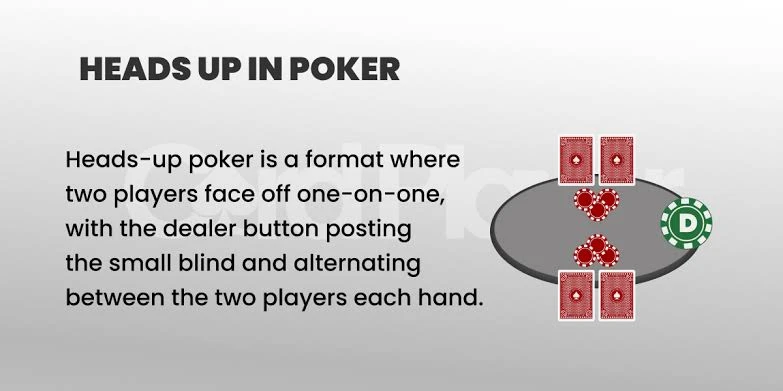
The button posts the small blind. In heads-up play, the dealer is the small blind. Their opponent posts the big blind. This is the rule people misremember most often, and it’s worth getting right because it flips everything downstream.
The button acts first before the flop, then last on every street after it. Preflop, the small blind (button) is first to act and can fold, call, or raise. Once the flop comes down, position reverses: the big blind acts first for the rest of the hand, and the button closes the action on flop, turn, and river.
Cards are dealt starting with the big blind, so the button receives the last card. The button alternates every hand, meaning you’re on the button half the time instead of one hand in nine. That alone changes the math of the game.
Heads up poker rules, hand by hand
The mechanics of a hand are unchanged from a full table:
- Post blinds. Button posts the small blind, opponent posts the big blind.
- Deal. Two hole cards each, big blind first, button last.
- Preflop betting. Button acts first. If the button just calls, the big blind can check or raise.
- Flop. Three community cards. Big blind acts first from here on.
- Turn. Fourth card, another betting round.
- River. Fifth card, final betting round.
- Showdown. The last player to bet or raise shows first. If the river was checked through, the big blind shows first.
Hand rankings do not change. A flush still beats a straight. What changes is how often those hands actually matter, which is the real subject of 2 player poker.
Why hand values look completely different
At a nine-handed table you fold most of what you’re dealt and wait. Heads-up, you’re posting a blind every single hand, and folding your way through the deck bleeds chips fast. Any two cards have a reasonable chance of being ahead when only one opponent holds cards.
| Starting hand | Roughly how playable, 9-handed | Roughly how playable, heads-up |
| A-A through Q-Q | Raise from anywhere | Raise, obviously |
| A-K, A-Q | Strong | Very strong |
| K-9 offsuit | Fold | Raise from the button |
| Q-7 suited | Fold | Raise from the button |
| J-4 offsuit | Fold | Marginal, often still a raise |
| 7-2 offsuit | Fold | Fold, but not always |
A reasonable heads-up button-raising range covers 70% to 85% of hands. Compare that to the 15% or so you’d open under the gun in a full ring game. The 2026 High Stakes Poker sessions offered a live demonstration of the principle: Eric Wasserson was voluntarily entering more than 60% of his hands in a six-handed nosebleed game and finished the week up $3.26 million. Heads-up, that number goes higher.
Second pair becomes a strong hand. Ace-high wins pots at showdown regularly. Bluffing frequency climbs, because your opponent is also missing the flop about two-thirds of the time.
The best formats for two players
Heads-up No-Limit Hold’em
The default, and the right starting point. It’s the most studied 2 player poker format, the easiest to find online, and the rules above apply directly. Deep-stacked cash play rewards postflop skill. Short-stacked play becomes a preflop shoving contest.
Heads-up Sit & Go
A single-table tournament with two players and a defined end. Both players start with equal chips, blinds rise on a timer, and it’s over when someone has everything. Good for beginners because the buy-in caps your loss and the escalating blinds force action. Match length usually runs 15 to 40 minutes.
Heads-up Pot-Limit Omaha
Four hole cards each, must use exactly two. Enormous variance and much bigger pots relative to the blinds, since equities run closer together. Fun if both players know what they’re doing, brutal if only one does.
Chinese Poker and Open-Face Chinese
Genuinely designed for small groups and excellent with two. You arrange 13 cards into three hands and score against your opponent row by row. No betting rounds, no bluffing, and a live-table favourite among high-stakes pros for a reason.
2-7 Triple Draw and Badugi
Draw games work well heads-up because the information is limited and the drawing decisions carry real weight. Both are staples of the mixed-game rotations you’ll see in the WSOP schedule.
Short Deck Hold’em
Remove the deuces through fives, and the whole hand-ranking structure shifts. Flushes beat full houses, and everyone connects with the board more often. Aggressive and fast, which suits two players.
Home-game options with a physical deck
If you’re sitting across a kitchen table, Chinese Poker needs nothing but cards. Heads-up Hold’em works with any chips, buttons, or coins you can find. Guts, Acey-Deucey, and Indian Poker all function with two, though none reward skill the way the games above do.
Where the action is right now
Live tournaments. The 2026 WSOP $25,000 Heads-Up No-Limit Hold’em Championship drew 128 entries for a $3,008,000 prize pool. Bulgaria’s Dimitar Danchev beat Nikita Kuznetsov in the final match for $800,000 and his second bracelet, both of which have come in heads-up formats. Phil Ivey and Phil Hellmuth were both eliminated before the final day.
High-stakes cash. Daniel “Jungleman” Cates sits atop the all-time livestream cash game money list at $14,339,575, according to Highroll Poker’s tracker. The overwhelming majority of that came from a single heads-up match against Ossi “Monarch” Ketola rather than from ring games, which is a fair indication of how much money can move in one-on-one play when the stakes are high enough.
Online. Dedicated heads-up cash tables have thinned out over the past decade because winning players used to sit and snipe weaker opponents, so most major rooms now restrict table selection or run anonymous tables. As of September 2026, PokerStars still carries the widest heads-up SNG schedule, GGPoker’s recreational-heavy pool is the softer field of the two market leaders, and Bovada and Ignition remain the common answers for US-facing anonymous heads-up play. Check current traffic before depositing anywhere; heads-up lobbies fluctuate more than any other format.
Six things that separate winners from losers heads-up
- Attack limps. If your opponent limps the button, raise. Limping heads-up is almost always weakness.
- Defend your big blind wide. You’re getting good odds and you’ll have position for the rest of the hand.
- Bet small and often on dry flops. A third of the pot is enough when your opponent has nothing two times out of three.
- Adjust faster than they do. You’ll see the same opponent for hundreds of hands. Whoever adapts first wins.
- Watch the blind ratio. In a heads-up SNG, once effective stacks drop under about 15 big blinds, the game is preflop shoves and calls. Learn a push-fold chart.
- Keep a bankroll. Heads-up variance is savage. Even a clear favourite loses individual matches often. Forty buy-ins is a sensible floor.
FAQs
Can you play poker with just 2 players?
Yes. Heads-up is a standard format with its own rules, tournaments, and professional specialists. Every major poker room offers it.
Who is the dealer in 2 player poker?
The button is the dealer and posts the small blind. The other player posts the big blind. The button alternates each hand.
Who acts first heads-up?
The button acts first preflop and last on the flop, turn, and river.
Do hand rankings change with two players?
No. The rankings are identical. Only the frequency with which hands win changes, and weaker holdings win far more often.
Is heads-up poker harder than a full table?
Skill differences show up faster and more brutally, because you play every hand and can’t wait for premiums. It’s harder to hide in, but easier to learn from.
What’s the best 2 player poker game for beginners?
Heads-up No-Limit Hold’em Sit & Gos. Fixed cost, defined ending, and the same rules you already know.
Disclosure: PokerClubGames may earn a commission when you use links to poker operators. This never changes the price you pay. 18+ (21+ where required). Gambling involves risk. How we make money