
Stu Ungar: The Tragic Genius Who Won Three Main Events
On this page
Three days ago, on November 22, 2026, it was 28 years since Stu Ungar died. He was found alone in a cheap motel room on the Las Vegas Strip, aged 45, eighteen months after winning poker’s world championship for the third time.
Nearly three decades later, poker players still argue about him. Was he the most naturally gifted card player who ever lived? Many of the people who played against him think so. Was his life a warning about addiction? Clearly. Is the Stu Ungar story just a sad one? Not quite. It’s also one of the most remarkable runs in the history of any game.
This is our look at “The Kid”: what he did, how he did it, why it all fell apart, and how his records compare with poker in 2026.
Stu Ungar at a Glance
| Full name | Stuart Errol Ungar |
| Nicknames | Stuey, The Kid, The Comeback Kid |
| Born | September 8, 1953, Manhattan, New York |
| Died | November 22, 1998, Las Vegas (aged 45) |
| WSOP Main Event titles | 3 (1980, 1981, 1997) |
| WSOP bracelets | 5 |
| WSOP cashes | 16 |
| Super Bowl of Poker titles | 3 (1984, 1988, 1989), the only player to win it three times |
| Biggest cash | $1,000,000 (1997 WSOP Main Event) |
| Recorded live tournament earnings | About $3.68 million (Hendon Mob) |
| Poker Hall of Fame | Inducted 2001, after his death |
From the Lower East Side to Unbeatable at Gin
Ungar grew up on Manhattan’s Lower East Side. His father ran a bar where illegal card games took place, so Stu was around cards and gamblers from a very young age.
He was clearly very bright. He skipped seventh grade and then dropped out of school in tenth grade. By then he had found the game that would make him famous before poker did: gin rummy.
Gin rewards exactly the skills Ungar had in huge amounts: remembering every card, quickly working out what’s left in the deck, and reading what an opponent wants from what they pick up and throw away. While still a teenager, he was beating adults for serious money. Before long, the top gin players in New York simply wouldn’t play him.
That became a pattern in his life. Being too good meant people stopped playing him. When gin dried up, he went to Las Vegas, first visiting in 1977, and the gin games there dried up just as quickly. Poker was the obvious next step.
1980: First Main Event, First Title
What happened next still surprises people. Ungar’s first major hold’em tournament was Amarillo Slim’s 1980 Super Bowl of Poker, where he finished 34th of 41, nowhere near the money.
A few weeks later he entered the 1980 WSOP Main Event at Binion’s Horseshoe. There were 73 players, each paying $10,000. Ungar told ESPN years later that it was the first Texas hold’em tournament he’d ever played, and by his own account he had almost no tournament experience.
He won it. At the final table he got heads-up with Doyle Brunson, already a two-time world champion and the most respected player in the game. The heads-up match lasted about 15 minutes: Brunson flopped two pair, and Ungar turned a straight. First prize was $365,000.
Why this still matters: Today’s Main Event champions usually have thousands of tournaments behind them, years of solver study and coaching. Ungar beat the best player in the world after watching, and learning, for a few days.
1981: Doing It Again
Most first-time champions have a quiet follow-up year. Ungar won the 1981 Main Event as well, becoming only the third player, after Johnny Moss and Doyle Brunson, to win back-to-back world titles.
That same year he also won the $10,000 Deuce-to-Seven Draw event, a lowball game that’s considered one of the toughest to play well. He added a Seven Card Stud bracelet in 1983. That’s five bracelets in four years, across three completely different games.
The most famous comment about him from that time came from Brunson, who said Ungar had the best natural talent he had ever seen. Few people have argued with that since.
The Super Bowl of Poker and the Blackjack Bans
In the 1980s, Amarillo Slim’s Super Bowl of Poker was the second most prestigious tournament in the world. Ungar won it in 1984, 1988 and 1989. Nobody else has won it three times.
He was also banned from playing blackjack in casinos. His card memory was so good that casinos refused to deal to him, the same thing that had happened at the gin table. Some of the stories about what he could do with a deck have probably grown over time. The basic fact, that casinos didn’t want to play against him, isn’t in doubt.
For modern players: Ungar didn’t win because of fancy plays. He won because he remembered everything and processed it faster than anyone else at the table. Modern players get similar information from tracking software and solvers. Ungar did it in his head.
The Fall: Addiction, Debt and the Lost Years
This is where the story gets hard to read.
By the mid-1980s, Ungar had a serious cocaine addiction. He also bet huge amounts on sports and golf, and most of those bets lost. People who knew him say he won an estimated $30 million across all games during his life. At his death, his net worth was close to zero.
The clearest example of how bad things got was the 1990 Main Event. Ungar collapsed in his hotel room after an overdose partway through the tournament and never returned to his seat. He had such a big chip stack that, even while he sat out and the dealers took his blinds and antes every orbit, he still finished 9th and won more than $20,000. It’s the only Main Event he ever entered and didn’t win.
For most of the 1990s, he hardly played major tournaments at all.
1997: The Comeback Kid
Then came one of the great comebacks in poker.
In 1997 the Main Event was played outdoors, under the Fremont Street Experience canopy in downtown Las Vegas. Ungar was broke. Fellow high-stakes player Billy Baxter put up the $10,000 entry for him, only minutes before registration closed, according to the story told ever since.
Ungar wore round blue-tinted sunglasses, partly to hide the damage drugs had done to his nose. He played like the Ungar of 1980.
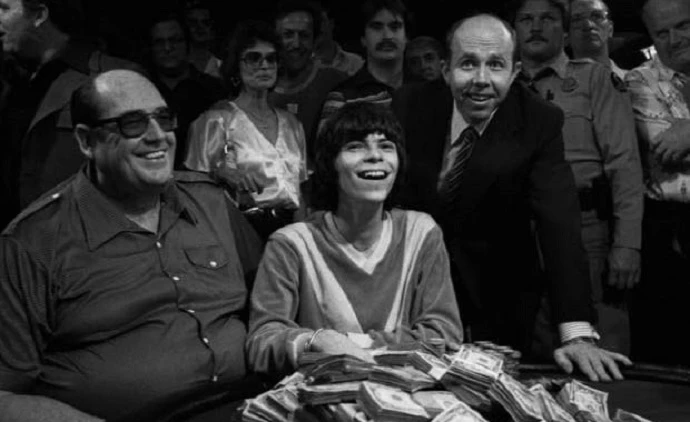
He reached the final table holding more than a third of the chips. He beat John Strzemp heads-up, outlasting a field of 312 entries, and won $1,000,000. He split the prize with Baxter, as players who are staked usually do.
It was his third Main Event title. Only Johnny Moss, who won in 1970, 1971 and 1974, has also won three. Moss’s 1970 title was decided by a vote of the players rather than a tournament, so many historians consider Ungar the only player to win three Main Events in a tournament format.
How It Ended
The comeback didn’t last.
Within months, most of the money had gone on drugs and sports betting. He skipped the 1998 Main Event. On November 22, 1998, he was found dead at the Oriole Motel on the Las Vegas Strip. The cause was a heart condition brought on by years of drug use. He was 45 years old.
Friends reportedly collected money at the funeral to help pay for it. One of the greatest card players in history died with very little to his name.
In 2001, he was inducted into the Poker Hall of Fame.
Then vs Now: How Ungar’s Main Event Wins Compare with 2026
Putting Ungar’s wins next to the current Main Event shows how much poker has changed. It also shows how hard his record would be to match today.
| 1980 | 1981 | 1997 | 2026 | |
| Winner | Stu Ungar | Stu Ungar | Stu Ungar | Lucas Jumalon |
| Entries | 73 | ~75 | 312 | 9,208 |
| First prize | $365,000 | ~$375,000 | $1,000,000 | $10,000,000 |
| Total prize pool | ~$730K | ~$750K | ~$3.1M | $85,634,400 |
Ungar won three times when fields were between 73 and 312 players. This summer’s Main Event had more than 9,200 entries. Even the best players in the world now face very long odds of winning it once. Doing it three times would be extraordinary.
That’s why so many people still say “there will never be another Stu Ungar.” It isn’t only nostalgia. With fields this big, the record is close to impossible to repeat.
The Stu Ungar Movie, Book and Documentaries
If you want more of the Stu Ungar story, here’s where to look:
- “High Roller: The Stu Ungar Story” (2003). A film about his life, starring Michael Imperioli as Ungar.
- “One of a Kind: The Rise and Fall of Stuey ‘The Kid’ Ungar” (2005). The best-known biography, by Nolan Dalla and Peter Alson, based largely on interviews Ungar gave near the end of his life.
- Short documentaries. In 2026, PokerListings released a short documentary based on interviews with people who knew him well.
- His daughter, Stefanie Ungar, has spoken publicly about her father, giving a more personal view of the man behind the legend.
What Today’s Players Can Learn from Stu Ungar
1. Talent isn’t enough without bankroll management. Ungar was probably the most gifted player of his time, and he still went broke several times. He mixed poker money with sports bets, golf bets and drugs. A player’s skill means nothing if they don’t manage their money.
2. Your edge comes from information. His memory and ability to read the game were his real advantage. Today’s tools (HUDs, solvers, hand reviews) do the same job. Use them.
3. Pay attention to your health. Long sessions, little sleep and stress take a toll on anyone. Ungar is the most extreme example, but burnout affects regular players too.
4. Know when you’re not in shape to play. Ungar’s 1990 result showed how good he was, but it was also a warning. Recognising when you’re not able to play well is a skill too.
He once described gambling and playing poker as hard work, and said people shouldn’t believe anyone who tells them otherwise. For someone who made poker look so easy, that may be the most honest thing he left behind.
FAQs
How many WSOP Main Events did Stu Ungar win?
Three: 1980, 1981 and 1997. He and Johnny Moss are the only players to win the Main Event three times. Moss’s first title in 1970 was decided by a vote of the players.
How many WSOP bracelets did Stu Ungar have?
Five: three Main Event bracelets, the 1981 $10,000 Deuce-to-Seven Draw and a 1983 Seven Card Stud bracelet. He also had 16 WSOP cashes.
How much did Stu Ungar win in the 1997 WSOP Main Event?
$1,000,000. He beat John Strzemp heads-up in a field of 312 entries, after Billy Baxter put up his $10,000 entry fee.
What was Stu Ungar’s net worth?
He’s estimated to have won around $30 million across poker, gin rummy and other gambling during his life, with about $3.68 million in recorded live tournament earnings. Because of his drug addiction and sports betting, he was almost broke when he died.
How did Stu Ungar die?
He was found dead at the Oriole Motel in Las Vegas on November 22, 1998, aged 45. The cause was a heart condition linked to years of drug use.
Disclosure: PokerClubGames may earn a commission when you use links to poker operators. This never changes the price you pay. 18+ (21+ where required). Gambling involves risk. How we make money