
Last Updated on September 1, 2026 by Bala Kumar
Why Limit Hold’em Still Deserves Your Attention
Walk into most online poker lobbies today and you’ll find dozens of No-Limit Hold’em tables for every one Limit Hold’em game running. It’s easy to see why No-Limit’s all-in drama and bluffing theatrics make for better TV and bigger headlines. But dismissing Limit Hold’em as a relic is a mistake, especially if you’re serious about mastering poker as a whole.
Limit Hold’em strips away stack-size psychology and forces you to win with pure edges: hand selection, position, pot odds, and disciplined aggression. Many of poker’s sharpest minds, including plenty of modern No-Limit crushers, credit Limit Hold’em with teaching them the fundamentals that made everything else click. This guide breaks down a complete fixed limit strategy for anyone looking to actually win at the forgotten format.
What Makes Limit Hold’em Different
In fixed limit poker, every bet and raise is set to a predetermined size, typically a “small bet” preflop and on the flop, and a “big bet” (double the small bet) on the turn and river. There’s no shoving your stack, no bet-sizing tells, and no way to bluff someone off a hand for “everything.”
That single structural difference changes almost everything about strategy:
- Bluffing is expensive relative to reward. You can’t apply maximum pressure with a single oversized bet, so bluffs need to be more selective and often multi-street.
- Pot odds dominate decision-making. Because bet sizes are fixed and predictable, math takes precedence over psychology far more than in No-Limit.
- Variance is lower, but so is your edge per hand. Winning in Limit Hold’em is a war of small, consistent advantages compounded over thousands of hands, not one big score.
Starting Hand Selection: The Foundation of Fixed Limit Strategy
Because you can’t leverage stack size to win big pots with marginal hands, limit hold’em starting hands matter enormously. Tight, position-aware hand selection is the single biggest lever you control before the flop.
Premium Hands (Raise/Reraise From Any Position)
- AA, KK, QQ, AKs, AKo
Strong Hands (Raise, Play Aggressively In Position)
- JJ, TT, AQs, AQo, AJs, KQs
Speculative/Marginal Hands (Position-Dependent)
- Suited connectors (98s, T9s, JTs)
- Small-to-mid pairs (66–99), good for set value, but fold easily if you miss
- Suited aces (A2s–A9s), flush and wheel potential
Hands to Avoid (Especially Out of Position)
- Weak offsuit aces (A2o–A8o)
- Disconnected, unsuited middle cards (Q7o, J4o, T6o)
A common beginner mistake is playing too many hands simply because the bet sizes feel “small.” In Limit Hold’em, those small bets add up fast across multiple streets, loose preflop calling is one of the most reliable ways to bleed your bankroll.
Positional Awareness Still Rules Everything
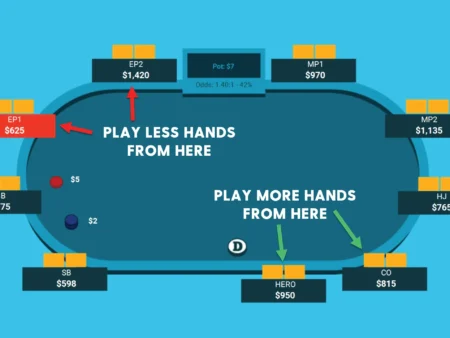
Position matters just as much in Limit Hold’em as it does in No-Limit, arguably more, since your ability to extract value or control pot size is entirely dependent on acting last. A hand like KTs might be a clear raise on the button but an easy fold from early position against multiple limpers.
Rule of thumb: tighten your opening range the earlier your position, and widen it as you move toward the button. Late position gives you the information advantage needed to make thin value bets and well-timed bluffs, both of which are harder to execute in fixed betting structures.
The Math Behind Fixed Limit Strategy
Limit Hold’em is often called a “math game” for good reason. Since bet sizes never change, calculating pot odds and implied odds becomes far more precise and repeatable than in No-Limit.
Pot Odds Basics
If the pot is $60 and you’re facing a $10 bet, you’re getting 6-to-1 pot odds ($60:$10). You need roughly a 14% chance of winning the hand to justify a call purely on pot odds. Because bet sizes are fixed, you can calculate this quickly at the table without needing to estimate future betting patterns.
The Four/Two Rule
A quick shortcut for estimating your equity with a draw:
- After the flop (two cards to come): multiply your outs by 4
- After the turn (one card to come): multiply your outs by 2
A flush draw (9 outs) after the flop equals roughly 36% equity, comfortably ahead of most pot odds you’ll face in a fixed limit structure.
Why Small Edges Compound
Because bet sizing is capped, a single correct decision might only be worth a fraction of a big bet in expected value. But across thousands of hands, these small, mathematically sound decisions compound into significant long-term win rates. This is why limit holdem odds work — profitable limit players think in terms of “big bets won per 100 hands,” not single massive scores.
Bluffing in Limit Hold’em: A Different Animal
Bluffing still matters in fixed limit strategy, but it looks nothing like a No-Limit bluff. You can’t apply the kind of stack-threatening pressure that forces folds through fear alone — opponents are often getting favorable pot odds to call your bluff, especially on later streets.
Effective limit bluffs typically rely on:
- Semi-bluffing draws rather than pure air, since you retain equity if called
- Multi-street credibility — a bluff that tells a consistent story across the flop, turn, and river is far more believable than a single big bet
- Exploiting capped ranges — if an opponent’s actions suggest they can’t have a strong hand (e.g., they checked a scary turn card), that’s a prime bluffing spot
Because bluffs are cheaper to call in Limit Hold’em, over-bluffing is one of the fastest ways to lose money in this format. Save your bluffs for spots where the story truly makes sense.
Common Mistakes That Sink Limit Players
- Overvaluing top pair. In Limit Hold’em, top pair with a weak kicker often isn’t strong enough to bet three streets for value against a tight range.
- Calling too often on the river. Small bet sizes make river calls tempting, but disciplined folding against clear value bets is essential.
- Ignoring table dynamics. Loose, passive tables call for more value betting and fewer bluffs; tight, aggressive tables call for tighter hand selection and more selective aggression.
- Playing too many hands from early position. The lack of stack-size leverage means marginal hands lose value fast when out of position.
Why Learning Limit Hold’em Makes You a Better Poker Player
Even if your long-term goal is crushing No-Limit cash games or tournaments, spending time with Limit Hold’em sharpens skills that translate everywhere:
- Precise pot odds calculation becomes second nature
- Hand reading improves because you can’t rely on bet-sizing tells
- Bankroll discipline strengthens, since Limit Hold’em’s lower variance rewards patient, long-term thinking
- Positional discipline becomes a habit rather than an afterthought
Many of the game’s most fundamentally sound players — across both live and online poker — built their foundation at fixed limit tables before ever touching a No-Limit stack.
Final Thoughts
Limit Hold’em may be the “forgotten format,” but the players who take the time to master its fixed limit strategy walk away with a deeper, more mathematically grounded understanding of poker as a whole. Tight starting hand selection, strong positional awareness, sharp pot odds calculations, and selective bluffing are the pillars of long-term winning play.
If you’ve only ever played No-Limit, spending a few sessions at the limit tables might be the best strategy investment you make this year.
FAQs
1. What is Limit Hold’em?
Limit Hold’em is a poker format where the amount you can bet or raise is fixed according to the game’s betting structure. Unlike No-Limit Hold’em, players cannot make oversized bets or go all-in whenever they choose.
2. What is the best strategy for Limit Hold’em?
The key to winning Limit Hold’em is tight starting-hand selection, positional awareness, disciplined aggression, and accurate pot-odds calculations. Small edges become valuable when repeated over a large number of hands.
3. How important is position in Limit Hold’em?
Position is extremely important because acting later provides more information about opponents’ actions. Players should generally play tighter from early position and widen their ranges toward the button.
4. Is bluffing effective in Limit Hold’em?
Yes, but bluffing should be more selective than in No-Limit Hold’em. Semi-bluffs with drawing hands, credible multi-street lines, and well-chosen opponents are generally more effective than frequent pure bluffs.
5. Why should I learn Limit Hold’em?
Learning Limit Hold’em can improve fundamental poker skills such as pot-odds calculation, hand reading, positional play, bankroll discipline, and value betting. These skills can also transfer to No-Limit Hold’em and other poker formats.
Founder of PokerClubGames.com and a Poker Researcher with 10+ years of experience in SEO, WordPress development, and gaming content strategy. Specializes in researching online poker sites, poker apps, tournaments, bonuses, and poker strategies. Experienced in poker platform reviews, affiliate marketing, and creating SEO-focused poker content for global audiences.
For collaborations, media inquiries, or poker-related partnerships:
Contact: Info@hugecount.com