
Natural8 Flip & Go Millionaire Beats Its $1M Guarantee From an $11 Buy-In, Plus How the PLO Series Finished
On this page
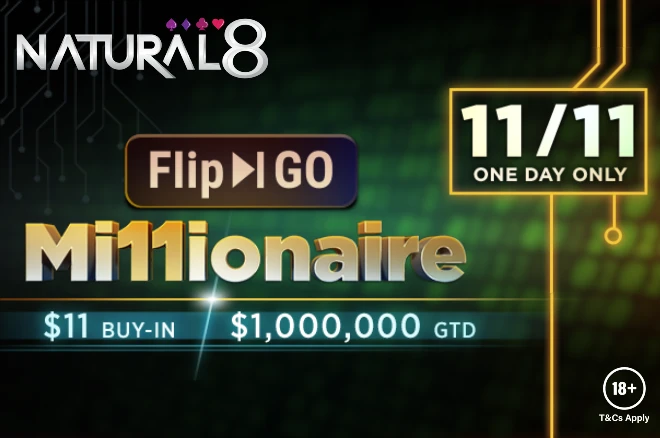
The cheapest seven-figure tournament of the year has done it again. Natural8’s Flip & Go Millionaire promised a $1,000,000 guarantee for an $11 buy-in, and it finished with a $1,101,889.80 prize pool. When the final Go Stage kicked off on November 11, 4,753 players sat down, and every one of them was already in the money.
The Millionaire was half of Natural8‘s November double-header. The other half was the $20 million guaranteed PLO Series, which ran from November 1 to 17. Together, the two events carried $21 million in guarantees.
This piece covers both. It explains how the Flip & Go format works, why the $0.11 satellites matter, what the numbers say about the final, and how the PLO Series closed out, including the $1M GTD PLO Bounty High Roller on November 16.
Editor’s note: The PLO Series ended on November 17. The events that were still on the calendar when this story first broke have now been played, so the section below has been updated with the results we could confirm.
Flip & Go Millionaire 2026 at a Glance
| Detail | Info |
| Room | Natural8 (GGNetwork, shared with GGPoker) |
| Buy-in | $11 direct |
| Satellites | From $0.11 |
| Guarantee | $1,000,000 |
| Final prize pool | $1,101,889.80 |
| Over the guarantee | $101,889.80 (about 10.2%) |
| Flip Stages | Hourly, November 1–11, 2026 |
| Last Flip Stage | 18:30 UTC, Nov 11 (02:30 HKT/SGT, Nov 12) |
| Go Stage | November 11, 2026 |
| Players in the Go Stage | 4,753 (all in the money) |
| Go Stage length | Just under 8 hours, finished early on Nov 12 |
How the Flip & Go Format Actually Works
If you’ve never played one, Flip & Go sounds strange. It’s simpler than it looks.
Stage 1: The Flip. Once a Flip Stage closes registration, every player gets three hole cards and has about 30 seconds to throw one away. Then everyone at the table is automatically all-in. You keep flipping until one player is left at each table, and that player moves on.
Stage 2: The Go. Everyone who wins a flip goes straight into the Go Stage, where they’re already in the money. From there it plays as a normal No-Limit Hold’em tournament. In past editions, players started the Go Stage with about 40 big blinds.
The feature that makes the Millionaire different is that chips stack up. If you win more than one Flip Stage, all of those chips go into your single Go Stage stack. So a player who won three flips starts the final with roughly three times the chips of someone who won one.
That’s the key to understanding the event. The Flip Stage is pure luck, but how many times you flip is a choice, and that choice decides how big your stack is on Go day.
Flip & Go vs a Regular Online MTT
| Flip & Go Millionaire | Standard $11 Online MTT | |
| Early levels | Skipped: one all-in flip | Hours of play before the money |
| Skill in Stage 1 | Minimal: just picking which card to discard | Full poker from hand one |
| Reaching the money | Win your flip and you’re paid | Usually around the top 12–15% |
| Starting stack in the paid stage | Depends on how many flips you won | Depends on how you played |
| Time needed | Minutes to qualify, about 8 hours on Go day | Often 8–12 hours in one go |
| Best for | Casual players, people short on time | Grinders who want edge from hand one |
Why the $0.11 Satellites Matter
The headline is “$11 to win a million,” but the real entry point was much lower. Satellites started at $0.11, which is 100 times cheaper than the direct buy-in.
For players across Asia, especially newer players in markets like Singapore, Malaysia, the Philippines and India, that matters. You can take a shot at a seven-figure prize pool for less than the price of a coffee, and if you lose, you’ve lost 11 cents.
There’s a practical point here too. A satellite seat is worth the same as an $11 cash entry, so a recreational player who satellites in two or three times builds a bigger Go Stage stack without spending more than a few dollars. For a format where stack size at the start of the Go Stage matters so much, that’s real value.
What the Numbers Tell Us
The Millionaire didn’t just reach its guarantee. It went past it by $101,889.80. Here’s what stands out:
- 4,753 players were paid. Every Go Stage player was in the money. That’s one of the biggest paid fields you’ll see in any online event this year.
- The average Go Stage share was about $232. Dividing $1,101,889.80 by 4,753 gives roughly $231.83 per player, about 21 times the $11 buy-in. Most of the money goes to the top, of course, so the typical min cash was much smaller. Still, the figure shows how deep the prize pool went.
- The final took less than eight hours. For a field this size, that’s quick. Late-stage NLH structures like this one move fast, so the players who did well were the ones who were comfortable playing short-stacked poker.
- It fit around a normal day in Asia. The final Flip Stage ran at 02:30 HKT/SGT, so most Asian players qualified in the evenings over the 11 days, then played the final overnight.
Natural8 hasn’t publicised the winner or the full payout structure, and Somuchpoker’s report didn’t include them either. We’ll update this page if the result is confirmed.
Practical Tips for Next Year’s Flip & Go Millionaire
The format comes back every November, so here’s what to take from this edition.
1. Plan how many flips you’ll fire. Your Go Stage stack depends on how many flips you win. Pick a budget before the series starts, for example ten $0.11 satellites or three $11 direct entries, and spread it across the 11 days.
2. Discard sensibly. With three cards, keep the two that work best for an all-in preflop. Pairs, big aces and suited connected cards are better than random offsuit cards. It’s a small edge, but it’s the only skill decision in the Flip Stage.
3. Treat the Go Stage like a pay-jump tournament. Everyone’s already in the money, so each place you climb is a pay jump. With a short stack, don’t just fold and hope. Look for good spots to shove, especially when you’re on the button or in the blinds.
4. Big stacks should pressure the middle stacks. Players with 20 to 30 big blinds are the most worried about busting before the next pay jump. If you’ve built a big stack from multiple flips, that’s where your pressure works best.
5. Clear your evening. The final runs for most of the night, so if you’ve qualified, make sure you can stay to the end.
The $20M PLO Series: How It Finished
While Hold’em players were flipping, Omaha players had their own festival. The $20M GTD PLO Series ran across 17 days, November 1–17, with buy-ins from $15 to $10,000. It included four-card PLO, PLO-5, bounty and turbo events, plus daily satellites in the PLO Series tab.
Key PLO Series Events and Results
| Event | Date | Buy-in | Guarantee | Result |
| PLO Ocean KO Final Stage | Nov 2 | $25 | $1M | Completed |
| PLO Mystery Bounty Main Event Final Stage | Nov 9 | $215 | $1M (at least one $100K bounty) | Completed |
| GGMillion$ PLO Bounty | Around Nov 10 | $10,000 | — | Tobias Schwecht won $301,133 (80 entries, $1,010,000 pool) |
| GGMillion$ PLO | Nov 15 | $10,000 | $1M | Austria’s Fabian R. won $264,726 (97 entries, just short of the guarantee) |
| The Weekender PLO Bounty Special Edition | Nov 15 | $54 | $125,000 | Completed |
| PLO Bounty High Roller Final Stage | Nov 16, 18:30 UTC | $1,050 | $1M | Played; winner not yet publicly reported |
The Big PLO Stories
Tobias Schwecht’s bounty run. The Austrian beat 2011 EPT Tallinn champion Ronny Kaiser heads-up to win the 10,000GGMillion PLO Bounty for $301,133, and $166,800 of that came from bounties. He’d already finished second in the series’ first 10,000GGMillion PLO on November 1. Two-time 2026 WSOP bracelet winner Eelis Parssinen finished third for $126,289.
The last GGMillion$ PLO. The final $10K PLO of the series drew 97 entries, just short of its $1M guarantee. Austria’s Fabian R. beat Ioannis Konstas for $264,726. A small overlay at the very top of the buy-in range shows that the high-stakes PLO player pool is still small, even on GGNetwork.
The Ocean KO debut. The $25 PLO Ocean KO on November 2 was the first major PLO event to use the Ocean KO bounty format, and it opened the series with a $1M guarantee at a low buy-in.
The PLO Bounty High Roller. The $1,050 High Roller, with daily Stage 1 flights and a $1M GTD final on November 16 at 18:30 UTC, was the last major event of the series. Neither Natural8 nor the major news sites have reported a full final table yet, so we haven’t printed one. We’ll add it once there’s a reliable source.
PLO Series Leaderboard: $200,000
| Detail | Info |
| Total prizes | $200,000 |
| Places paid | Top 1,500 |
| 1st place | 20,000package:T10,000 + one 10,000GGMillion PLO High Roller ticket |
| 1,500th place | T$20 |
| Scoring | Prize pool size, finishing position and field size |
| Payout timing | Within 72 hours of the series ending (so by about November 20) |
If you played the series and think you should have finished on the leaderboard, check your rewards in the Natural8 client now. Eligibility depends on local regulations, so players in some countries may not have qualified.
Natural8 vs GGPoker: Same Events, Different Doors
Natural8 runs on GGNetwork, the same network as GGPoker, so the Flip & Go Millionaire and PLO Series events were shared. That’s why you’ll see the same tournaments described as “GGPoker” events in some reports and “Natural8” events in others. Players on both sites were playing for the same prize pools.
The difference is in what the two sites offer around the games. Natural8 is popular in Asia, and alongside the November series it advertised the GGNetwork $14M November Giveaway and Ocean Rewards cashback of up to 80%. If you’re choosing between the two, compare the promotions and payment methods available in your country, because the tournaments themselves are the same.
What’s Next on Natural8
November isn’t over yet. The 10,000GGMillion Festival with a $10M GTD has already started, and the Black Friday Gem Sale has been running since November 16 as part of the November Giveaway. For live events this week, see our guide: Poker Tournaments This Week: November 23–29, 2026
FAQs
1. What is the Natural8 Flip & Go Millionaire?
It’s an annual $11 tournament on Natural8 and GGPoker with a $1,000,000 guarantee. Players qualify through all-in Flip Stages, then play a regular No-Limit Hold’em final called the Go Stage.
2. Did the 2026 Flip & Go Millionaire beat its guarantee?
Yes. The final prize pool was $1,101,889.80, about $101,890 (10.2%) above the $1M guarantee.
3. How many players reached the 2026 Go Stage?
4,753 players played the Go Stage on November 11, and all of them were in the money. The final lasted just under eight hours and finished early on November 12.
4. How do Flip & Go Flip Stages work?
Each player gets three hole cards, discards one within about 30 seconds, and is then automatically all-in. The last player left at each table moves on to the Go Stage. In the Millionaire, chips from every Flip Stage you win are added together.
Disclosure: PokerClubGames may earn a commission when you use links to poker operators. This never changes the price you pay. 18+ (21+ where required). Gambling involves risk. How we make money