
What Music Do Poker Players Listen To? Inside the Headphones
On this page
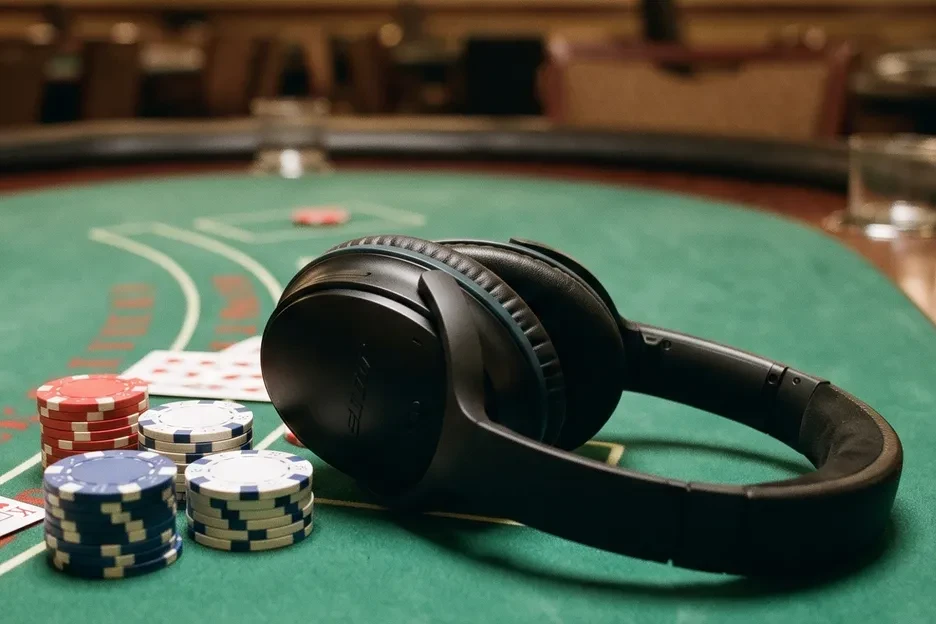
Walk through any big tournament room, from the Horseshoe in Las Vegas to the Merit in Cyprus, and count the headphones. On a busy Day 1 at the world’s biggest poker tournaments, a large share of the field has something over their ears: big noise-cancelling cans, a single earbud, or a hoodie pulled over the lot. It’s one of the most recognisable looks in modern poker.
So what’s actually playing in there? Is it a focus tool, armour against table chat, or just a way to make a ten-hour day feel shorter? This guide brings together three things:
- what named players have said on the record about their music
- what research says about music and concentration
- the 2026 device rules you need to know before you plug in at a major event
The Short Answer
Most poker players who listen to music at the table pick steady, low-vocal or instrumental sound. That usually means electronic music (trance, house, lo-fi), classical or ambient tracks. Players tend to save lyric-heavy, high-energy songs for breaks or for getting pumped up before they sit down. Some of the best players in the world prefer silence.
There’s no single “poker genre.” But the pattern is clear once you look at what players actually say.
What the Pros Say They Listen To
Players’ tastes vary a lot, which is the most honest finding here. These are documented picks, with where they come from and when:
| Player | What they listen to | Where it’s from |
| Jeremy Ausmus (multiple WSOP bracelets) | Mostly classical, plus instrumental covers such as Vitamin String Quartet. He says lyrics distract him and he often pauses the music during a hand | Poker.org “Ask the Org”, Oct 2024 |
| Daniel Negreanu | Relaxation tracks with ocean waves and birdsong to stay calm. Missy Elliott for a lift, and the Rocky soundtrack before he sits down | 2014 feature (Zumic / partypoker). Older info; his habits may have changed |
| Phil Hellmuth | ’80s and ’90s rock | Same 2014 feature. Older info |
| Mike Sexton (late WPT commentator) | Old country songs about poker legends, including one he wrote himself | Same 2014 feature. Older info |
| Alex Foxen | Uses music to keep a steady rhythm in his thinking and “stay in the zone” | As quoted by Chip Leader Coaching |
| Chance Kornuth | Usually no music. He compares the brain to a computer with limited RAM, where every extra program slows it down | As quoted by Chip Leader Coaching |
Look at Negreanu’s 2014 picks and there’s a clear split. He used calm sound to stay focused and saved the energetic stuff for before he played. Ausmus describes the same instinct more recently: he listens to music but pauses it when real money is in the middle. Kornuth goes all the way and plays in silence.
Online, coach and author Nathan “BlackRain79” Williams has written that most of the online grinders he knows play to uplifting trance and progressive house with few vocals. That’s his own circle, not a survey, but it fits the wider pattern of low-vocal, steady-tempo music.
Why Lyrics Matter More Than Genre
The useful question isn’t really “rock or classical?” It’s “words or no words?”
A 2023 study in the Journal of Cognition by Souza and Barbosa tested over 100 university students on general cognitive tasks in three conditions:
- silence
- instrumental lo-fi hip-hop
- popular songs with lyrics in the students’ own language
The tasks were remembering word lists, remembering visual patterns, reading comprehension and arithmetic. What they found:
- Music with lyrics hurt memory performance, both verbal and visual, compared with silence. The effect was small but consistent.
- Instrumental music didn’t clearly help or hurt. It was roughly neutral.
- Participants knew lyrics were distracting. But they also believed instrumental music was helping them, and the data didn’t back that up.
An important caveat: this was a study of lab-style cognitive tasks, not of poker. It doesn’t show that any kind of music makes you a better or worse poker player, and it certainly doesn’t show that instrumental music improves your decisions. The most it supports is a cautious inference.
Poker does lean on similar mental skills:
- Working memory: tracking stack sizes, remembering how a regular played a river two orbits ago.
- Arithmetic: pot odds, effective stacks, SPR (the core maths in any poker tournament strategy).
Lyrics may compete for the same “inner voice” you use to talk yourself through a hand. So turning off vocal tracks during serious decisions is a sensible precaution. It isn’t a proven edge.
The last finding is worth remembering too. Feeling sharper with music on doesn’t prove you are. Treat your playlist mainly as a comfort and energy tool, not as a way to improve your results.
The Hidden Cost: You Stop Hearing the Table
The research covers your own thinking. Live poker adds another problem: information that only reaches you through your ears.
A lot of live tells are verbal:
- the player who chats away with air but goes quiet with the nuts
- the “I guess I’ll call” that’s really a snap
- a half-joking “only two hands beat me” that turns out to be exactly true
A PokerNews strategy piece described this first-hand. The writer had headphones in, missed an opponent talking through a hand, and called off with A-J into pocket queens. The opponent had more or less announced his hand range out loud.
There are also practical misses:
- a dealer announcing an all-in
- a floor call
- the clock being called on you
- an announcement about a break or a redraw
At high volume, sooner or later one of these will be missed.
Some players actually want that isolation. Table chat can be draining, and headphones politely say “not now.” But the trade-off is real: you’re swapping information for focus.
Music by Tournament Stage: A Practical Approach
Many experienced players don’t leave one playlist on all day. They adjust it to the stage of the tournament. A simple framework:
| Stage | What’s at stake | Suggested sound |
| Early levels (deep stacks, low pressure) | Boredom and loose, careless play | Upbeat instrumental or light electronic |
| Middle stages (antes in, stacks shrinking) | Decisions start costing real equity | Instrumental only (lo-fi, ambient, classical), low volume |
| Bubble, ICM spots, final tables | Every decision is big | Silence or one earbud. At many events the rules remove the choice anyway (see below) |
| Breaks and dinner | Resetting your mood | Whatever fires you up, including lyrics |
This matches what the players above describe: pause during big hands, keep vocals for downtime, and focus fully when it counts. That last point is easy to see in any multi-day final table recap, where the late-stage decisions are the ones that decide the money.
Online vs Live: Different Rules of Thumb
Online, there’s no table talk to miss and no dealer to hear. That’s why music is so common among grinders, whether they’re in a PPPoker or PokerBros club or a big online series. The bigger risk is autopilot. If the music keeps you comfortable through hour six of eight tables, check whether timeouts and misclicks creep up late in your sessions.
Live, the costs above apply in full. One earbud, noise-cancelling switched off and a volume at which you can still hear a normal voice is a sensible compromise for most recreational players.
Headphone Rules in 2026: What Applies Where
Rules on music and devices aren’t universal. They fall into two layers, and it helps to keep them separate.
1. General industry guidance (Poker TDA)
Most cardrooms base their rules on the Poker Tournament Directors Association (TDA) rulebook, but each venue adds its own house rules.
- The debate: In May 2026, TDA co-founder Matt Savage said a headphone ban would be discussed at that year’s summit. The trigger was reports that future earbuds could include built-in cameras. Player reaction was strongly divided.
- The outcome: At the June 2026 TDA Summit in Las Vegas, no new electronics rule or procedure was created and headphones were not banned. Directors were urged to watch more closely which devices reach the table, and smart glasses such as Meta’s were singled out as a no-go.
- What this means: No industry-wide headphone ban exists today. But the subject is clearly live, so expect individual venues to tighten their own rules first.
2. Event-specific rules (examples from 2026)
| Event / venue | What the 2026 rules say | Scope |
| WSOP (2026 Official Tournament Rules, Rule 64) | Music players and noise-reduction headsets are allowed until the final three tables of a tournament, then all devices must be removed. They’re not allowed at any feature table, and staff can tell a player to stop using a device at any time | All WSOP live events under these rules |
| Wynn Signature Poker Series (Aug–Sep 2026 terms) | The tournament director can restrict phones, headphones and earbuds at any time. All devices are barred at the final table. During restricted periods, hoods or clothing can’t cover your ears | That Wynn series only. Wynn also hosts WPT events, which publish their own terms |
| Asian Poker Tour (current tournament rules) | No electronic device use while in a hand, no devices on the playing surface, and none at streaming tables. Headphones aren’t specifically mentioned | APT events |
In short, the deeper you go in a big event, the less likely you’ll be allowed music at all. If you rely on headphones to focus, practise playing without them too. Otherwise your first headphone-free session could be at a final table, which is the worst time to find out you need them.
Rules can change between festivals, so always read the rulebook for the specific event before you travel, whether that’s the Malta Poker Festival or the Battle of Malta.
How to Build Your Own Poker Playlist
A practical checklist:
- Default to instrumental. Lo-fi, ambient, classical, film scores or instrumental covers of songs you already love.
- Pick familiar over new. Unfamiliar music pulls your attention to it. Tracks you know well fade into the background.
- Keep the tempo moderate. Very fast, aggressive tracks can push you toward impulsive aggression. You want steady energy.
- Make one long playlist instead of constantly choosing songs. Every skip is a small decision you didn’t need to make.
- Use a “big hand” habit. Pause or lower the volume whenever you’re facing a significant bet, the way Ausmus does.
- Keep the energetic songs for breaks. Your Rocky moment belongs at the dinner break, not in the middle of a river decision.
- Test it honestly. Write a short note after sessions, with and without music. Research suggests our feelings about music’s benefits aren’t reliable, so your own results tell you more.
Final Thoughts
So what do poker players listen to? Players who think about it carefully mostly choose calm, largely wordless sound while they play, and save the rest for breaks. Others, like Kornuth, prefer silence.
Music can make long days bearable and keep table chat at bay. There’s no evidence it makes you a better player, though, and at the wrong moment it can cost you exactly the information that would have saved you a buy-in. Treat your headphones like any other tool in your game: use them on purpose, adjust them to the stage of the tournament, and know when to take them off. Some events will make that last decision for you.
FAQs
What kind of music do most poker players listen to?
Based on what players have said publicly, mostly instrumental or low-vocal music: electronic (trance, house, lo-fi), classical and ambient. Many players save songs with lyrics for breaks.
Do poker pros wear headphones during tournaments?
Many do, especially online and in the early stages of live events. Jeremy Ausmus has said he listens to classical music and often pauses it during hands. Players such as Chance Kornuth prefer no music at all.
Is listening to music while playing poker bad?
Not necessarily. No study has directly tested music’s effect on poker results. A 2023 Journal of Cognition study on general cognitive tasks found that songs with lyrics slightly hurt memory compared with silence, while instrumental music was roughly
Are headphones allowed at the WSOP in 2026?
Yes, with limits. Under Rule 64 of the 2026 WSOP Official Tournament Rules, music players and noise-reduction headsets are allowed until the final three tables of a tournament. From then on, and at any feature table, all devices must be removed.
Has poker banned headphones?
No. A headphone ban was discussed ahead of the June 2026 Poker TDA Summit, but no new electronics rule was adopted. Individual events still set their own limits, especially at final tables.
What is the best focus music for poker?
There’s no proven “best” option. A sensible choice is familiar instrumental music at a moderate tempo and low volume, such as lo-fi, ambient, classical or film scores, paused or turned down during big decisions.
Disclosure: PokerClubGames may earn a commission when you use links to poker operators. This never changes the price you pay. 18+ (21+ where required). Gambling involves risk. How we make money