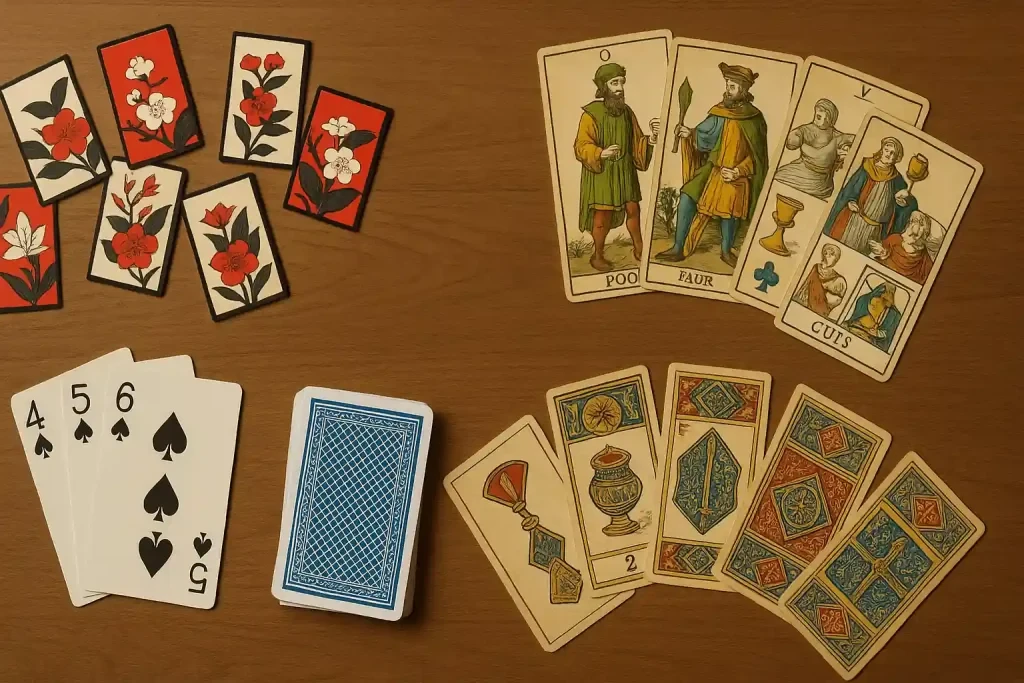
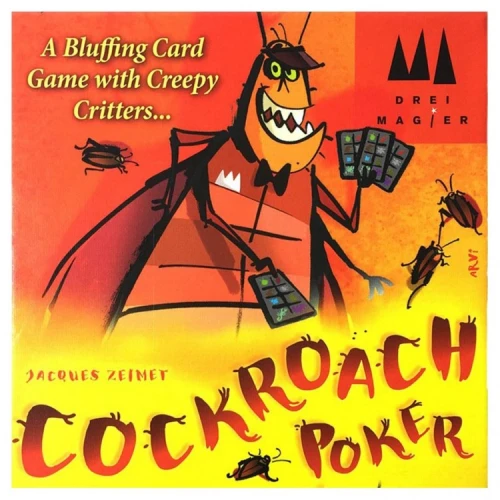
Cockroach Poker: The Bluffing Party Game Where No Cards Are Ranked
On this page
Picture this. A friend slides a face-down card across the table, looks you straight in the eye and says, “This is a cockroach.”
You have no pot odds, no hand ranking and no outs to count. All you’ve got is that person’s face and whatever you know about how they lie.
That’s Cockroach Poker, and it’s why a 64-card game about bugs has been on game shelves for more than twenty years. It has nothing to do with flushes or full houses. But anyone who enjoys the bluffing side of real poker will feel right at home within one round.
This guide explains what the game is, the complete rules (including the two-player version), the strategy that wins at the table, and how it compares with other bluffing card games.
What Is Cockroach Poker?
Cockroach Poker (Kakerlakenpoker in the original German) is a bluffing card game for 2–6 players. It was designed by Jacques Zeimet, illustrated by Rolf Vogt, and first published in 2004 by the German publisher Drei Magier Spiele. Today it’s printed in many languages by publishers around the world, including Devir, Gigamic and Coiledspring Games.
| Quick facts | |
| Designer | Jacques Zeimet |
| First published | 2004 (Drei Magier Spiele) |
| Players | 2–6 (community votes favour 5) |
| Play time | About 20 minutes |
| Age | 8+ |
| Components | 64 cards: 8 creatures × 8 cards each |
| Complexity | About 1.1 out of 5 on BoardGameGeek |
| Community rating | About 6.8/10 from over 16,000 ratings on BoardGameGeek |
| Recognition | Spiel des Jahres nominee (2004) and As d’Or nominee (2006) |
The eight creatures are the cockroach, bat, fly, toad, rat, scorpion, spider and stink bug. None outranks another. There’s no “high card,” no suit order and no best hand. This is the main difference from real poker: the card itself barely matters. What matters is what people say the card is.
The Goal: Don’t Be the One Collecting Bugs
Most card games are about winning. Cockroach Poker is about not losing. There’s exactly one loser, and everyone else wins.
You lose if either of these happens:
- You collect four cards of the same creature face up in front of you (four rats, four flies and so on).
- It’s your turn to start a round and you have no cards left in hand.
Board gamers call this “reverse set collection”: you’re trying to give other players the matching sets.
How to Play Cockroach Poker: Step-by-Step Rules
Setup
Shuffle all 64 cards and deal them face down to every player. Uneven hands are fine. Keep your cards hidden. You’ll place collected cards face up in front of you, sorted by creature, so everyone can see who is getting close to four.
Taking a turn
- Offer a card. The starting player picks a card from their hand and slides it face down to any other player. They then say what it is, for example: “This is a spider.” That claim can be true or a lie.
- The receiver chooses one of two options:
Option A: Call it. Without looking, say “true” (you believe it’s a spider) or “false” (you think it isn’t). Then flip the card:
- If you’re right, the player who offered it must take it back and place it face up in front of themselves.
- If you’re wrong, you keep it face up in front of you.
Option B: Peek and pass. Secretly look at the card, then pass it face down to another player who hasn’t seen it yet. You make your own claim. You can repeat the original (“Yep, spider”) or change it (“Actually, it’s a bat”). The new receiver then faces the same choice.
- The last player must call. A card can never go to someone who has already seen it. If only one player hasn’t seen the card, that player must call true or false.
- The loser of that exchange starts the next round by offering a card from their own hand.
Play continues until someone has four of a kind in front of them, or can’t start a round because their hand is empty.
Two-player rules
Cockroach Poker works for two, with a few changes:
- Remove 10 cards unseen before dealing.
- No passing. Every card offered must be called true or false.
- You lose at five of the same creature (not four), or if you have to start a round with no cards.
It’s playable, but most groups agree the game is at its best with 4–6 players. That’s where the passing chains, and the chaos, really happen.
Why Poker Players Love It (and What It Teaches)
The name is a bit of a joke, since there’s no betting and no hand strength. But the skills it uses will feel very familiar to anyone who plays real poker tournaments.
Reading people over reading cards. Without any card value, every decision comes down to the person across the table. Do they pause before speaking? Repeat the claim too quickly? Look at the card on the table or at you? It’s live-poker tell-reading with nothing else to rely on.
Balanced bluffing. In poker, a player who only bets big with the nuts is easy to read. Cockroach Poker works the same way. If you lie every time, people just call “false.” If you tell the truth every time, they call “true.” The players who last mix it up enough that opponents can’t find a pattern, which is a real-life lesson in staying unpredictable.
Table image. Get caught bluffing twice early and you’ll be seen as a liar for the rest of the night. Smart players use that. Once you’ve got a reputation as a bluffer, telling the plain truth becomes your most effective lie.
Pressure and stack awareness. Everyone’s face-up collection is visible, so you always know who is “short.” A player sitting on three toads is like a short stack on the bubble: every toad offered to them is a high-stakes decision.
It also works as a fun, low-stakes warm-up before a home game. If you’re interested in bluff theory for real money, our poker tournament strategy guide covers the serious version.
Cockroach Poker Strategy: 7 Practical Tips
- Target the vulnerable player. Someone with three scorpions is under pressure. Offer them a card and say “scorpion,” whether it’s true or not. They have to get the call right, and the fear alone often forces a mistake.
- Use the truth as a weapon. Players often assume an obvious claim is a bluff. Saying “stink bug” to the player with three stink bugs while actually handing over a stink bug is one of the game’s classic moves.
- Peeking gives you information. When you peek and pass, you learn which card is in play, and that tells you what’s left in the deck. With only eight copies of each creature, card counting is surprisingly useful in the late game.
- Pass when you don’t have a read. If you have no strong feeling, passing moves the risk elsewhere. Just don’t pass so often that you become predictable.
- Watch your hand size. Running out of cards when it’s your turn to start is an instant loss. Players focused on avoiding four-of-a-kind sometimes forget this second way to lose.
- Vary your timing. Instant claims and long pauses can both give you away. Try to keep the same rhythm whether you’re lying or not, just as you would in a live poker hand.
- Spread the damage. If you have to take a card, it’s better to take a creature you have none of than one you have two or three of. Keep your collection varied for as long as you can.
Cockroach Poker vs Other Bluffing Card Games
If your group likes Cockroach Poker, here’s how it compares with other popular bluffing games:
| Game | Players | Core bluff | Best for |
| Cockroach Poker | 2–6 | Lie about what a face-down card is | Quick, chaotic, very social groups |
| Skull | 3–6 | Bluff about how many flowers (and no skull) you can reveal | Poker-style bidding and pressure |
| Coup | 2–6 | Claim character powers you may not have | Short, cut-throat elimination games |
| Liar’s Dice (traditional) | 2+ | Bid on hidden dice across the table | The closest feel to poker betting |
| Sheriff of Nottingham | Small-group party game | Smuggle goods past the inspecting “sheriff” | Negotiation and bribery fans |
Here’s where Cockroach Poker stands out:
- Simplest to teach. You can explain it in about two minutes.
- No cards in hand matter. Pure bluffing, nothing else.
- Everyone stays in until the end. Coup eliminates players along the way; Cockroach Poker doesn’t.
Editions and Spin-offs
- Cockroach Poker (original, 2004): The standard 64-card version. This is the one to buy first.
- Cockroach Poker Royal (2012): A standalone version with 66 cards. It adds a “royal” card for each creature plus special cards, including a joker. Receiving a royal card carries an extra penalty. It’s good for groups who’ve played the original to death and want a twist.
Both use the same core loss condition: the most bugs of one kind loses.
Price and Where to Buy (November 2026)
Cockroach Poker is one of the cheapest good games you can own. Prices at the time of writing:
| Retailer (region) | Price | Note |
| Goblin Gaming (UK) | £9.34 (RRP £10.99) | Low stock at time of writing |
| Miniature Market (US) | $12.99 (MSRP $14.99) | Devir edition, out of stock at time of writing |
| JB Hi-Fi (Australia) | A$22.70 | Drei Magier Spiele edition |
| Well Played (Switzerland) | CHF 19.00 | English/German/French edition |
Expect to pay roughly 12–20 / £9–£12 / €10–€15 depending on region and edition. Stock changes often, so check your local game shop first. They usually carry it, and it’s a great impulse buy at the counter.
Is Cockroach Poker Worth It?
Buy it if:
- your group enjoys table talk, teasing and bluffing
- you need a game that teaches in two minutes
- you want something light to play between serious games, or before a home poker night
Skip it if:
- your group doesn’t enjoy direct confrontation
- you mostly play with two people (it works, but it isn’t at its best)
- you want deep strategy or long play sessions
Verdict: For the price of a takeaway lunch, Cockroach Poker delivers some of the loudest, funniest twenty minutes in card gaming. It’s not poker. But it might be the purest bluffing exercise you can put on a table.
Into the real thing too? Browse our list of the best poker tournaments in the world, catch up on the latest poker tournament results, or read what music poker players listen to at the table.
FAQs
Is Cockroach Poker actually poker?
No. Despite the name, there are no hand rankings, chips or betting. It shares poker’s bluffing and people-reading, but it’s a “reverse set collection” card game where you try not to collect four of a kind.
How many players can play Cockroach Poker?
2–6 players. It’s at its best with 4–6, and the BoardGameGeek community most often votes 5 as the ideal number.
How do you lose in Cockroach Poker?
You lose if you collect four face-up cards of the same creature, or if it’s your turn to start a round and you have no cards left in hand. In the two-player game the limit is five of the same creature.
Can you play Cockroach Poker with 2 players?
Yes. Remove 10 cards before dealing, don’t allow passing (every card must be called true or false), and play to five of a kind instead of four.
How long does a game of Cockroach Poker take?
About 20 minutes, and setup only takes a shuffle and a deal.
What’s the difference between Cockroach Poker and Cockroach Poker Royal?
Royal is a standalone version with 66 cards. It adds a royal card for each creature and special cards such as a joker, and royal cards carry an extra penalty when you receive them. The original is simpler and better for first-time players.
Disclosure: PokerClubGames may earn a commission when you use links to poker operators. This never changes the price you pay. 18+ (21+ where required). Gambling involves risk. How we make money