

Chinese Poker
Last Updated on July 24, 2026 by Bala Kumar
Introduction
If you’ve spent any time around a poker room in 2026, you’ve probably noticed a card game being played in the corner that looks nothing like Texas Hold’em, no community cards, no flop, no betting rounds in the traditional sense, just players quietly arranging thirteen cards into three separate hands. That’s Chinese Poker, and learning how to play Chinese Poker has become one of the most searched topics among poker beginners heading into 2026.
Originally a casual home game popular across Asia in the early 20th century, Chinese Poker has evolved dramatically. Its modern spinoff, Open-Face Chinese Poker (OFC), exploded in popularity after high-stakes legends like Phil Ivey and Tom Dwan were spotted playing it during breaks at televised tournaments back in 2011. Today, OFC Poker and its variants — including Pineapple OFC and Progressive Chinese Poker, are thriving both online and live. Platforms like KKPoker report Chinese Poker tables running around the clock, with stakes ranging from penny games all the way up to $1,000–$2,000 limits during peak hours.
Whether you’re a Hold’em player looking for something new or a complete beginner searching for Chinese Poker rules explained simply, this guide covers everything from basic Chinese Poker rules to advanced Chinese Poker strategy so you can start playing with confidence.
What is Chinese Poker?
Chinese Poker is a partition-style card game, meaning instead of building one hand like in Hold’em, each player is dealt a full 13-card hand and must split it into three separate poker hands of different sizes. There’s no community board, no flop, and no traditional betting rounds during the hand, the entire game revolves around how well you organize your cards. This is one of the biggest differences poker beginners notice when comparing Chinese Poker vs Texas Hold’em.
Key characteristics:
- Played with a standard 52-card deck
- Typically played by 2 to 4 players
- Each player receives 13 cards
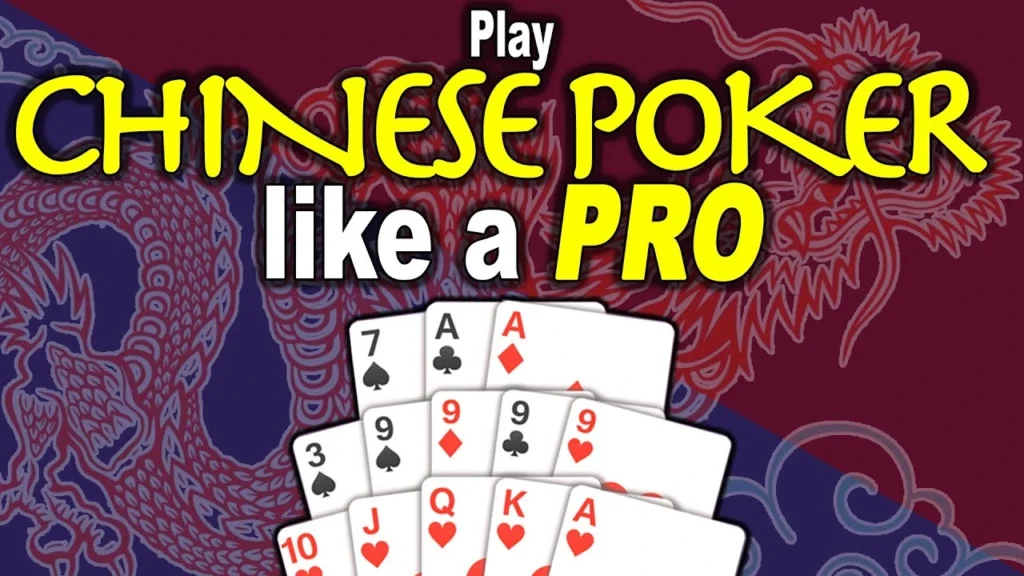
- Players arrange their cards into three hands: a 5-card “back hand,” a 5-card “middle hand,” and a 3-card “front hand”
- Scoring happens by comparing each of your three hands against every other player’s corresponding hand
- No bluffing or betting occurs during the hand, the skill is entirely in hand construction and strategy
Because there’s no folding and no in-hand betting, Chinese Poker feels less like traditional poker and more like a strategic card-placement game, which is part of why so many players describe it as more relaxing, and, in some ways, more mentally demanding, than Hold’em or Omaha Poker.
Basic Rules of Chinese Poker
Here’s a step-by-step breakdown of how Chinese Poker works, ideal for anyone learning Chinese Poker for beginners:
Step 1: Dealing
- All 52 cards are dealt out evenly, giving each of the (typically four) players exactly 13 cards.
Step 2: Arranging Your Hands
Each player privately organizes their 13 cards into three hands:
- Back Hand (5 cards): Must be your strongest hand
- Middle Hand (5 cards): Must be weaker than or equal in strength to your back hand
- Front Hand (3 cards): Must be the weakest of the three, and can only contain a pair or high card (no five-card hands like straights or flushes apply here since it’s only 3 cards)
Step 3: The Golden Rule, No “Fouling”
Your three hands must be arranged in descending strength: back hand ≥ middle hand ≥ front hand. If your middle hand accidentally outranks your back hand, your entire hand is disqualified , this is called “fouling,” one of the most common Chinese Poker mistakes beginners make, and it usually results in an automatic loss of points for that round.
Step 4: Showdown and Comparison
Once everyone has arranged their hands, all three hands are revealed simultaneously and compared head-to-head against every other player’s matching hand (back vs. back, middle vs. middle, front vs. front).
Step 5: Scoring
- Players typically earn or lose 1 point per hand won or lost in each of the three categories.
- Winning all three hands against an opponent often awards a bonus, known as “scooping.”
- Special bonus points (called royalties) are awarded for exceptionally strong hands, such as a full house or better in the back hand, or trips in the front hand.
Poker Hand Rankings
Chinese Poker uses the same standard poker hand rankings as Texas Hold’em, Pot-Limit Omaha, and most other poker variants, from lowest to highest:
- High Card
- One Pair
- Two Pair
- Three of a Kind
- Straight
- Flush
- Full House
- Four of a Kind
- Straight Flush
- Royal Flush
Important note: In the 3-card front hand, only high card, pair, and three-of-a-kind are possible, since you need at least 5 cards to make a straight or flush. Understanding Chinese Poker hand rankings is essential before diving into royalty scoring.
Gameplay Structure
Unlike Texas Hold’em, Chinese Poker doesn’t use community-card stages like the Pre-Flop, Flop, Turn, and River. Instead, the game unfolds through these distinct phases:
Standard Chinese Poker
- Dealing Phase: All 13 cards are dealt at once, face-down.
- Arrangement Phase: Players privately sort their cards into the three hands.
- Showdown Phase: All hands are revealed and compared simultaneously.
- Scoring Phase: Points are tallied based on hand-by-hand comparisons and any royalty bonuses.
Open-Face Chinese Poker (OFC) — The Modern, More Popular Variant
In OFC Poker, the structure changes to add a layer of live decision-making, which is a big reason it has become one of the most trending poker variants of 2026:
- Initial Placement: Each player is dealt 5 cards and must place them face-up, one at a time, into their three hands.
- Subsequent Rounds: Players then receive 3 cards at a time (in Pineapple OFC variants) and choose 2 to place while discarding one, repeating this process until all 13 cards are placed.
- No Rearranging: Once a card is placed, it cannot be moved — every decision is final, which creates much higher strategic tension than the classic format.
- Fantasyland Bonus Round: If a player qualifies with a strong front hand (typically a pair of Queens or better), they earn access to a bonus round called “Fantasyland,” one of the most talked-about features in OFC strategy guides, where all 13 cards are dealt at once instead of gradually.
Tips for Beginners
- Prioritize not fouling. A weak but legal hand almost always beats a strong hand that gets disqualified.
- Start with the back hand. Since it must be your strongest, planning your back hand first makes the rest of your arrangement easier.
- Don’t overvalue your front hand. Beginners often try to force a pair or trips into the 3-card hand and end up weakening their back and middle hands unnecessarily.
- Learn the royalty bonus chart. Since bonus points often outweigh a single hand win, understanding when to aim for royalties (like quads or a straight flush) can significantly boost your win rate. This is a core part of any solid Chinese Poker strategy.
- In OFC, plan ahead before placing cards. Since placements are permanent, think two or three cards ahead rather than reacting card-by-card.
- Practice with low stakes or friendly games first. Chinese Poker’s strategy takes time to click, and low-pressure games are the best way to learn hand-reading and arrangement instincts.
Common Mistakes to Avoid
- Fouling your hand by misjudging hand strength between your back and middle hands
- Ignoring royalty opportunities, which can be a major source of points over time
- Overcommitting to one strong hand at the expense of balance across all three hands
- Playing too passively in OFC by avoiding strong-but-risky placements out of fear of fouling
- Failing to track opponents’ visible cards in Open-Face Chinese Poker, where mistakes are often punished heavily since cards are dealt face-up
Chinese Poker vs Other Poker Variants
If you’re coming from Texas Hold’em, PLO, or other poker variants, here’s how Chinese Poker compares:
| Feature | Chinese Poker | Texas Hold’em | Pot-Limit Omaha |
| Cards per player | 13 | 2 | 4 |
| Betting during hand | None (classic) | Yes | Yes |
| Community cards | None | 5 | 5 |
| Skill focus | Hand arrangement | Betting & bluffing | Hand reading & pot control |
| Best for | Strategic, low-stress play | Classic tournament poker | High-variance, big-pot poker |
This makes Chinese Poker an excellent side game for players who enjoy Hold’em or Omaha but want a break from constant betting decisions.
Conclusion
Chinese Poker offers a refreshing change of pace from traditional poker formats, no bluffing pressure, no chip stacks to protect, just pure strategic card arrangement. Its modern cousin, Open-Face Chinese Poker, has become a genuine trend in 2026, drawing both casual players and high-stakes professionals into dedicated online rooms and live side games around the world.
Whether you’re looking for a relaxed alternative to Hold’em or a new strategic challenge to sharpen your card-reading skills, learning how to play Chinese Poker is well worth the effort. Start with the basics, avoid fouling your hands, and don’t be afraid to jump into a low-stakes table to get a feel for the format, from there, the strategic depth of this rising poker variant will reveal itself the more you play.
FAQs
1. What is Chinese Poker?
Chinese Poker is a card game where players arrange 13 cards into three separate hands instead of betting during each round.
2. What is the difference between Chinese Poker and OFC?
In Chinese Poker, all 13 cards are dealt at once. In Open-Face Chinese Poker (OFC), cards are dealt gradually and placed face-up.
3. Can you bluff in Chinese Poker?
No. Chinese Poker has no betting rounds, so success depends on hand arrangement rather than bluffing.
4. What happens if you foul your hand?
A fouled hand breaks the required hand order and is usually disqualified, resulting in a loss of points.
5. Is Chinese Poker good for beginners?
Yes. The basic rules are easy to learn, making it a great poker variant for beginners looking to improve their strategy.
Disclosure: PokerClubGames may earn a commission when you use links to poker operators. This never changes the price you pay. 18+ (21+ where required). Gambling involves risk. How we make money