
Last Updated on October 5, 2026 by Bala Kumar
Why most home games go wrong
Anyone can invite friends round and shuffle a deck. Running a home poker tournament that finishes on time, feels fair and doesn’t end in an argument over who owes what is a different job.
The good news is that almost every problem comes from the same three places: a blind structure that’s too slow or too fast, a chip set-up that runs out of small chips, and payouts nobody agreed on in advance. Get those right and the night runs itself.
This guide gives you a ready-to-use plan for 6 to 10 players, with tables you can print and use tonight.
Quick checklist
| Item | What you need |
| Players | 6–10 for one table (up to 20 across two tables) |
| Time | About 3.5–4.5 hours with 20-minute levels |
| Chips | 300 for up to 7 players, 500 for 8–10, 1,000 for two tables |
| Cards | Two decks with different backs, so one can be shuffled while the other is dealt |
| Timer | Any phone timer or free tournament clock app |
| Extras | Dealer button, a printed blind sheet, pen and paper for the payout list |
Step 1: Check the rules where you live
Laws on private poker games vary widely between countries, states and provinces. In many places a friendly game is fine as long as the host doesn’t take a cut of the buy-ins or charge entry fees. In others, any game played for money is restricted.
Take two minutes to check your local rules. If in doubt, play for a trophy, bragging rights or very small stakes, and never take a rake as host.
Step 2: Choose your format and buy-in
Freezeout: Everyone buys in once. Lose your chips and you’re out. This is the simplest format and keeps the timing predictable.
Rebuy: Players can buy back in during the first few levels. It’s more relaxed for beginners, but it makes the night longer and the prize pool harder to predict.
For your first home poker tournament, run a freezeout. Choose a buy-in everyone is comfortable losing, collect it before the first hand, and write the names down.
Step 3: Get the right chips
How many chips per player
A starting stack of 10,000 is easy to count and gives everyone room to play. Here’s a simple breakdown that uses just four chip values:
| Chip value | Chips per player | Value per player | Total for 10 players |
| 25 | 8 | 200 | 80 chips |
| 100 | 8 | 800 | 80 chips |
| 500 | 6 | 3,000 | 60 chips |
| 1,000 | 6 | 6,000 | 60 chips |
| Total | 28 | 10,000 | 280 chips |
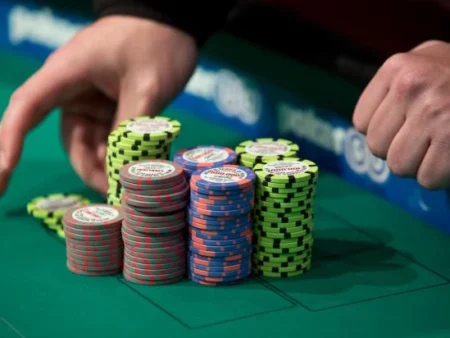
A standard 500-chip set covers 10 players comfortably, with spares left over for making change. Colours vary between sets, so simply decide which colour equals which value and write it on the blind sheet.
Best poker chip set for home games: what to buy
You don’t need branded casino chips to run a great game. What matters most is the material, the weight and having at least four distinct colours. Here’s what you can expect to pay for a 500-chip set with a case, based on current US retail prices checked in October 2026:
| Chip type | Weight | Typical 500-set price | Feel and best use |
| Plastic / budget composite | about 11.5 g | about 40–60 | Light and clicky; fine for occasional games |
| Clay composite (mid-range) | 13.5 g | about 85–130 | Casino-style heft and sound; the sweet spot for regular games |
| Heavy clay composite | 14 g | about 110–150 | Solid stacking feel; good for serious groups |
| Ceramic (printed values) | 10–12 g | about 200–400 | Custom designs and denominations printed on the chip |
For most groups, a 13.5 g clay-composite set is the best value. It looks and sounds like a real card room without the premium-ceramic price. Check that the set has numbers printed on the chips, or at least enough colours for your four values. Prices vary by region, so treat these as a rough guide.
Step 4: Set the poker tournament blind structure
The blind structure decides how long your tournament lasts. Too slow and you’ll still be playing at 2 a.m. Too fast and it becomes an all-in lottery.
This structure is built for 10,000 starting chips and 20-minute levels:
| Level | Small blind | Big blind | Notes |
| 1 | 25 | 50 | |
| 2 | 50 | 100 | |
| 3 | 75 | 150 | |
| 4 | 100 | 200 | |
| 5 | 150 | 300 | |
| Break | — | — | 10 minutes; colour up the 25 chips |
| 6 | 200 | 400 | |
| 7 | 300 | 600 | |
| 8 | 400 | 800 | |
| 9 | 500 | 1,000 | |
| 10 | 600 | 1,200 | |
| Break | — | — | 10 minutes |
| 11 | 800 | 1,600 | |
| 12 | 1,000 | 2,000 | |
| 13 | 1,500 | 3,000 | |
| 14 | 2,000 | 4,000 | |
| 15 | 3,000 | 6,000 | Usually heads-up by now |
How to adjust it:
• Want a shorter night? Use 15-minute levels. You’ll finish about an hour earlier.
• Want more play? Use 25- or 30-minute levels, or start with 15,000 chips.
• Want to speed up the late stages? Add a “big blind ante” from level 7, where the player in the big blind pays one extra big blind for the whole table.
Colouring up simply means removing the smallest chips once they’re no longer needed. At the first break, swap every four 25 chips for one 100 chip. Any leftover 25s are usually rounded up to a 100 for the player with the most leftovers.
Step 5: Agree the payouts before the first hand
Nothing kills the mood faster than arguing about prizes at the final table. Decide the payout structure, write it down and announce it before cards are dealt.
| Number of players | Places paid | Split of the prize pool |
| 2–6 | 1–2 | Winner takes all, or 70% / 30% |
| 7–10 | 3 | 50% / 30% / 20% |
| 11–15 | 4 | 45% / 25% / 18% / 12% |
| 16–20 | 5 | 40% / 25% / 16% / 11% / 8% |
Example: 10 players each put in 20, making a 200 prize pool. First place gets 100, second gets 60 and third gets 40.
Many groups also like a “bubble” rule, where everyone chips in a small amount to refund the player who finishes one spot outside the money. It’s optional, but it keeps the late stages friendly.
Step 6: How to deal a poker game properly
Good dealing keeps the game fair and moving. If players take turns dealing, make sure everyone follows the same routine.
1. Place the dealer button. Draw for the highest card to decide who starts with the button. It moves one seat to the left after every hand.
2. Post the blinds. The player to the left of the button posts the small blind, and the next player posts the big blind.
3. Shuffle thoroughly. Mathematicians have shown that about seven riffle shuffles are needed to properly mix a deck. Finish with a cut by the player to the dealer’s right.
4. Deal clockwise. Start with the small blind and deal one card at a time to each player until everyone has two.
5. Burn and turn. Before the flop, turn and river, discard one card face down (the “burn”), then deal three, one and one community cards.
6. Manage the pot. Keep bets in front of each player until the betting round ends, then push them into the middle. This avoids confusion about who has called.
7. Showdown. The last player to bet or raise shows first. Read both hands out loud before pushing the pot to the winner.
Using two decks speeds this up: one player shuffles the spare deck while the current hand is played.
Rules to settle before you start
Write these on the blind sheet so nobody can argue later:
• One player to a hand. No advice from people who’ve already busted.
• No string bets. A player must announce “raise” or put all the chips out in one motion.
• Cards speak. The best hand wins, even if a player misreads it.
• Exposed cards. If a card is flipped during the deal, the dealer replaces it with the next card and puts the exposed one on top as the first burn.
• Absent players. Their blinds are still posted, and their hand is folded if they’re not back in time to act.
Common mistakes to avoid
Too few small chips. If players can’t make change for the blinds, the game slows down. Keep a “bank” of spare chips with the host.
No timer. Without a visible clock, levels quietly stretch and the night drags. Put a phone timer where everyone can see it.
Starting late. Set a firm start time and begin even if one person is missing. Late arrivals can join with a full stack, minus any blinds already posted.
Unclear payouts. Always announce the payout split before the first hand.
Hosting while playing too seriously. As host, your job is to keep things moving. Appoint a helper to handle the clock if you want to focus on your game.
Final thoughts
A great home poker tournament doesn’t need a fancy table or expensive gear. It needs a decent chip set, a sensible blind structure, payouts everyone has agreed to, and a dealing routine that keeps things fair. Print the tables above, set your timer and you’ll run a smoother game than most casual card rooms.
FAQs
How many chips do you need for a home poker tournament?
Plan on about 28 chips per player for a 10,000 starting stack. A 500-chip set covers up to 10 players, and 1,000 chips covers two tables.
What is a good blind structure for a home poker tournament?
With 10,000 starting chips, start at 25/50 and increase every 20 minutes through levels such as 50/100, 100/200, 200/400 and 500/1,000. This usually finishes in about 3.5 to 4.5 hours with 10 players.
How should home poker tournament payouts be split?
For 7–10 players, a common split is 50% for first, 30% for second and 20% for third. Smaller games can use winner-takes-all or 70/30.
What is the best poker chip set for home games?
For most groups, a 500-piece set of 13.5-gram clay-composite chips offers the best balance of casino feel and price, typically around $85 to $130 as of October 2026.
Founder of PokerClubGames.com and a Poker Researcher with 10+ years of experience in SEO, WordPress development, and gaming content strategy. Specializes in researching online poker sites, poker apps, tournaments, bonuses, and poker strategies. Experienced in poker platform reviews, affiliate marketing, and creating SEO-focused poker content for global audiences.
For collaborations, media inquiries, or poker-related partnerships:
Contact: partnerships@pokerclubgames.com