
If you’ve searched for a poker odds calculator recently, you’ve probably noticed the field is more crowded than it was a few years ago. PokerStove, the tool an entire generation of players cut their teeth on, stopped receiving mainstream updates years ago, reports on the exact timeline vary, with its stable release dated to 2008 and the original pokerstove.com site going offline around 2013, though the code was later open-sourced and has seen occasional community-maintained releases since. In its place, a whole ecosystem of desktop programs, mobile apps, and browser-based calculators has grown up, each built for a slightly different job: quick hand-vs-hand checks, deep range-vs-range study, tournament ICM math, or full solver-based GTO work.
Most “best odds calculator” roundups just list ten tools without telling you which one fits what you’re actually trying to do. Here’s a practical 2026 comparison, Poker Odds Calculators Compared (Plus Our Free Instant Tool), covering what each major option does well, what it costs, and who it’s genuinely built for.
What a Poker Odds Calculator Actually Does
Before comparing tools, it’s worth being precise about the category. A poker odds (or equity) calculator — often searched as a Texas Hold’em odds calculator, takes your hole cards, the board, and either a specific opponent hand or an opponent’s range, and returns your win/tie/loss probability. Exact enumeration produces a precise equity result by checking every possible remaining card combination for the specified inputs. Monte Carlo simulation instead estimates equity by running a large number of randomized trials, accurate enough for practical decisions once the sample size is high, but technically an approximation rather than an exact figure.
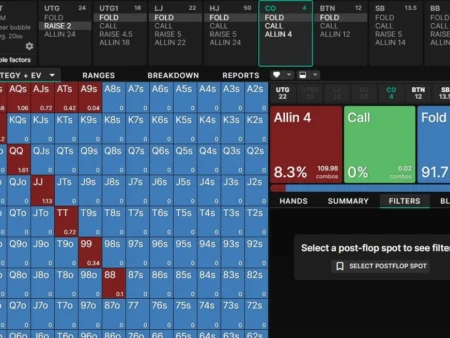
That’s a different job from a solver like GTO Wizard or PioSOLVER, which doesn’t just tell you your equity — it tells you the theoretically optimal strategy for the whole hand, including bet sizing and frequency. Confusing these two categories is the most common mistake players make when shopping for a tool. One practical note on accuracy: exact enumeration and Monte Carlo simulation converge closely once the simulation sample size is large enough, so in practice most accuracy complaints trace back to incorrect range inputs rather than the calculation method itself.
The Current Field, Compared
| Tool | Type | Best For | Cost |
| Equilab | Desktop (Windows) | Free range-vs-range study, the closest spiritual successor to PokerStove | Free |
| PokerCruncher | Mobile app | On-the-go equity checks with a genuinely deep paid tier | Free (basic) / paid upgrade |
| HoldemResources Calculator | Desktop | Tournament-focused equity and ICM work at a lower price point than premium suites | Paid, one-time |
| Flopzilla | Desktop | Board texture and range visualization — how a range hits a specific flop | Paid |
| GTO Wizard | Web/cloud platform | Full solver-based strategy study, not just raw equity | Multiple tiers, restructured in 2026 — check official pricing before subscribing |
| ICMIZER | Web/desktop | Tournament push/fold and final-table ICM decisions | Subscription |
| CardsChat / CardPlayer / PokerNews calculators | Free web tools | Fast, no-signup hand-vs-hand checks | Free |
| PokerStove | Desktop (legacy) | No longer mainstream-supported; code now community-maintained on GitHub | Free, unofficial |
A few things stand out looking at this list as a whole. The split between free and paid tools maps almost exactly onto casual versus serious study — Equilab and the web calculators cover the “I just want the number” use case for free, while GTO Wizard and ICMIZER exist for structured, repeated study and are priced accordingly (GTO Wizard’s tiers were restructured in early 2026, so it’s worth checking current rates directly on their site rather than relying on an older price quoted elsewhere). And PokerStove’s long absence from mainstream development has created a real gap that Equilab and newer browser-based tools have stepped in to fill — worth knowing if you’ve been hunting for a working PokerStove download, since the official site hasn’t been actively maintained for years.
Where Each Tool Actually Wins
Free, no-signup, right-now answers: the web calculators from CardsChat, CardPlayer, and PokerNews are built exactly for this. Type in two hands, hit calculate, get a percentage. No installs, no accounts, no learning curve. The tradeoff is depth — you won’t model a 15-hand opponent range or visualize how it interacts with a paired board.
Serious range study without paying: Equilab remains the standard recommendation. It’s a genuine desktop application, handles Hold’em and Omaha, and lets you build custom ranges, run scenario simulations, and quiz yourself on hand-reading — all for free. It’s aging in places, but the underlying math still holds up.
Studying on your phone: PokerCruncher is the consistent pick across current buyer’s guides. The free tier covers basic preflop equity fast; the paid version is one of the more advanced mobile equity tools available, bringing range work to a phone that used to require a desktop.
Tournament play: a plain equity calculator won’t tell you whether a call is correct once ICM pressure is factored in — stack sizes, payout jumps, and bubble dynamics change the math completely. HoldemResources Calculator and ICMIZER exist specifically for this; neither Equilab nor a quick web calculator is a substitute.
Outgrowing equity math entirely: GTO Wizard sits in a different category. It’s not answering “what’s my equity” — it’s answering “what’s the theoretically correct play, and how often should I make it.” That’s useful once you know pot odds and ranges cold, but it’s the wrong starting point for beginners; pricing runs across several tiers and changed in early 2026, so check GTO Wizard’s own site for current rates rather than an older figure.
Our Free Instant Tool
We built our own free poker calculator specifically for that first category — instant, no-signup, browser-based answers to the question players ask most during hand reviews, study sessions, or between sessions: “who’s ahead here, and by how much?” (Note: using an odds calculator during live play at a casino or on a poker site is against the rules almost everywhere — this tool is for study and review, not for in-hand use.) Enter your hand and your opponent’s hand (or a range), set the board, and get a real-time win/tie/loss breakdown without downloading anything or creating an account.
It’s not trying to replace Equilab for deep range study or GTO Wizard for solver work — it’s built for the fast, practical check that covers most real situations: a hand history you’re reviewing, a spot you want to settle an argument about, or a quick sanity check after a session. If that’s what you need, it’s right here on the site, free, whenever you want it.
Final Thoughts
The right poker odds calculator depends on what problem you’re solving. For a fast answer, use a free web tool. For serious range study, Equilab is still the standard. For mobile work, PokerCruncher. For tournament decisions, ICMIZER or HoldemResources Calculator. For full solver-based strategy, GTO Wizard. None of them are wrong — they’re built for different depths of the same question, and most serious players end up using two or three for different jobs rather than hunting for one tool that does everything.
FAQs
What is the best free poker odds calculator in 2026?
Equilab remains the top free desktop option for range-vs-range study, while browser-based tools from CardsChat, CardPlayer, and PokerNews offer faster, no-signup checks for quick hand-vs-hand questions.
Is PokerStove still available in 2026?
Not as an actively maintained mainstream product. Reports vary on the exact timeline, but the tool stopped receiving regular commercial updates around 2008–2013, and while its code was later open-sourced with occasional community releases, working official downloads are increasingly hard to find. Equilab is generally considered its closest free successor.
What’s the difference between an odds calculator and a solver like GTO Wizard?
An odds calculator returns your win/tie/loss probability for a given hand and board. A solver like GTO Wizard goes further, calculating the theoretically optimal strategy — including bet sizing and frequency — for the entire hand.
Which poker odds calculator is best for mobile?
PokerCruncher is consistently recommended for mobile use, with a free tier for basic preflop checks and a paid tier offering deeper range analysis on a phone.
Do I need a separate tool for tournament poker?
Yes, generally. Standard equity calculators don’t account for ICM (Independent Chip Model) pressure from stack sizes and payout jumps. Tools like ICMIZER and HoldemResources Calculator are built specifically for tournament
Founder of PokerClubGames.com and a Poker Researcher with 10+ years of experience in SEO, WordPress development, and gaming content strategy. Specializes in researching online poker sites, poker apps, tournaments, bonuses, and poker strategies. Experienced in poker platform reviews, affiliate marketing, and creating SEO-focused poker content for global audiences.
For collaborations, media inquiries, or poker-related partnerships:
Contact: Info@hugecount.com