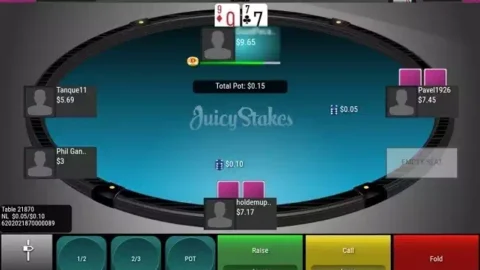

Review of the Poker Game: A Complete Guide for Players

On this page
Few card games have endured, and evolved, quite like poker. What began in smoky backrooms has become a global phenomenon spanning live casinos, home games, and a rapidly growing online ecosystem projected to reach roughly $4.78 billion in market value in 2026. Whether you’re completely new to the poker game or looking to sharpen an existing understanding of it, this guide breaks down what poker actually is, how its major variants work, and what you need to know before sitting down at a table — virtual or otherwise.
What Makes Poker Different From Other Card Games
At its core, poker is a game of incomplete information, calculated risk, and psychological pressure. Unlike games of pure chance, a poker game rewards players who can read situations, manage uncertainty, and make disciplined decisions over time. That’s what separates it from something like blackjack or roulette, skill compounds across sessions in poker in a way that pure games of chance don’t allow.
This is also why poker has sustained such long-term popularity: it rewards improvement. A player who studies fundamentals genuinely gets better, which keeps the competitive incentive alive in a way few other card games manage.
The Most Popular Poker Variants
Not all poker games are the same, and understanding the differences matters before you pick where to spend your time.
Texas Hold’em
By far the most widely played variant worldwide, Texas Hold’em gives each player two private cards combined with five shared community cards. Its balance of simplicity and strategic depth has made it the default format for most major tournaments and online rooms.
Omaha
Omaha shares Hold’em’s community-card structure but deals four hole cards instead of two, requiring players to use exactly two of them in their final hand. This creates bigger hand ranges and generally more action-heavy pots, appealing to players who enjoy higher variance.
Seven-Card Stud
A format that predates Hold’em’s dominance, Stud deals a mix of face-up and face-down cards with no community cards at all. It rewards strong memory and observational skills since so much information is visible throughout the hand.
Short-Deck (Six-Plus) Hold’em
A newer variant gaining traction, particularly in Asian markets and high-stakes cash games, Short-Deck removes cards 2 through 5 from the deck, which shifts hand values and increases the frequency of strong hands significantly.
Cash Games vs. Tournaments
One of the most important early decisions any player makes is choosing between cash games and tournament poker — and the two require genuinely different skill sets.
Cash games let you buy in and cash out at any point, with chips holding direct real-money value throughout the session. This format rewards consistent, disciplined decision-making since you can reload and adjust your strategy freely.
Tournaments involve a fixed buy-in, escalating blind levels, and elimination — you’re playing for a share of a prize pool rather than direct chip value. This format demands a different mindset: stack preservation, ICM (Independent Chip Model) awareness near the money, and adapting aggressively as blinds increase relative to your stack.
Neither format is objectively better — they simply reward different strengths, and many strong players specialize in one over the other.
Online Poker vs. Live Poker
The online poker landscape has changed dramatically over the past several years, with mobile-first platforms now representing a significant share of overall player traffic. Online play offers speed, accessibility, and multi-tabling, which changes both the pace of decision-making and how you read opponents — timing patterns and bet sizing replace physical tells almost entirely.
Live poker, by contrast, moves slower, and physical presence introduces psychological and social elements that don’t exist online — reading posture, tone, and demeanor alongside the betting action itself.
Many serious players engage with both, treating online play as higher-volume practice and live play as a different, complementary discipline.
Core Skills Every Poker Player Needs
Regardless of variant or format, a handful of fundamentals show up across every serious poker guide:
- Starting hand selection — Playing too many hands is the most common leak among newer players.
- Positional awareness — Acting later in a hand provides a genuine informational advantage.
- Pot odds and equity — Understanding whether a call is mathematically justified removes guesswork from close decisions.
- Bankroll management — Playing within stakes appropriate to your bankroll protects both your finances and your decision-making.
- Emotional control — Tilt following a bad beat is one of the fastest ways serious players lose more than the hand that triggered it.
What to Look for When Choosing Where to Play
Whether you’re picking an online room or a live cardroom, a few practical factors are worth checking before committing real money:
- Game variety — Does the room support the format you actually want to play?
- Player traffic — Higher traffic generally means better table availability and more consistent tournament guarantees being met.
- Security and licensing — Verify actual regulatory licensing and encryption standards rather than relying on marketing language.
- Rake structure — Understand exactly how much is taken from pots or buy-ins, since this directly affects long-term profitability.
- Customer support quality — Responsive support matters more than it seems until you actually need it.
Is Poker Still Worth Learning in 2026?
With online poker traffic continuing to consolidate around a handful of major networks and overall market size still expanding year over year, the game remains far from a declining pastime. If anything, the barrier to entry has dropped, mobile access, free-to-play formats, and abundant strategy resources make it easier than ever to start learning the fundamentals seriously.
Final Thoughts
The poker game, in any of its major forms, rewards patience, study, and disciplined decision-making far more than luck alone. Whether you gravitate toward the fast pace of online cash games, the structured pressure of tournament poker, or the social dynamics of a live table, understanding the fundamentals covered in this guide gives you a genuine foundation to build on — one hand, one session, and one decision at a time.
Disclosure: PokerClubGames may earn a commission when you use links to poker operators. This never changes the price you pay. 18+ (21+ where required). Gambling involves risk. How we make money