ICM Tools & Bubble Factor: Reading Pressure Like a Pro
On this page
In a poker tournament, chips and money aren’t worth the same thing. Losing a stack costs you more than winning the same stack gains you, and that gap is widest near the bubble. ICM tools put a number on it, and the bubble factor turns that number into a simple rule: how much equity you need to call.
This guide explains both ideas with real numbers and compares the ICM tools poker players are using in 2026.
What Is ICM?
ICM (the Independent Chip Model) turns tournament chip stacks into real-money equity. It works out each player’s chance of finishing in every paid place and multiplies those chances by the prize for each place. Most ICM tools poker players use rely on the Malmuth-Harville model.
The key result is that chips have diminishing value. Doubling your stack doesn’t double your money equity, because the top prize is capped and you’ve already locked in part of the lower prizes.
What Is Bubble Factor?
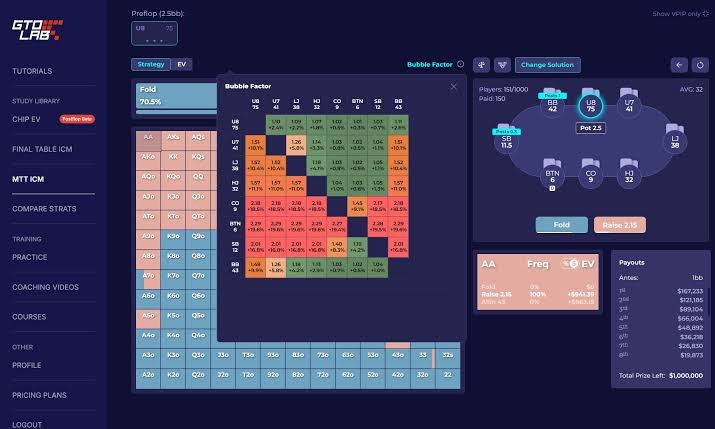
Bubble factor compares what you lose by busting an all-in with what you gain by winning it, both measured in tournament dollars.
Bubble factor = (equity lost if you lose) ÷ (equity gained if you win)
A bubble factor of 1.0 means chips and money are worth the same, just like a cash game. Anything above 1.0 means losing hurts more than winning helps, so you need a stronger hand to get your chips in.
To turn bubble factor into the equity you need to call:
Required equity = BF ÷ (BF + 1)
A worked example on the bubble
Four players are left, three get paid ($50 / $30 / $20), and the stacks are:
Player A: 4,000 chips. ICM equity $33.60
Player B: 3,000 chips. ICM equity $29.49
Player C: 2,000 chips. ICM equity $23.59
Player D: 1,000 chips. ICM equity $13.32
We calculated these with the standard Malmuth-Harville model. Here’s how much pressure each all-in creates:
A calls B’s all-in: bubble factor 1.71. A needs 63.1% equity, not 50%
B calls A’s all-in: bubble factor 2.69. B needs 72.9% equity
C calls B’s all-in: bubble factor 2.17. C needs 68.5% equity
D calls A’s all-in: bubble factor 1.57. D needs 61.1% equity
A calls D’s all-in: bubble factor 1.13. A needs 52.9% equity
Reading Pressure Like a Pro
The numbers show three patterns that ICM tools confirm again and again.
- Medium stacks are under the most pressure. Player B has a bubble factor of 2.69 against the chip leader, so a call needs almost 73% equity. Busting before the short stack would waste a stack that is close to a guaranteed payout.
- The chip leader has a licence to attack. A only needs 52.9% to call the short stack, but every opponent needs 61–73% to call A. That gap is why big stacks should open wide and shove often on the bubble.
- The short stack has less to lose than you’d think. D’s bubble factor is lower than B’s or C’s because D is already likely to finish fourth. Short stacks can gamble more, and medium stacks should avoid tangling with them unless they hold strong hands.
The practical rule: before you call an all-in near the money, ask who covers whom, what each stack loses by busting, and what the bubble factor says you need. Then check the spot afterwards in an ICM tool.
Best ICM Tools for Poker in 2026
ICMIZER 3 (Windows, macOS)
Price: Basic $17.99/month or $99.99/year. PRO $32.99/month or $179.99/year (prices exclude VAT)
Free option: Free basic ICM calculator and a 7-day trial
Best for: Push/fold training and hand review. The PRO plan adds MTT Coach and a replayer.
HoldemResources Calculator (HRC) (Windows, macOS, Linux)
Price: Classic $16.66/month or $119.90/year. Pro $49.99/month or $359.90/year
Free option: Full 2-week trial
Best for: Accurate Nash and ICM calculations. Classic handles up to 50,000 nodes, which suits stacks under 30 big blinds. Pro has no node limit and adds postflop modelling. It supports ICM, Weitzman and FGS models and imports hands from HM2, PT3 and PT4.
GTO Wizard (browser)
Price: From $49/month, or $39/month billed yearly. Premium $99, Elite $169, Ultra $279 per month
Free option: None listed by the source we used
Best for: Full ICM solutions with training drills and multi-payout support.
SnapShove (iOS, Android)
Price: Core $3.99/month. Unlimited $9.99/month or $99.99/year
Free option: One calculation a day, with unlimited training
Best for: Push/fold checks at the table on your phone
Free ICM calculators
MTTDB and the PokerJudge ICM Calculator both work in the browser, and CHIMP is a free download. None of them includes a push/fold solver, but all are fine for checking ICM equity and bubble factor by hand.
Which ICM Tool Should You Choose?
If you play SNGs or short-stacked MTTs on a budget, HRC Classic or ICMIZER Basic covers most push/fold spots for around $100–120 a year. If you play deep-stacked MTTs and want full postflop ICM, GTO Wizard or HRC Pro is the step up. To learn bubble factor without spending anything, start with a free calculator and work through your own bubble hands.
How to Use a Bubble Factor Calculator
- Enter every player’s stack and the prize structure.
- Choose the two players involved in the all-in.
- Note each player’s ICM equity before the hand, after a win and after a loss.
- Divide the loss by the gain to get the bubble factor.
- Convert it to required equity with BF ÷ (BF + 1), then compare that with your hand’s equity against your opponent’s range.
FAQs
What is the best ICM tool for poker?
For accuracy, HoldemResources Calculator is the most common pick. ICMIZER is the easiest for push/fold training. GTO Wizard has the most complete ICM solutions if you play deeper stacks.
Is there a free ICM tool for poker?
Yes. ICMIZER has a free basic calculator, HRC has a two-week free trial, and MTTDB, PokerJudge and CHIMP are free.
What is a good bubble factor?
There’s no good or bad bubble factor. It describes how much risk you’re facing. Around 1.0 plays like a cash game, while 2.0 or higher means you need roughly 67% or more equity to call.
Who has the highest bubble factor on the bubble?
Medium stacks facing the chip leader usually do. In our example, the 3,000-chip stack needed 72.9% equity to call the 4,000-chip leader.
Does ICM matter in cash games?
No. In cash games, chips are worth exactly their cash value, so the bubble factor is always 1.0.
Disclosure: PokerClubGames may earn a commission when you use links to poker operators. This never changes the price you pay. 18+ (21+ where required). Gambling involves risk. How we make money