
Last Updated on September 22, 2026 by Bala Kumar
There’s a specific kind of mistake that even experienced players make more often than they’d like to admit: playing a hand based on a stack size that no longer exists. You glance at your opponent’s stack once, early in the session, file it away as “the deep stack” or “the short stack” in your head, and then keep making decisions off that mental snapshot for the next hour — even as the actual number in front of them has moved dramatically.
Monitoring stack sizes isn’t a one-time task you complete when you sit down. It’s an ongoing habit, closer to checking your mirrors while driving than reading a menu once before ordering. And like most habits that matter, it’s easy to let slip during a long session, which is exactly when it costs the most.
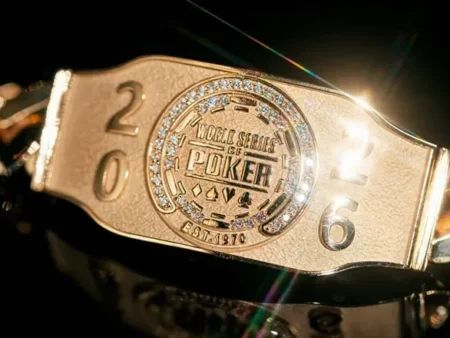
A Real Example: The 2026 WSOP Main Event Bubble
Few moments in poker demonstrate the value of constant stack awareness better than a tournament bubble, and the 2026 WSOP Main Event bubble was a particularly vivid one. Heading into Day 4, the field had been trimmed from 9,208 entries down to 1,389 players, with only seven eliminations standing between the remaining field and a guaranteed $15,000 payday. Every single stack at every table suddenly mattered in a way it hadn’t the day before.
The spread was extreme. Chip leader Sasha Liu returned with roughly 300 big blinds, while several players — including Nicholas Hellmuth, son of poker legend Phil Hellmuth — came back with as few as six big blinds. Reigning champion Michael “The Grinder” Mizrachi navigated Day 5 with around 30 big blinds, comfortable enough to play real poker but far from safe. Meanwhile, 2003 World Champion Chris Moneymaker was eliminated in 1,383rd place during hand-for-hand bubble play, one of three players sent to the rail simultaneously as the rest of the field erupted in relief at finally reaching the money.
What made the difference between the players who survived the bubble and those who didn’t wasn’t just raw stack size — it was how closely they were tracking everyone’s stack at the table, including their own, in real time. Short-stacked players who made it through the bubble typically picked their spots with unusual discipline, aware down to the big blind of exactly how much pressure they could apply or absorb. Players who busted often did so by misjudging a stack — their own or an opponent’s — in a moment that called for precision.
Why Stack Monitoring Slips During a Session
Nobody sits down intending to stop paying attention to chip counts. It happens gradually, usually for one of a few predictable reasons. Long sessions create fatigue, and fatigue narrows attention to the cards in front of you rather than the wider table. Multi-tabling online compounds this further — with several tables open at once, it’s tempting to register only your own stack and skip a genuine read on opponents. And emotionally, a bad beat or a big pot can pull focus inward for several hands, right when the table’s stack picture may have shifted the most.
The irony is that the moments when attention naturally drifts — after a big pot, deep into a long session, during a distracting multi-table stretch — are often exactly when stack sizes have changed the most and monitoring matters the most.
A Practical Tool: The M-Ratio
Counting big blinds is a good habit, but it doesn’t tell the whole story, especially in tournaments with antes. This is where the M-ratio, a concept popularized by poker author Dan Harrington, becomes genuinely useful. M is calculated by dividing your stack by the total cost of one orbit — all the blinds and antes you’ll be forced to post as the button moves around the table once.
An M of 20 or higher generally means you have room to play a fuller range of hands and wait for good spots. An M between 10 and 20 starts to call for tighter, more selective play. Below an M of 10, you’re typically in push/fold territory, and below 5, nearly every decision becomes about finding a spot to shove before the blinds take the choice away from you entirely. Checking your M periodically, rather than just glancing at your chip stack, gives a far more accurate sense of urgency than the raw number alone.
Monitoring in Cash Games Looks Different — But Matters Just as Much
Tournament players get most of the attention when it comes to stack awareness, but cash game players need the habit just as badly, for different reasons. In a cash game, your own stack size is largely a choice — you can reload, top up, or leave — so monitoring shifts toward reading the table around you.
A big stack that’s been steadily climbing over the last hour might be playing looser and more aggressively than they were when you sat down, simply because they’re playing with house money and feel less attached to the risk. A player who’s been ground down after a couple of tough beats might tighten up defensively, or swing the other way and start playing recklessly to win it back. Neither read is available to you if you’re only working off the stack sizes you noticed when you first sat down.
Building the Habit
The good news is that stack monitoring doesn’t require special talent — it requires a routine. A few habits make it stick:
Check stacks in big blinds, not chip counts. A number like “40,000 chips” tells you nothing on its own; “20 big blinds” tells you everything about urgency. Most online platforms display both, and live players should make the mental conversion a reflex.
Do a full-table scan once per orbit. Rather than only checking stacks when it’s your turn to act, take a few seconds each time the button passes to note which stacks have meaningfully changed since your last scan.
Re-check before any big decision, not just at the start of the hand. A stack can change even within a single hand if there’s been action before it reaches you — make sure the number in your head still matches reality before you commit chips.
The Bottom Line
Stack size isn’t a fact you learn once about a player and carry with you for the rest of the session — it’s a live number that’s constantly in motion, shaped by every pot at the table, including ones you weren’t even part of. The players who consistently make good decisions under pressure, whether it’s a WSOP Main Event bubble or a Tuesday night online cash game, are usually the ones who never let their mental picture of the table go stale. Everything else in strategy — ranges, bet sizing, bluff frequency — is built on top of that picture. Get it wrong, and the rest of your strategy is built on sand.
Founder of PokerClubGames.com and a Poker Researcher with 10+ years of experience in SEO, WordPress development, and gaming content strategy. Specializes in researching online poker sites, poker apps, tournaments, bonuses, and poker strategies. Experienced in poker platform reviews, affiliate marketing, and creating SEO-focused poker content for global audiences.
For collaborations, media inquiries, or poker-related partnerships:
Contact: Info@hugecount.com