

Ultimate Texas Hold’em
Last Updated on September 25, 2026 by Bala Kumar
What Is Ultimate Texas Hold’em?
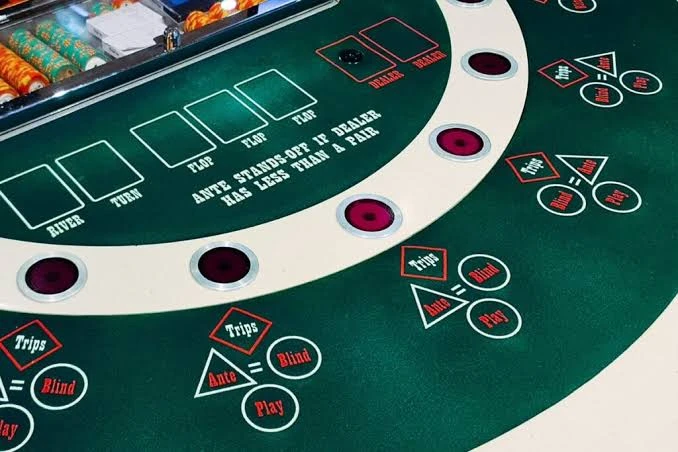
Ultimate Texas Hold’em is a casino table game based on Texas Hold’em poker. The key difference is that you play against the dealer instead of against other players. You and the dealer each get two hole cards and share five community cards, and whoever makes the better five-card poker hand wins.
What makes the game interesting is its raising system. You get one raise per hand, and the earlier you raise, the bigger it can be. You can raise 3x or 4x your Ante before the flop, 2x on the flop, or only 1x once all the community cards are out. That single decision of when to commit, and how much, is where the skill in the game lies.
If you already play Texas Hold’em, the hand rankings and the board will feel familiar. The strategy is different, though, because the dealer never bluffs, never folds and always plays to a fixed rule.
Looking for the poker game played against other players? This page covers the casino table version. For the classic poker game, see our.
Ultimate Texas Hold’em at a Glance
| Topic | Details |
| Deck | Single standard 52-card deck, no jokers |
| Opponent | The dealer (house-banked) |
| Starting bets | Ante and Blind, equal amounts, both required |
| Optional bet | Trips (plus other side bets at some tables) |
| Cards | 2 hole cards each + 5 shared community cards |
| Raise options | 3x or 4x Ante preflop, 2x on the flop, 1x on the river |
| Raises per hand | One |
| Dealer qualifies with | A pair or better |
| House edge | 2.185% of the Ante with optimal strategy |
| Element of risk | 0.526% of total money bet |
Where the Game Came From
Ultimate Texas Hold’em was invented by Roger Snow of Shuffle Master, a company behind many modern casino table games. It turned the most popular form of poker into a house-banked table game that casinos could deal at any stake. It now appears in casino table pits and online casino lobbies alongside games like. A very similar game is also sold under the name Heads Up Hold ‘Em.
Ultimate Texas Hold’em Terms You Should Know
- Ante: A required starting bet. It only gets paid if the dealer qualifies.
- Blind: A second required bet, equal to the Ante. It pays a bonus when you win with a straight or better.
- Play bet: Your raise. You make it only once per hand, at 4x (or 3x), 2x or 1x the Ante, depending on when you raise.
- Check: Choosing not to raise yet, so you can see more cards.
- Fold: Giving up your hand on the river, which forfeits your Ante and Blind.
- Qualify / Open: The dealer “qualifies” or “opens” with a pair or better. If the dealer doesn’t qualify, your Ante is returned.
- Trips: An optional side bet that pays if your final hand is three of a kind or better, whatever the dealer has.
- Hole cards: The two private cards dealt to you and to the dealer.
- Community cards: The five shared cards: the flop (three cards), then the turn and river (dealt together in this game).
- Hidden pair: A pair that uses at least one of your hole cards, so the dealer can’t share it through the board.
- Outs: Dealer hole cards that would beat your hand. You count these to decide whether to call or fold on the river.
- Element of risk: The expected loss divided by the average total amount you bet. Useful for comparing games where you add money mid-hand.
How to Play Ultimate Texas Hold’em, Step by Step
Each hand has three decision points. You can raise at only one of them, and once you raise, you make no more decisions that hand.
- Place your Ante and Blind. Both bets must be the same size. Add a Trips bet at this point if you want one.
- Get two hole cards. You and the dealer each receive two cards face down. Look at yours.
- Decision 1 (preflop): Raise 3x or 4x your Ante, or check.
- The flop. The dealer turns over three community cards.
- Decision 2 (flop): If you checked before, you can now raise 2x your Ante or check again.
- The turn and river. The final two community cards are turned over together.
- Decision 3 (river): If you checked twice, you must now either raise exactly 1x your Ante or fold. Folding loses your Ante and Blind.
- Showdown. The dealer reveals their hole cards. Both sides make the best five-card hand from their two cards plus the five community cards.
- Settle bets. The dealer checks whether they qualify (a pair or better), then pays or collects each bet according to the rules below.
| Decision point | Cards you’ve seen | Your options |
| Preflop | Your 2 hole cards | Raise 3x or 4x the Ante, or check |
| Flop | Hole cards + 3 community cards | Raise 2x the Ante, or check (only if you checked preflop) |
| River | Hole cards + all 5 community cards | Raise 1x the Ante, or fold (only if you checked twice) |
Ultimate Texas Hold’em Rules
How Each Bet Is Settled
This scoring table is the heart of the game. Once you understand it, everything else follows.
| Who wins | Dealer qualifies? | Blind | Ante | Play |
| Player | Yes | Win | Win | Win |
| Player | No | Win | Push | Win |
| Dealer | Yes | Lose | Lose | Lose |
| Dealer | No | Lose | Push | Lose |
| Tie | Either | Push | Push | Push |
Two rules often confuse new players:
- Your Play bet always has action. Even if the dealer doesn’t qualify, the Play bet is still decided by whose hand is better. Only the Ante pushes when the dealer doesn’t qualify.
- The Blind has special rules. When you win, it only pays if your hand is a straight or better (see the payouts table below). If you win with anything less, the Blind pushes.
If you need a refresher on which hands beat which, see our poker hand rankings guide.
Three Worked Examples
All three examples use a $10 Ante and $10 Blind.
Example 1: You raise 4x and the dealer doesn’t qualify.
You hold A♠ J♦ and raise 4x ($40). The board comes K♥ J♣ 7♠ 4♦ 2♣, so you have a pair of jacks. The dealer shows Q♥ 9♣, which is queen-high, so the dealer doesn’t qualify.
Result: your Ante pushes, your Blind pushes (you won with less than a straight), and your Play bet wins $40. Net: +$40.
Example 2: Same hand, but the dealer pairs up.
The dealer shows K♣ 9♣ instead, making a pair of kings. The dealer qualifies and beats your jacks.
Result: you lose the Ante (10),theBlind(10) and the Play bet ($40). Net: −$60.
Example 3: You check to the river and fold.
You check twice with a weak hand and fold on the river.
Result: you lose the Ante and Blind. Net: −$20.
These examples show the game’s basic trade-off. Big early raises win the most when you’re ahead and cost the most when you’re behind, while folding caps your loss at your two starting bets.
Other Rules to Know
- Best five cards: Under standard rules, both you and the dealer can use any combination of your two hole cards and the five community cards, including “playing the board” with all five. A few casinos change this. Wizard of Odds describes an Auckland, New Zealand version where both sides must use exactly two hole cards and three board cards.
- One raise only: Once you’ve raised, you can’t add more.
- Maximum payout caps: Some tables limit the total payout on a single hand. If your Ante is large relative to that cap, a royal flush may not pay in full.
Ultimate Texas Hold’em Payouts
Ultimate Texas Hold’em payouts vary by the table’s Blind and Trips paytables, so always check the posted rules before playing. The Ante and Play bets pay even money (1 to 1). The Blind pays according to the paytable below. This is the standard version:
| Your winning hand | Blind pays |
| Royal flush | 500 to 1 |
| Straight flush | 50 to 1 |
| Four of a kind | 10 to 1 |
| Full house | 3 to 1 |
| Flush | 3 to 2 |
| Straight | 1 to 1 |
| Anything less | Push |
Ultimate Texas Hold’em Hand Rankings
The game uses standard poker hand rankings. The table also shows how often your final seven cards (your two hole cards plus the five community cards) make each hand of three of a kind or better. Those are the hands that matter for the Trips bet.
| Rank | Hand | Example | Chance your 7 cards make it |
| 1 | Royal flush | A♠ K♠ Q♠ J♠ 10♠ | 0.0032% |
| 2 | Straight flush | 9♥ 8♥ 7♥ 6♥ 5♥ | 0.0279% |
| 3 | Four of a kind | 8 8 8 8 | 0.168% |
| 4 | Full house | K K K 4 4 | 2.60% |
| 5 | Flush | Five cards of one suit | 3.03% |
| 6 | Straight | 10 9 8 7 6 | 4.62% |
| 7 | Three of a kind | 7 7 7 | 4.83% |
| 8 | Two pair | J J 5 5 | — |
| 9 | One pair | Q Q | — |
| 10 | High card | No pair | — |
Probabilities are from the Trips bet analysis at Wizard of Odds. In total, you finish with three of a kind or better about 15.3% of the time, and with two pair or less about 84.7% of the time.
Ultimate Texas Hold’em Side Bets
The Ultimate Texas Hold’em Trips bet is optional and is settled independently of the dealer’s hand. It pays according to your final hand alone, even if you fold. Trips paytables vary between casinos, and the paytable changes the house edge considerably:
| Hand | Paytable 1 | Paytable 2 | Paytable 3 | Paytable 4 |
| Royal flush | 50 to 1 | 50 to 1 | 50 to 1 | 50 to 1 |
| Straight flush | 40 to 1 | 40 to 1 | 40 to 1 | 40 to 1 |
| Four of a kind | 30 to 1 | 30 to 1 | 30 to 1 | 20 to 1 |
| Full house | 9 to 1 | 8 to 1 | 8 to 1 | 7 to 1 |
| Flush | 7 to 1 | 6 to 1 | 7 to 1 | 6 to 1 |
| Straight | 4 to 1 | 5 to 1 | 4 to 1 | 5 to 1 |
| Three of a kind | 3 to 1 | 3 to 1 | 3 to 1 | 3 to 1 |
| House edge | 0.90% | 1.90% | 3.50% | 6.18% |
Practical tip: Check the full house and flush payouts on the table layout. They are the quickest way to tell which paytable you’re facing.
Other Side Bets You May See
Many casinos add extra side bets. Most carry higher house edges than the main game:
| Side bet | What it pays on | House edge |
| Pairs Bonus | Strong starting hole cards | 8.9% |
| Hole Card Bonus | Your hole cards (top prize also needs dealer aces) | 8.54% |
| Bad Beat Bonus (paytable 1) | You or the dealer losing with three of a kind or better | 14.79% |
| Bad Beat Bonus (paytable 2) | Same, different paytable | 20.39% |
Progressive jackpot side bets work differently, because their value depends on the size of the jackpot meter. Wizard of Odds shows that for one common progressive, the fixed prizes alone return about 53% before the jackpot is counted. For a $1 bet with no other players at the table, the house edge only reaches zero when the meter is around $160,500.
Ultimate Texas Hold’em Odds and House Edge
House Edge vs Element of Risk
You’ll see two figures quoted for this game. Both are correct, but they measure different things:
- House edge: 2.185% of the Ante. If you bet $10 on the Ante (and $10 on the Blind) and play perfectly, you lose about 22 cents per hand on average.
- Element of risk: 0.526%. Because you often add a Play bet, the average total wagered per hand is about 4.15 times your Ante. Dividing the expected loss by that total gives the element of risk.
Use the element of risk when comparing games where you raise mid-hand. Use the house edge per Ante when estimating what a session might cost. Our bankroll calculator can help you plan session sizes.
How Often Each Decision Comes Up
We added up the probabilities in Wizard of Odds’ optimal-strategy return table to see how often a perfect player makes each decision:
| Decision (optimal strategy) | Share of hands |
| Raise 4x preflop | ~37.7% |
| Raise 2x on the flop | ~21.3% |
| Raise 1x on the river | ~21.8% |
| Fold on the river | ~19.2% |
Under optimal strategy, the 4x preflop raise is made on more than a third of all hands. If you raise preflop much less often than that, compare your decisions with the strategy chart below.
Why Rule Variations Matter
Small rule changes can move the numbers a lot, so always check the table sign:
- 3x-only tables: At a version where the largest preflop raise is 3x, Wizard of Odds estimates the player loses about five times as much as in the standard 4x game.
- Simplified vs perfect strategy: Following the Wizard of Odds simplified strategy gives a house edge of about 2.43% of the Ante (element of risk about 0.58%), compared with 2.185% for perfect play.
- Payout caps and paytables: Blind paytables, Trips paytables and maximum payout limits all affect your return.
Ultimate Texas Hold’em Strategy
Because the dealer plays to a fixed rule and never bluffs, strategy in Ultimate Texas Hold’em isn’t about reading people. It’s about knowing which hands are strong enough to raise at each decision point. Below is a widely used simplified strategy based on the Wizard of Odds approach.
Decision 1: Preflop, When to Raise 4x
Raise 4x with:
- Any pair of 3s or higher (check with a pair of 2s)
- Any hand with an ace
- King with: any suited card, or an offsuit 5 or higher
- Queen with: a suited 6 or higher, or an offsuit 8 or higher
- Jack with: a suited 8 or higher, or an offsuit 10
Check everything else.
Why raise so many hands? Your Ante and Blind are already on the table, and the dealer plays every hand to showdown. So a hand like K♣ 6♦ doesn’t have to be strong by regular poker standards. It only has to win often enough against one random dealer hand for the 4x raise to be worth more than checking. Note that Wizard of Odds’ optimal-strategy analysis uses the 4x raise, not 3x.
Decision 2: The Flop, When to Raise 2x
If you checked preflop, raise 2x on the flop with:
- Two pair or better
- A hidden pair (a pair using at least one of your hole cards), except a pair of 2s
- Four to a flush where you hold a hidden 10 or higher of that suit
Otherwise, check.
Why hidden pairs? A pair that’s only on the board is shared with the dealer. A pair made with your own card is a real edge over the dealer.
Decision 3: The River, When to Raise 1x or Fold
If you checked twice, raise 1x with:
- A hidden pair or better, or
- Any hand where fewer than 21 dealer hole cards would beat you
Otherwise, fold.
Source: Wizard of Odds
How to Count Dealer Outs: A Worked Example
You hold K♦ 7♣. The final board is Q♠ 9♥ 5♣ 4♦ 2♠, so you have king-high with no pair.
Count the single dealer hole cards that would beat you:
- Cards that pair the board: any queen, nine, five, four or two. That’s 5 ranks with 3 cards left each, so 15 cards.
- Aces: any ace gives the dealer ace-high, which beats your king-high. That’s 4 cards.
Total: 19 outs. That’s fewer than 21, so you raise 1x.
Count single cards only. Wizard of Odds’ method deliberately ignores two-card combinations, such as two dealer spades making a flush, to keep the rule practical at the table. For general practice with poker probabilities, try our poker odds calculator and pot odds calculator.
Is the Simplified Strategy Good Enough?
Perfect play gives a house edge of 2.185% of the Ante, and the simplified strategy gives about 2.43% (Wizard of Odds). Each player can decide whether that small difference is worth learning a more complex strategy. Wizard of Odds also offers a free Ultimate Texas Hold’em calculator for checking specific hands.
Best Ultimate Texas Hold’em Tips for Beginners
- Learn the preflop 4x list first. It’s the decision you face on every hand.
- Know which pairs count on the flop. A pair that’s only on the board isn’t a 2x raise under the strategy above. Your pair needs to use one of your own cards.
- Practise counting outs with free-play games until it feels quick.
- Budget for the full raise. With a $10 Ante, one hand can cost $60 (Ante + Blind + 4x Play).
- Read the table layout for the Trips paytable, any side bets and any payout cap.
- Keep side bets small relative to your main bets, since they usually carry higher house edges.
Common Ultimate Texas Hold’em Mistakes
| Mistake | Why it matters | Better approach |
| Checking hands on the 4x list | Differs from the optimal strategy | Follow the preflop 4x list |
| Raising 3x instead of 4x | Optimal-strategy analysis uses the 4x raise | Raise the maximum preflop |
| Raising 2x with a board-only pair | The dealer shares the same pair | Raise 2x with hidden pairs, two pair or better, or qualifying flush draws |
| Folding hands with fewer than 21 outs | Folding always loses the Ante and Blind | Count outs and raise 1x when there are fewer than 21 |
| Calling every river | Adds money on hands the strategy folds | Fold with 21+ outs and no hidden pair |
| Ignoring the Trips paytable | Trips house edges range from ~0.9% to ~6.2% | Check the paytable before betting |
| Large progressive bets on small meters | Low return unless the jackpot is very large | Check the meter size first |
Ultimate Texas Hold’em vs Regular Texas Hold’em Poker
| Ultimate Texas Hold’em | Texas Hold’em Poker | |
| Opponent | The dealer (house) | Other players |
| How the house earns | Built-in house edge | Rake or tournament fees |
| Bluffing | No effect; the dealer always shows down | Part of the game |
| Betting rounds | One raise per hand | Up to four betting rounds |
| Folding | Only on the river | At any point |
| Main decision | When to raise | Many decisions across the hand |
If you want to play against other people, regular Texas Hold’em provides that format. Ultimate Texas Hold’em instead uses a fixed dealer opponent and a casino-game betting structure. You can learn the player-vs-player version in our Texas Hold’em guide.
Ultimate Texas Hold’em vs Other Casino Poker Games
| Game | Typical house edge | Main decision |
| Casino Hold’em | 2.16% of Ante | Call or fold after the flop |
| Ultimate Texas Hold’em | 2.19% of Ante | When to raise: 4x, 2x or 1x |
| Pai Gow Poker | 2.51% (optimal setting); ~2.84% (house way) | How to split seven cards |
| Three Card Poker (Ante & Play) | 3.37% of Ante | Play or fold |
Sources: Gambling.com for Casino Hold’em, Ultimate Texas Hold’em, Pai Gow Poker (optimal) and Three Card Poker; OLG PlaySmart for Pai Gow Poker house way. Figures assume the rules and strategies stated by each source.
Each game uses a different decision structure, so compare the specific rules and paytable of any table before you play. You can browse more games in our casino games section.
How to Play Ultimate Texas Hold’em Online
Online Ultimate Texas Hold’em follows the same rules as the table game. Paytables, side bets and limits can differ between software providers and casinos.
| Online (RNG) | Live dealer / land-based | |
| Pace | Set by you | Set by the dealer and table |
| Other players | Usually solo | Shared table |
| Strategy help | Some games include hints or strategy aids | None from the game itself |
| Free play | Often available | Not available |
| Side bets | Vary by game | Vary by casino |
| Bet limits | Vary by casino and game | Vary by casino and table |
Getting Started Online
- Check that online casino games are legal where you live. Rules vary by country and region.
- Choose a licensed casino with clear terms and responsible-gambling tools.
- Play a free version first. Wizard of Odds offers a free Ultimate Texas Hold’em game with a strategy-advice feature.
- Open the game’s help screen and check the Blind paytable, the Trips paytable and any maximum payout.
- Start with a small Ante. One hand can cost up to six times your Ante.
Watch the pace. Online games can deal hands faster than a live table. More hands per hour means more money wagered, so set a time limit as well as a budget.
Ultimate Texas Hold’em Live Casino Guide
- Buy in between hands. Place cash on the table and let the dealer exchange it for chips.
- Match your Ante and Blind. They must be equal.
- Use clear signals. Players commonly tap the table to check, and place chips in the Play circle to raise.
- Keep your cards on the table and don’t show them to other players.
- Don’t touch your chips after you’ve acted.
- Follow local tipping customs. Practices differ between countries and casinos.
FAQs
What is Ultimate Texas Hold’em?
Ultimate Texas Hold’em is a casino table game based on Texas Hold’em poker, where you play against the dealer rather than other players. You and the dealer each get two hole cards and share five community cards, and the better five-card hand wins.
How do you play Ultimate Texas Hold’em?
Place equal Ante and Blind bets, then receive two cards. You can raise 3x or 4x before the flop, 2x after the flop, or 1x on the river. You can only raise once, and if you haven’t raised by the river, you must raise 1x or fold.
What does the dealer need to qualify?
The dealer needs a pair or better to qualify. If the dealer doesn’t qualify, your Ante is returned as a push, but your Blind and Play bets are still decided by who has the better hand.
What is the house edge in Ultimate Texas Hold’em?
According to Wizard of Odds, the house edge is 2.185% of the Ante with optimal strategy, and the element of risk is 0.526% of the total amount bet. Rule and paytable variations change these figures.
What is the best Ultimate Texas Hold’em strategy?
A widely used simplified strategy is to raise 4x preflop with any pair of 3s or higher, any ace and certain king, queen and jack hands. On the flop, raise 2x with two pair or better, a hidden pair or qualifying flush draws. On the river, raise 1x with a hidden pair or when fewer than 21 dealer cards beat you, and fold otherwise.
Disclosure: PokerClubGames may earn a commission when you use links to poker operators. This never changes the price you pay. 18+ (21+ where required). Gambling involves risk. How we make money