Last Updated on September 14, 2026 by Bala Kumar
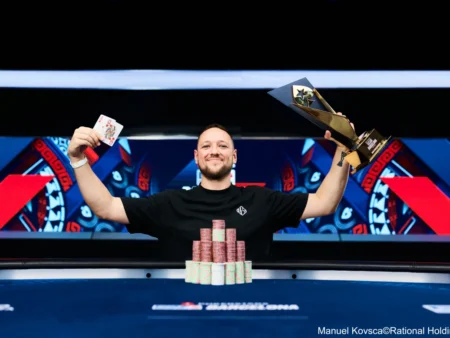
Every so often, poker gets a champion whose story feels almost too clean to be real: the kid who learned the game at his dad’s kitchen table, promised his mom he’d finish college first, and then went out and won the biggest tournament on the planet a few months after graduation. That’s exactly what happened this August at Horseshoe and Paris Las Vegas, where 22-year-old Lucas Jumalon of Spokane, Washington, won the 2026 WSOP Main Event for $10,000,000, becoming the second-youngest champion in the event’s history.
The wildest part isn’t even the age. It’s that Jumalon never trailed. Not once. From the moment the final table started, he held the chip lead through every single hand until the last card fell three days later.
The Numbers Behind the Win
| Detail | Figure |
| Total entries | 9,208 (4th-largest Main Event field ever) |
| Buy-in | $10,000 |
| First-place prize | $10,000,000 |
| Runner-up prize | $6,000,000 |
| Tournament dates | July 2 – August 5, 2026 |
| Champion’s age | 22 years, 4 months, 27 days |
| Historical rank by age | 2nd-youngest champion ever (behind Joe Cada, 2009) |
Full Final Table Results
| Place | Player | Country | Prize |
| 1st | Lucas Jumalon | United States | $10,000,000 |
| 2nd | Lauri Saaskilahti | Finland | $6,000,000 |
| 3rd | Greg Mueller | Canada | $3,750,000 |
| 4th | Michael Gagliano | United States | $2,750,000 |
| 5th | Han Feng | United States | $2,250,000 |
| 6th | Rami Hammoud | Canada | $1,750,000 |
| 7th | Jamie Shaevel | United States | $1,500,000 |
| 8th | Mario Boos | France | $1,250,000 |
| 9th | Evagoras Evagorou | Cyprus | $1,000,000 |
A Rail Full of GCU Classmates
Jumalon isn’t a lifelong touring pro. He’s a recent business administration graduate from Grand Canyon University who learned the game in home games with his father, Butch. His mother, Robin, reportedly made finishing his degree a condition before he went all-in on poker, and he did exactly that, graduating in May before making his deepest run of the summer just weeks later.
His rail at the final table reflected that path: college classmates chanting his school’s initials, his parents and brothers watching every hand, and poker pros including Patrick Leonard, who had coached him ahead of the final table. Speaking to PokerNews afterward, Jumalon described the win as a feeling of pure euphoria that hadn’t fully sunk in yet.
How the Final Table Unfolded
The final nine sat down with a genuinely varied mix of backgrounds: multi-time bracelet winners Greg Mueller and Michael Gagliano, cash-game specialist Jamie Shaevel playing in his eighth in-the-money Main Event, and rising pro Han Feng, widely regarded as one of the most technically sound players at the table. Evagoras Evagorou of Cyprus went out first in 9th place after shoving pocket jacks into Shaevel’s ace-queen, which improved on the flop. Mario Boos of France followed in 8th when his pocket eights ran into Saaskilahti’s king-nine.
Han Feng’s exit in 5th place turned into one of the tournament’s more painful beats, with his pocket aces cracked to help fuel Saaskilahti’s push toward the final two. By the end of Day 1 of the final table, Jumalon already held a commanding 212 million chips, more than double his nearest competitor.
The Heads-Up Battle: Two Underdogs, One Bracelet
What made the finish genuinely compelling wasn’t a superstar showdown, it was two relatively inexperienced players with career-high scores in the five figures, both of whom had jokingly predicted they’d end up heads-up together after a memorable clash back on Day 5 with hundreds of players still in the field.
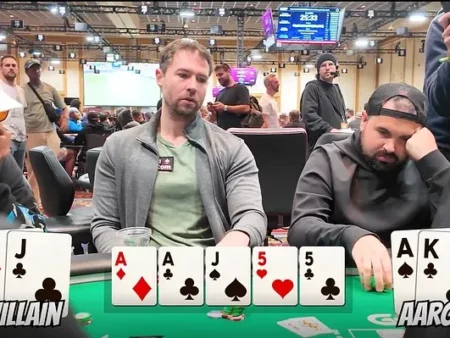
Saaskilahti, a 40-year-old father from Finland with only around $138,000 in prior tournament cashes before this run, refused to fold quietly. Heads-up play opened with Jumalon holding 109 big blinds to Saaskilahti’s 75, and the deficit briefly flipped when Saaskilahti called off his stack preflop with ace-ten against Jumalon’s ace-nine, a spot where he was ahead until a nine on the turn nearly ended it, before a diamond river bailed him out and briefly threatened Jumalon’s lead for the only time all final table.
The hand that effectively ended it came minutes later. On a board of 4♣-A♠-K♠-J♠-6♠, with 100 million already in the pot, Jumalon shoved 180 million holding just queen-high, leaving Saaskilahti with only eight big blinds if he called. After a long tank, Saaskilahti made what he later called a hero call with jack-three, a call he was honest about missing. He was behind, and the call effectively finished the tournament in Jumalon’s favor.
The final hand was almost a formality after that: Saaskilahti open-shoved ace-seven into Jumalon’s king-six, and running sixes on the flop and turn sealed the title before the river even mattered.
Where Jumalon’s Win Fits in WSOP History
A few records worth flagging for anyone tracking Main Event history:
- Jumalon is the first Main Event champion born in Washington state, following past runners-up Perry Green (1981) and John Wasnock (2025) from the same state.
- He’s the first player to win wire-to-wire from the final table chip lead since Koray Aldemir in 2021.
- He continues an unusual four-year cycle in Main Event history: four American champions from 2015-2018, four non-American champions from 2019-2022, and now four American champions again from 2023-2026.
- Saaskilahti’s elimination marked the fifth time in Main Event history a player has gone out drawing dead on the river of the final hand, joining moments dating back to Hal Fowler in 1979 and Johnny Chan’s famous slow-play of Erik Seidel in 1988.
What This Win Means Going Forward
For a 22-year-old who wasn’t a known name on the circuit before this summer, a $10 million score changes the trajectory of an entire career overnight. Jumalon told reporters immediately after the win that he needed a few days just to process it before making any real decisions about what comes next, a notably grounded response for someone who just became one of poker’s youngest world champions.
It’s also a genuinely good story for poker as a sport heading into a period where the game is constantly trying to find new faces to build around. A college graduate who kept his promise to finish school, then went out and outlasted 9,207 other players for the biggest prize in the game, is exactly the kind of narrative that tends to stick.
FAQs
Who won the 2026 WSOP Main Event?
Lucas Jumalon, a 22-year-old from Spokane, Washington, defeating Lauri Saaskilahti of Finland heads-up for the $10,000,000 first-place prize and the championship bracelet.
How many players entered the 2026 WSOP Main Event?
9,208 entries, the fourth-largest field in Main Event history, each paying the $10,000 buy-in.
Is Lucas Jumalon the youngest WSOP Main Event champion ever?
No, the second-youngest. At 22 years, four months, and 27 days old, he ranks just behind Joe Cada, who won in 2009.
How much did the runner-up win?
Lauri Saaskilahti earned $6,000,000 for second place, the deepest Main Event run and biggest score ever by a Finnish player.
What was the final hand of the 2026 WSOP Main Event?
Saaskilahti shoved all-in preflop with ace-seven against Jumalon’s king-six. Sixes on the flop and turn gave Jumalon trips and sealed the title before the river.
Did Lucas Jumalon hold the chip lead the whole final table?
Yes, from the first hand of the final table through the final river card, the first wire-to-wire chip-lead win since Koray Aldemir in 2021.
Founder of PokerClubGames.com and a Poker Researcher with 10+ years of experience in SEO, WordPress development, and gaming content strategy. Specializes in researching online poker sites, poker apps, tournaments, bonuses, and poker strategies. Experienced in poker platform reviews, affiliate marketing, and creating SEO-focused poker content for global audiences.
For collaborations, media inquiries, or poker-related partnerships:
Contact: Info@hugecount.com