
Borgata Chainsaw Series Omaha Hi-Lo: My Final Table Run From 44k to 7th Place
On this page
Introduction
Some tournaments you forget by the time you reach the parking garage. This one I’ll remember for a while.
On Wednesday, November 4, 2026, I sat down for the opening event of the Chainsaw Mixed Series of Poker at the Borgata in Atlantic City: Event #2 of the Fall Poker Open, Chainsaw’s Omaha H/L. Fifty-eight players showed up, I rode a stack that went up and down like a slot machine reel, and I ended up at the final table, finishing 7th.
This is my honest recap of the day: the stack swings, the spots where I was hanging on by a thread, the back-to-back double-ups that saved me, and what I took away from it.
What Is the Chainsaw Mixed Series at Borgata?
If you mostly play No-Limit Hold’em, this series is a different world. The Chainsaw Mixed Series of Poker is run by Allen “Chainsaw” Kessler and focuses entirely on non-Hold’em games: Omaha Hi-Lo, Stud Hi-Lo, H.O.R.S.E., T.O.R.S.E., Big O and other mixed formats. It runs as part of the Borgata Fall Poker Open (November 4–17, 2026), and 2026 is the first year the series has come to Atlantic City. Before this it lived at Caesars Palace in Las Vegas.
Two things make it stand out for regular players:
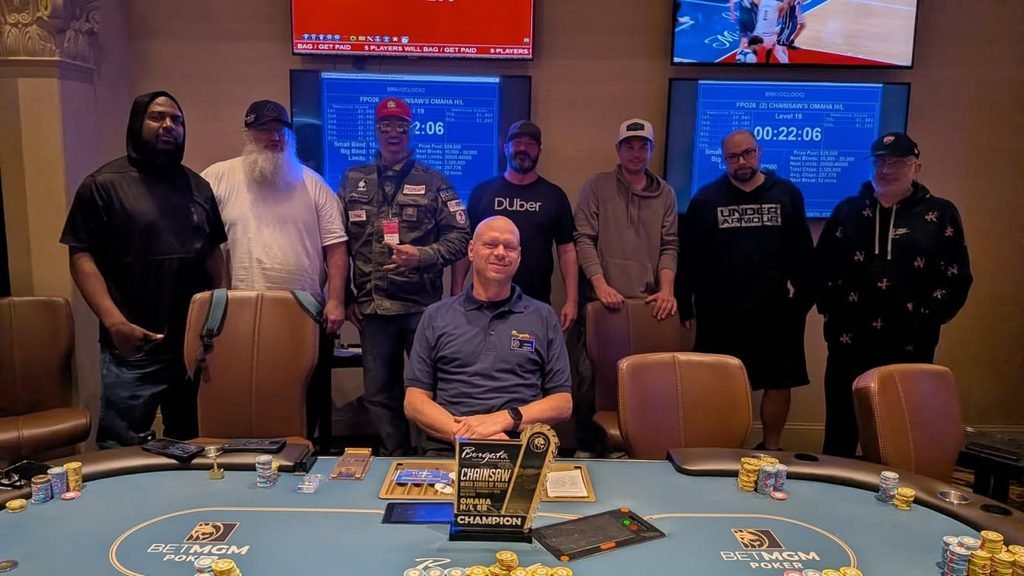
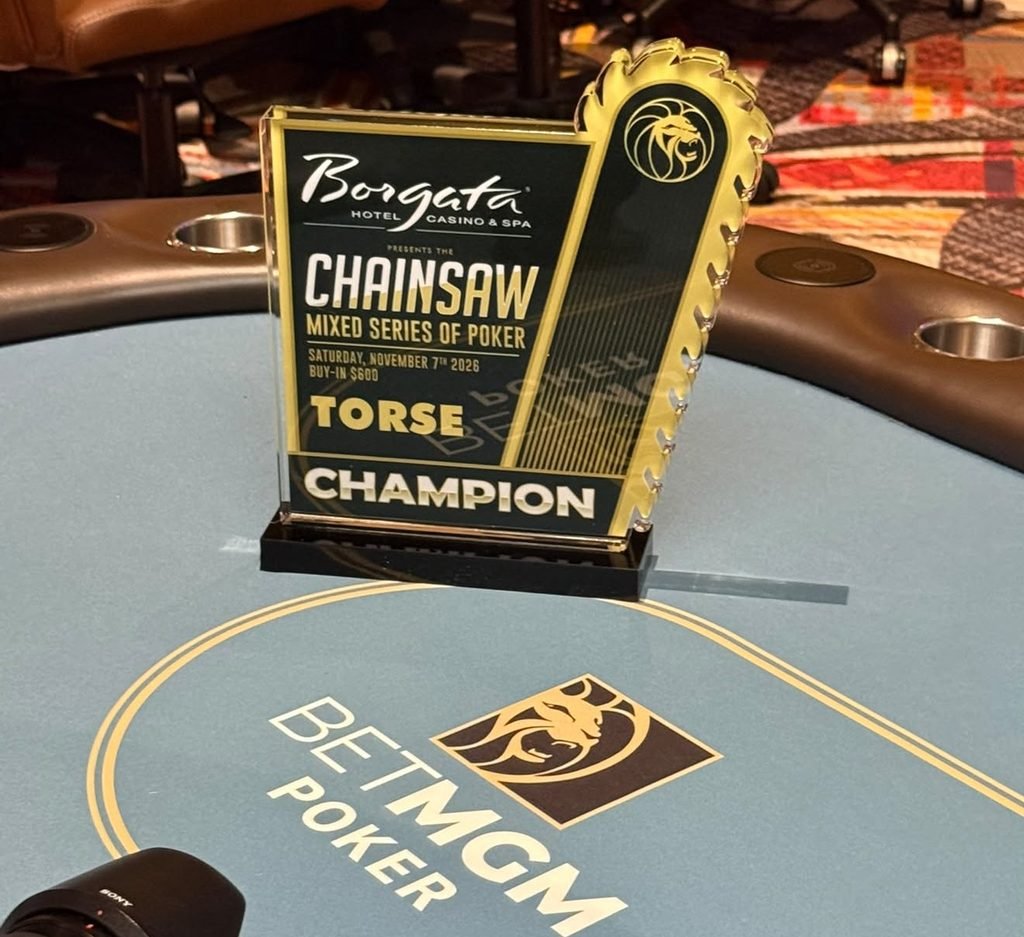
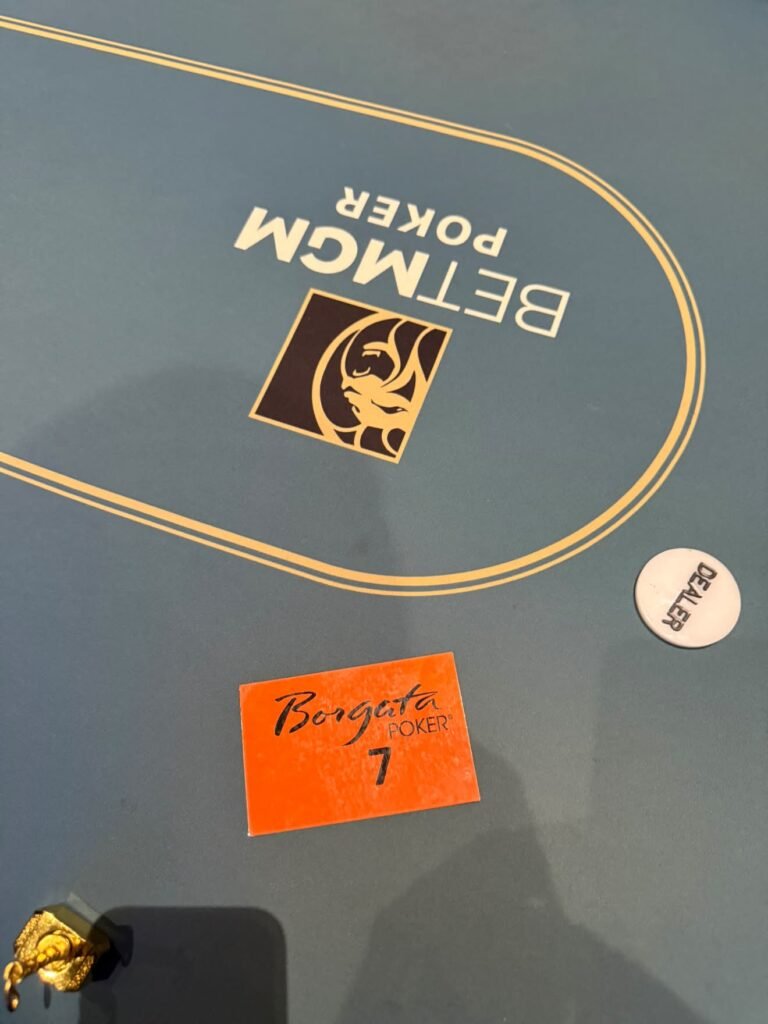
- Every event has its own trophy. Not just a payout, an actual chainsaw-shaped trophy. I snapped a photo of one sitting on a BetMGM Poker table (the one for the Saturday, November 7 T.O.R.S.E. event), and they look great in person.
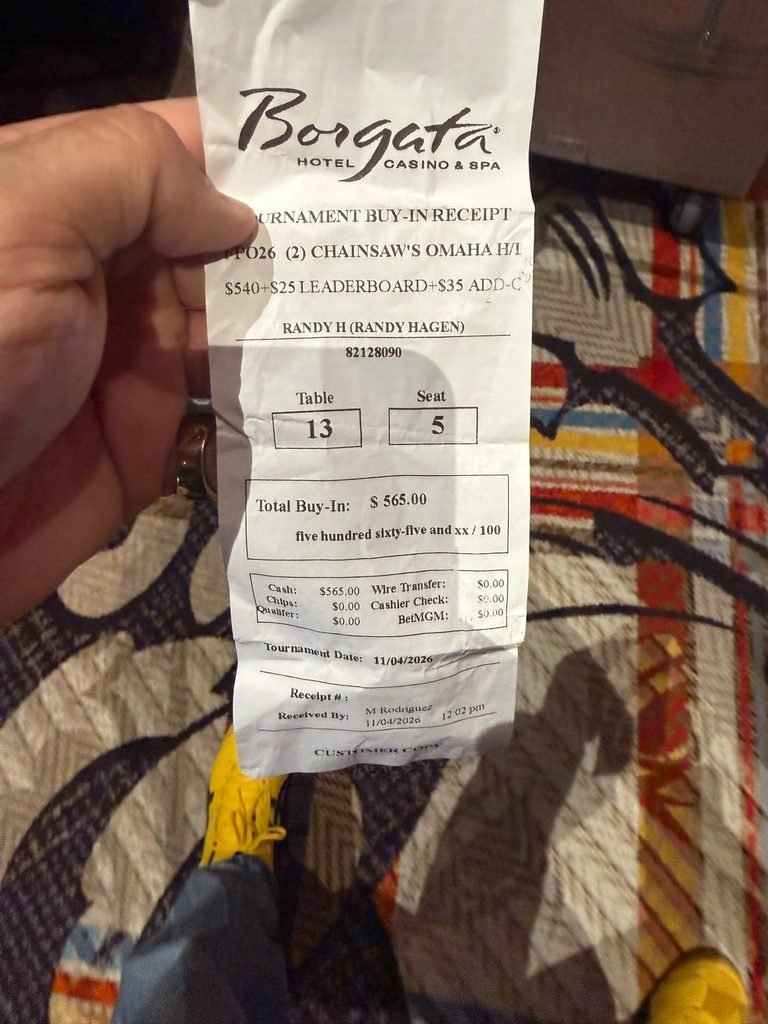
- A Player of the Series leaderboard. Every event feeds points into it, which is why my receipt included a small leaderboard fee.
[Image: Chainsaw trophy on the BetMGM Poker felt. Alt text: Borgata Chainsaw Mixed Series of Poker champion trophy on a BetMGM Poker table]
The Event at a Glance
Here’s the hard data, taken straight from my buy-in receipt and the tournament clock:
| Detail | Info |
|---|---|
| Event | FPO26 Event #2 – Chainsaw’s Omaha H/L (8 or Better) |
| Venue | Borgata Hotel Casino & Spa, Atlantic City |
| Date | November 4, 2026 |
| Buy-in | $540 entry + $25 leaderboard + $35 add-on ($600 total) |
| Starting stack | 40,000 |
| Entrants | 58 |
| Prize pool | $29,000 |
| Places paid | 8 |
| Late registration | Until the start of Level 13 |
| My finish | 7th – $1,460 |
Full payout structure
| Place | Payout |
|---|---|
| 1st | $9,840 |
| 2nd | $6,045 |
| 3rd | $3,940 |
| 4th | $2,735 |
| 5th | $2,025 |
| 6th | $1,695 |
| 7th | $1,460 |
| 8th | $1,260 |
One thing worth noticing: first place took about a third of the whole pool, and the jump from 7th to 6th was only $235. That flat bottom end matters when you’re short at a final table, and I’ll come back to it.
How it compares
For context, 58 runners is a healthy turnout for a $600 mixed-game event. At the May 2026 Chainsaw series at Caesars Palace, the $600 Limit Omaha 8 / Stud 8 event drew 34 entrants for a $17,680 prize pool, and the $600 H.O.R.S.E. drew 32. Getting 58 players for an Omaha Hi-Lo opener in Atlantic City tells you East Coast mixed-game players were hungry for this.
Quick Primer: How Limit Omaha Hi-Lo Works
If you’ve never played it, here’s the short version:
- Four hole cards. You get four cards instead of two, and you must use exactly two of them with exactly three from the board.
- The pot can split. Half goes to the best high hand and half goes to the best low hand. A low hand needs five different cards, all eight or below (that’s the “8 or Better” part). If nobody qualifies for low, the high hand takes it all.
- Fixed-limit betting. You can’t shove all-in whenever you like. Bets come in set sizes. When the clock says “Limits 8,000–16,000”, that means bets are 8,000 on the first two betting rounds and 16,000 on the last two.
That last point is huge. In limit poker, a short stack isn’t as dead as it is in No-Limit, because nobody can blow you off a hand with one massive bet. But it also means building a stack back up takes time and several winning pots.
Early Levels: 40k to 75k
I started with the standard 40,000 chips. By the first break I had built that up to about 75,000.
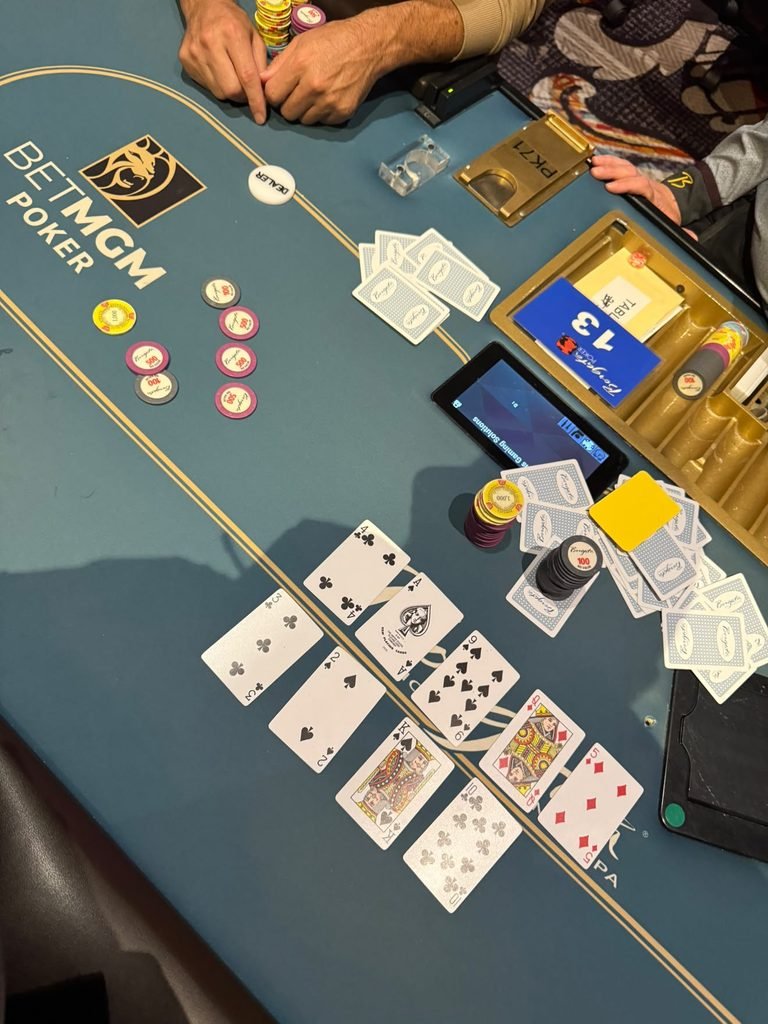
The hand I went into that break with was a monster. I had the four cards I photographed, and my opponent had flopped a set (three of a kind using a pocket pair and one card on the board). Sets are strong in Omaha, but they’re beatable, and this was one of those spots where it pays to have a hand that’s bigger than what your opponent thinks is good.
Nearly doubling the starting stack before the first break is a nice feeling. It gives you room to breathe in a game where pots get split and you’re often winning only half of what you put in.
The Middle Stretch: Up to 160k, Then Down to 46k
This was the roller coaster part of the day.
At one point I was as high as 160,000, four times my starting stack. By the dinner break I was down to about 46,000.
That’s the reality of Omaha Hi-Lo. The game is full of draws, split pots and “quartered” pots (where you get only a quarter because another player ties you for one half). Stacks swing hard, and a big lead can melt quickly. By this point registration had closed, so the field was set at 58.
What I learned here: don’t fall in love with your peak stack. The number that matters is the one in front of you right now, and the job at dinner was to reset and play the next hand well.
Down to 16 Players: Short and Fighting
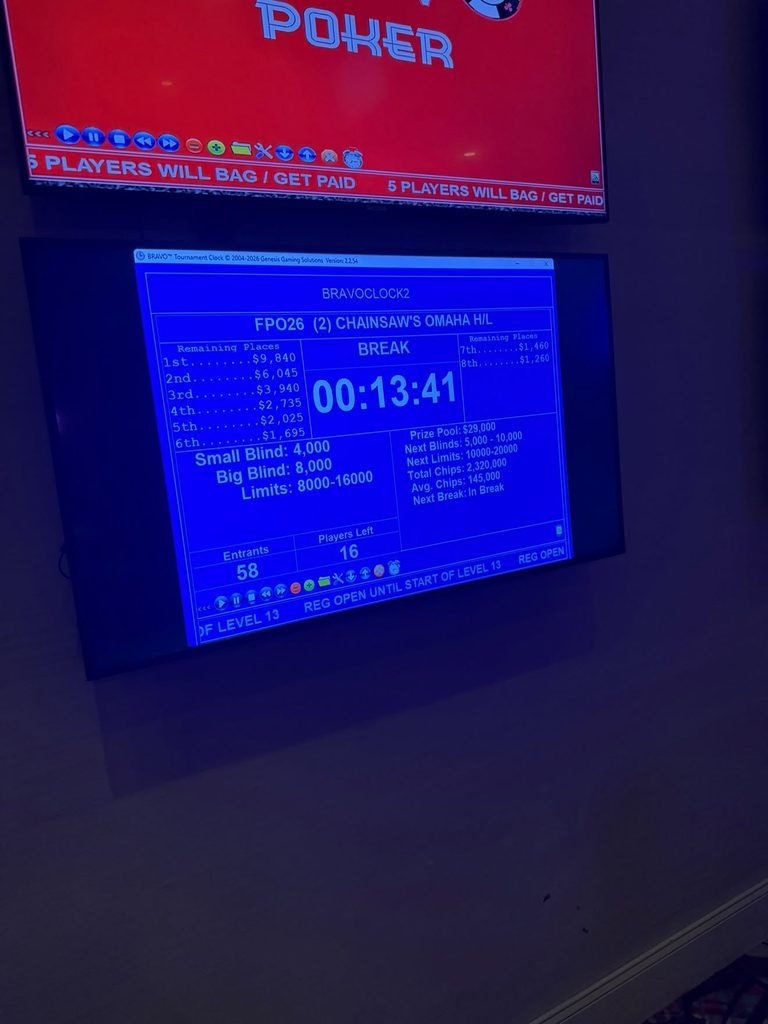
At the next break, 16 players were left. Nine would make the final table and eight would get paid. I had 44,000.
To put that in perspective, the clock showed an average stack of 145,000. I had less than a third of average. Blinds were 4,000/8,000 with limits of 8,000/16,000, and they were about to go up to 5,000/10,000 with 10,000/20,000 limits. In “big bets”, I had less than three. That is short.
The Comeback: Back-to-Back Double-Ups and Quad Sixes
This is where things turned.
I hit back-to-back double-ups, and the last of them came with quad sixes (four of a kind). Going from a desperate short stack to a real one in two hands is the kind of swing limit Omaha can give you if you stay patient and get your chips in with the best of it.
By the time we were one player away from the final table, I had 150,000, more than triple what I’d had at the 16-player break.
The practical lesson for anyone newer to limit games: a short stack in limit poker still has a lot of play. You don’t need one miracle; you need a couple of good hands, and you need to be in the pot when they come.
The Final Table: 9 Players, 8 Paid
We reached the final table with 9 players left and only 8 getting paid. I sat down with about 120,000.
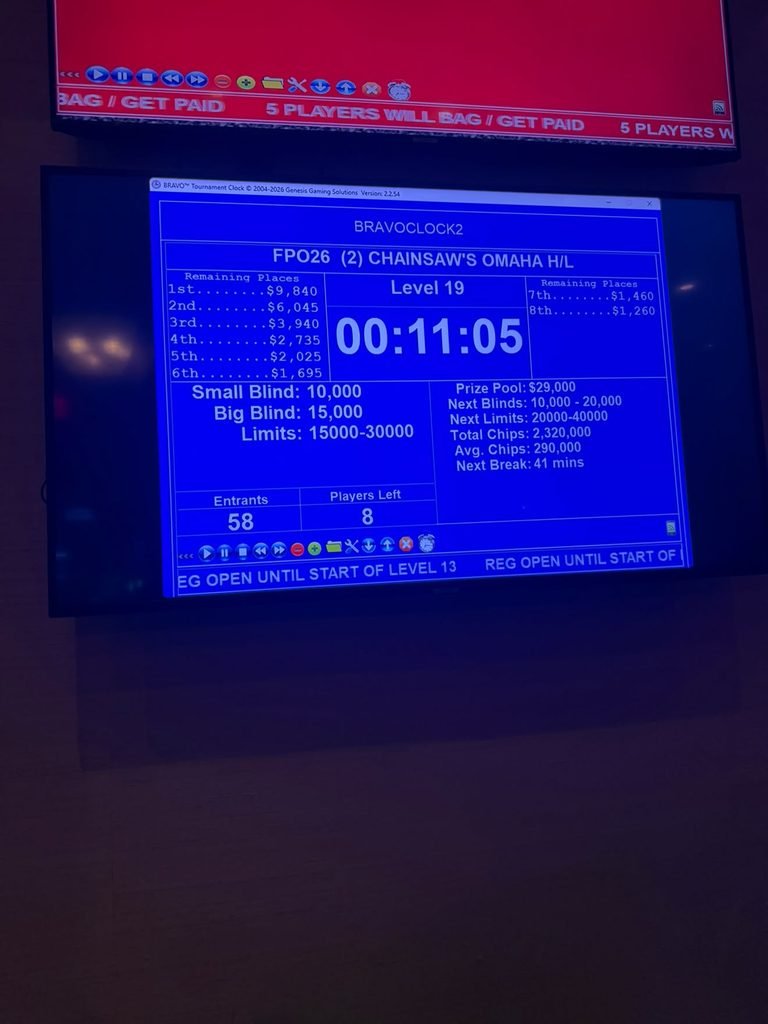
From there I slipped to around 80,000. When the clock showed 8 players remaining, we were in Level 19: blinds 10,000/15,000, limits 15,000/30,000, with an average stack of 290,000. At that level, 80,000 is under three big bets again.
The Result: 7th Place for $1,460
I finished 7th out of 58 for $1,460. That’s roughly 2.4 times my $600 total buy-in, a cash and a final table in the very first event of the series.
Would I have loved to fight longer for that $9,840 and the trophy? Of course. But looking back at my stack at the 16-player break, 44k with an average of 145k, making the final table and cashing was a solid result.
What I Took Away From This Tournament
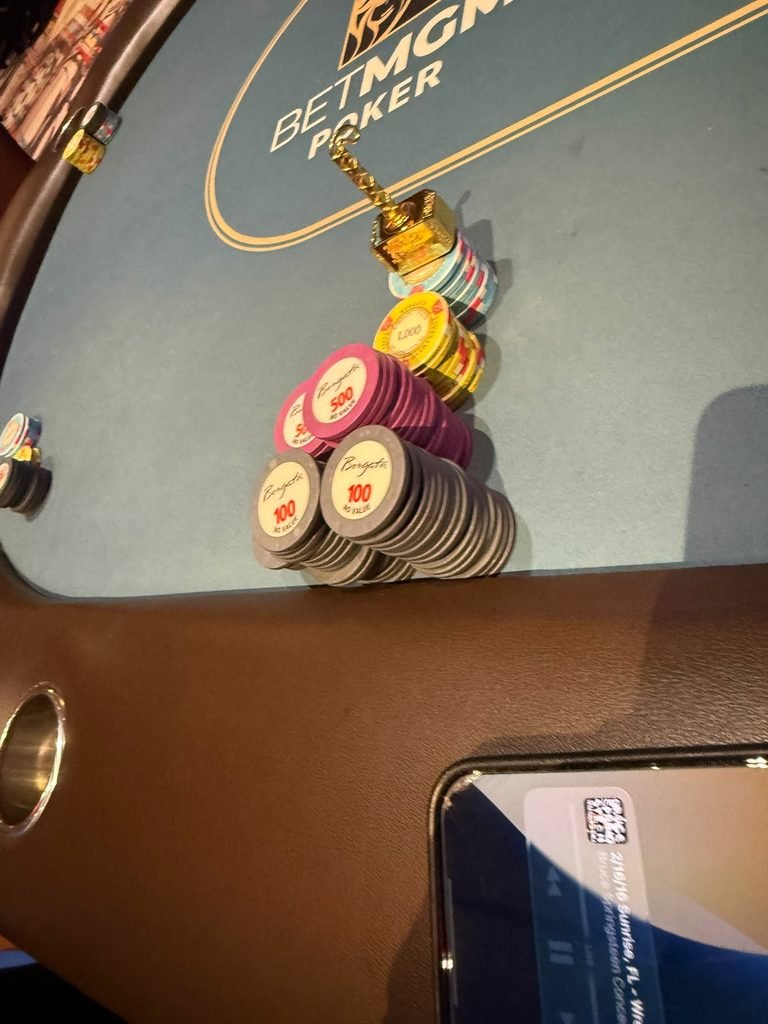
- Stack swings are normal in Omaha Hi-Lo. I went 40k → 75k → 160k → 46k → 44k → 150k → 120k → 80k. If you play this game, get comfortable with that ride.
- Short doesn’t mean finished in limit games. With less than three big bets at 16 left, I was still able to come back with two double-ups.
- Know the payout ladder. With small gaps near the bottom ($1,260 for 8th, $1,460 for 7th, $1,695 for 6th) and a big top prize, the real money is in going deep, not just inching up.
- Mixed-game series are worth your time. Smaller fields than big Hold’em events, softer variety, trophies for every event, and a friendly, regular crowd.
Final Thoughts
My first Chainsaw Mixed Series event at the Borgata gave me everything a tournament player wants in a day: a strong start, a painful slide, a real comeback with quad sixes, and a final table in a 58-player field. Seventh place and $1,460 isn’t the trophy, but it’s a cash I’m happy with, and I’m looking forward to the rest of the series.
If you’re on the fence about trying mixed games, the Borgata Chainsaw Series Omaha Hi-Lo event is a great place to start. Learn the split-pot basics, stay patient when you’re short, and enjoy the ride.
Frequently Asked Questions
What is the Chainsaw Mixed Series of Poker?
It’s a mixed-game tournament series created by Allen “Chainsaw” Kessler. It features non-Hold’em games like Omaha Hi-Lo, Stud Hi-Lo, H.O.R.S.E. and T.O.R.S.E., with a trophy for every event and a Player of the Series leaderboard.
When is the Chainsaw Series at Borgata in 2026?
It runs inside the Borgata Fall Poker Open, which takes place November 4–17, 2026 in Atlantic City. The Chainsaw series has 11 events and opened with Omaha Hi-Lo on November 4.
How much was the buy-in for the Omaha Hi-Lo event?
The total was $600: a $540 entry, a $25 leaderboard fee and a $35 add-on.
How many players entered and how many got paid?
58 players entered for a $29,000 prize pool. The top 8 were paid, with $9,840 for first and $1,260 for 8th.
What does “8 or Better” mean in Omaha Hi-Lo?
To win the low half of the pot, your five-card hand must have five different cards ranked eight or lower. If no one qualifies, the best high hand wins the whole pot.
Can you come back from a short stack in Limit Omaha Hi-Lo?
Yes. Because bets are fixed, you can’t be pushed out of a hand with one huge bet. I came back from 44k (under a third of average) to 150k with two double-ups.
Disclosure: PokerClubGames may earn a commission when you use links to poker operators. This never changes the price you pay. 18+ (21+ where required). Gambling involves risk. How we make money