Last Updated on September 26, 2026 by Bala Kumar
What Is Three Card Poker?
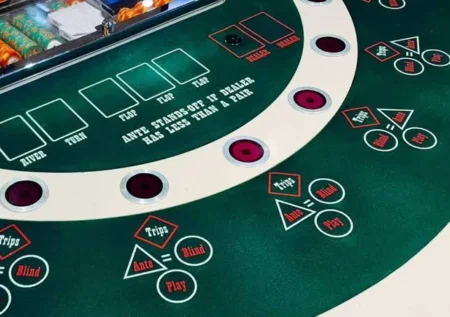
Three Card Poker is a casino table game where you and the dealer each get three cards, and the better three-card poker hand wins. There’s no drawing, no community cards and no bluffing. You look at your cards, make one decision, and the hand is settled.
That simplicity has made it a fixture on casino floors around the world. A round takes well under a minute, and the one strategy decision can be learned in seconds: raise or fold. The details still matter, though. Which bets you place and which paytable the table uses change your expected cost more than most players realise.
Although it uses poker hands, Three Card Poker is a casino game, not traditional poker. You play against the house rather than against other players, and reading opponents or bluffing plays no part.
The table offers two separate games:
- Ante & Play: a head-to-head game against the dealer.
- Pairplus: a bet on your own hand only.
You can play either one, or both.
Three Card Poker at a Glance
| Topic | Details |
| Deck | Single standard 52-card deck |
| Cards dealt | 3 to each player and 3 to the dealer |
| Main bets | Ante (then Play or fold) and/or Pairplus |
| Your decision | Raise (Play bet equal to your Ante) or fold |
| Dealer qualifies with | Queen-high or better |
| Recommended raise point | Q-6-4 or better |
| Ante & Play house edge | 3.37% on the most common Ante Bonus paytable (Wizard of Odds) |
| Ante & Play element of risk | 2.01% (Wizard of Odds) |
| Pairplus house edge | 2.32% to 7.28%, depending on the paytable (Wizard of Odds) |
Where the Game Came From
Three Card Poker was created by British inventor Derek Webb in the 1990s (Wikipedia). Wizard of Odds describes it as one of the earliest and most successful of the “new” casino table games. Today it sits alongside Ultimate Texas Hold’em and Pai Gow Poker in most casino table pits and online lobbies.
Three Card Poker Online, Live Dealer & Casino Play
You can play Three Card Poker in three main ways. The rules are the same in each, but the pace, paytables and experience differ.
| Format | What it is | Things to know |
| Online Three Card Poker (RNG) | A computer version where a random number generator deals the cards | You set the pace; many sites offer free play; paytables vary by software provider |
| Live dealer Three Card Poker | A real dealer streamed from a studio | Closer to the casino experience; some studios call the game Teen Patti |
| Three Card Poker in a casino | The table game on a land-based casino floor | Paytables and side bets vary by casino; check the table layout |
Playing Three Card Poker for real money is legal only in some countries and regions, so check the rules where you live. Only use licensed casinos with clear terms and responsible-gambling tools. Wherever you play, check two things before your first bet:
- the Ante Bonus paytable
- the Pairplus paytable
The full online and live-play guide is further down this page.
Three Card Poker Terms You Should Know
- Ante: Your starting bet in the Ante & Play game, placed before any cards are dealt.
- Play bet: The raise you make after seeing your cards. It’s always equal to your Ante.
- Fold: Giving up your hand, which loses your Ante.
- Qualify: The dealer needs queen-high or better to “qualify” or “play”. If not, your Ante wins and your Play bet is returned.
- Pairplus: A separate bet that pays when your own hand is a pair or better, whatever the dealer holds.
- Ante Bonus: An extra payout on your Ante for a straight or better. It’s paid even if the dealer beats you.
- Q-6-4: The standard strategy threshold. Raise with queen-6-4 or better, and fold anything weaker.
- Paytable: The list of payouts a table uses. Different casinos use different paytables.
- Full-pay: The most player-favourable version of a paytable, with the lowest house edge.
- Mini Royal: A suited A-K-Q, which some tables pay extra for.
- 6 Card Bonus: A side bet on the best five-card hand from your three cards plus the dealer’s three.
- Element of risk: Expected loss divided by the average total amount bet. It’s useful here because you sometimes add a Play bet.
How to Play Three Card Poker, Step by Step
- Place your bets. Put chips on the Ante, the Pairplus, or both. Add any side bets now.
- Get three cards. You and the dealer each receive three cards face down. Look at yours.
- Make your decision (only if you bet the Ante). Either raise by placing a Play bet equal to your Ante, or fold and lose your Ante.
- Pairplus settles on its own. If you bet Pairplus, it’s paid or collected based only on your hand, whether you raised or folded.
- Dealer reveals. The dealer turns over their three cards.
- Check whether the dealer qualifies. The dealer needs queen-high or better.
- Settle the Ante and Play bets using the table below.
- Pay any Ante Bonus. If you placed an Ante and hold a straight or better, you get the Ante Bonus regardless of the dealer’s hand.
| Situation | Ante | Play |
| You fold | Lose | — |
| Dealer doesn’t qualify | Wins 1 to 1 | Push (returned) |
| Dealer qualifies, you win | Wins 1 to 1 | Wins 1 to 1 |
| Dealer qualifies, dealer wins | Lose | Lose |
| Dealer qualifies, tie | Push | Push |
Source: Wizard of Odds
Three Card Poker Rules You Need to Know
The Dealer Qualifying Rule
The dealer must have queen-high or better to qualify. A hand like J-10-8 with no pair, straight or flush does not qualify. If the dealer doesn’t qualify, you win even money on your Ante and your Play bet is returned. This is the only time the Ante wins without you having to beat the dealer.
The Ante Bonus
If you place an Ante and your hand is a straight or better, you get a bonus payout on the Ante. It’s paid even if the dealer beats you or doesn’t qualify. The bonus is paid in addition to the normal result of the hand.
Pairplus Is a Separate Game
Pairplus ignores the dealer completely. If your three cards make a pair or better, you’re paid according to the Pairplus paytable. If not, you lose the bet. You can bet Pairplus without betting the Ante.
Rule Variations
- Ties go to the player: Some casinos let players win ties. Wizard of Odds estimates this lowers the Ante & Play house edge from 3.37% to 3.24% (Wizard of Odds).
- Regional versions: California card rooms, Florida card clubs and some Macau casinos use modified rules. Outside a standard casino, check the posted table rules.
Three Card Poker Hand Rankings
Three Card Poker rankings are not the same as five-card poker rankings. With only three cards, a straight is harder to make than a flush, so a straight ranks higher.
| Rank | Hand | Example | Combinations | Probability |
| 1 | Straight flush | 9♠ 8♠ 7♠ | 48 | 0.22% |
| 2 | Three of a kind | Q♥ Q♣ Q♦ | 52 | 0.24% |
| 3 | Straight | 6♦ 5♣ 4♥ | 720 | 3.26% |
| 4 | Flush | K♥ 9♥ 3♥ | 1,096 | 4.96% |
| 5 | Pair | 8♠ 8♦ K♣ | 3,744 | 16.94% |
| 6 | High card | A♣ 10♦ 6♠ | 16,440 | 74.39% |
| Total | 22,100 | 100% |
Two things to remember:
- A straight beats a flush in this game. There are 720 possible three-card straights but 1,096 possible three-card flushes.
- About three hands out of four have no pair or better. That’s why Pairplus loses most of the time and why its bigger payouts matter so much.
For five-card rankings used in other games, see our poker hand rankings guide.
Three Card Poker Payouts
Three Card Poker payouts depend on the table’s Ante Bonus and Pairplus paytables, so always check the posted paytable before you play.
How to read payouts: “4 to 1” means you win 4 times your bet, and your original bet is also returned. A $10 bet at 4 to 1 wins $40, and you collect $50 in total.
Ante Bonus Paytables
| Hand | Paytable 1 (most common) | Paytable 2 | Paytable 3 | Paytable 4 |
| Straight flush | 5 to 1 | 4 to 1 | 3 to 1 | 5 to 1 |
| Three of a kind | 4 to 1 | 3 to 1 | 2 to 1 | 3 to 1 |
| Straight | 1 to 1 | 1 to 1 | 1 to 1 | 1 to 1 |
| House edge | 3.37% | 3.83% | 4.28% | 3.61% |
| Element of risk | 2.01% | 2.28% | 2.56% | 2.16% |
Source: Wizard of Odds. Wizard of Odds notes that the vast majority of tables use paytable 1, often written as “1-4-5”.
Three Card Poker Pairplus Paytables
Pairplus paytables are usually written as five numbers: the payouts for a pair, flush, straight, three of a kind and straight flush. So “1-4-6-30-40” means a pair pays 1 to 1, a flush 4 to 1, a straight 6 to 1, three of a kind 30 to 1 and a straight flush 40 to 1.
| Hand | 1-4-6-30-40 (full-pay) | 1-4-6-25-40 | 1-4-5-30-40 | 1-4-5-25-40 | 1-3-6-30-40 (common) |
| Straight flush | 40 to 1 | 40 to 1 | 40 to 1 | 40 to 1 | 40 to 1 |
| Three of a kind | 30 to 1 | 25 to 1 | 30 to 1 | 25 to 1 | 30 to 1 |
| Straight | 6 to 1 | 6 to 1 | 5 to 1 | 5 to 1 | 6 to 1 |
| Flush | 4 to 1 | 4 to 1 | 4 to 1 | 4 to 1 | 3 to 1 |
| Pair | 1 to 1 | 1 to 1 | 1 to 1 | 1 to 1 | 1 to 1 |
| House edge | 2.32% | 3.49% | 5.57% | 6.75% | 7.28% |
Common vs full-pay: what’s the difference?
- Full-pay (1-4-6-30-40) is the most player-favourable of these paytables, with the lowest house edge (2.32%). It’s harder to find in casinos.
- Common (1-3-6-30-40) is the paytable Wizard of Odds uses as its standard reference for Pairplus. It’s widely used, and it has the highest house edge in this table (7.28%). Wizard of Odds’ Ask the Wizard section notes that casinos commonly use this lower-paying version.
- The only difference between them is the flush payout: 4 to 1 on full-pay, 3 to 1 on the common table. That single change more than triples the house edge.
Quick check at any table: look at what a flush pays. 4 to 1 is better for you than 3 to 1.
Four Worked Examples
All examples use a $10 Ante. Example 3 also includes a $5 Pairplus bet on the common 1-3-6-30-40 paytable. For each winning bet, the example shows the winnings, and your original stake on that bet is returned as well.
Example 1: You raise and beat a qualifying dealer.
You hold K♦ J♣ 5♥. K-J-5 is above the Q-6-4 threshold, so you raise $10. The dealer has Q♠ 8♥ 3♣, which is queen-high, so the dealer qualifies. Your king-high wins.
- Ante wins $10 and Play wins $10.
- Your $20 in stakes is also returned.
- Profit: $20.
Example 2: You raise and the dealer doesn’t qualify.
Same hand, but the dealer has J♥ 9♦ 4♠. That’s jack-high, so the dealer doesn’t qualify.
- Ante wins $10.
- Play pushes, so your $10 Play stake is simply returned.
- Profit: $10.
Example 3: You make a straight.
You hold 9♣ 8♦ 7♠, which is a straight, and raise $10. The dealer has a pair of 5s. Your straight wins.
| Bet | Stake | Result | Winnings |
| Ante | $10 | Wins 1 to 1 | $10 |
| Play | $10 | Wins 1 to 1 | $10 |
| Ante Bonus (straight) | — (paid on the Ante) | 1 to 1 | $10 |
| Pairplus (straight) | $5 | 6 to 1 | $30 |
| Total | $25 staked | $60 profit |
You collect $85 in total: $60 in winnings plus your $25 in original stakes.
Example 4: You fold.
You hold J♠ 9♦ 4♣, which is below Q-6-4, so you fold.
- You lose your $10 Ante.
- Loss: $10. If you had a Pairplus bet, it would also lose, because you have no pair.
Three Card Poker Odds and House Edge
Ante & Play
On the most common Ante Bonus paytable (1-4-5), the Ante & Play has a house edge of 3.37% and an element of risk of 2.01% (Wizard of Odds).
Why two numbers? The house edge is measured against your Ante. The element of risk is measured against the total you actually bet, including the Play bets you add. You raise on about two-thirds of hands, so the element of risk is lower.
Win, Push and Loss Rates on the Ante
| Outcome (optimal strategy) | Probability |
| Win | 44.91% |
| Push | 0.06% |
| Loss (including folds) | 55.03% |
| Of which: hands you fold | 32.58% |
Source: Wizard of Odds. The fold rate comes from Wizard of Odds’ Ante return table.
With the standard strategy, you fold roughly one hand in three and raise the other two.
Playing Both Ante and Pairplus
Suppose you bet equal amounts on the Ante and Pairplus, using the 1-4-5 Ante Bonus paytable and the common 1-3-6-30-40 Pairplus paytable. Wizard of Odds calculates these results:
| Combined bet | Figure |
| House edge | 5.32% |
| Win probability | 32.06% |
| Push probability | 13.23% |
| Loss probability | 54.71% |
Which Bet Has the Lower House Edge?
It depends on the Pairplus paytable:
| Pairplus paytable | Pairplus house edge | Ante & Play house edge (1-4-5) | Lower house edge |
| Full-pay 1-4-6-30-40 | 2.32% | 3.37% | Pairplus |
| Common 1-3-6-30-40 | 7.28% | 3.37% | Ante & Play |
Measured by element of risk, full-pay Ante & Play (2.01%) is slightly lower than full-pay Pairplus (2.32%), according to Wizard of Odds. This is why advice about which bet is “better” varies online. The answer depends on the paytable at your table and on which measure you use.
Three Card Poker Strategy
The Q-6-4 Rule
The optimal Ante & Play strategy is simple: raise with Q-6-4 or better, and fold anything worse. This holds regardless of the Ante Bonus paytable (Wizard of Odds).
To compare a hand with Q-6-4, look at the highest card first, then the second, then the third:
| Your hand | Compared with Q-6-4 | ]Decision |
| Any pair or better | Above the threshold | Raise |
| A-4-2 | Ace is higher than queen | Raise |
| K-5-3 | King is higher than queen | Raise |
| Q-7-2 | Queens tie; 7 is higher than 6 | Raise |
| Q-6-4 | Exactly the threshold | Raise |
| Q-6-3 | Queens and 6s tie; 3 is lower than 4 | Fold |
| Q-5-4 | Queens tie; 5 is lower than 6 | Fold |
| J-10-8 | Jack is lower than queen | Fold |
Why Q-6-4 Is the Line
Wizard of Odds calculated the expected results for the hands on either side of the line (Wizard of Odds):
- Q-6-3: raising has an expected loss of about 1.003 units, slightly worse than the 1 unit you lose by folding.
- Q-6-4: raising has an expected loss of about 0.993 units, slightly better than folding.
How Other Strategies Compare
| Strategy | Ante & Play house edge |
| Raise with Q-6-4 or better (optimal) | 3.37% |
| “Mimic the dealer” (raise with any queen or better) | 3.45% |
| Raise every hand without looking | 7.65% |
Pairplus Strategy
Pairplus involves no decisions, because it’s settled purely on your cards. The only choice is whether to place it, based on the table’s paytable and house edge.
Three Card Poker Side Bets
Many tables offer extra side bets. Most carry higher house edges than the main game:
| Side bet | What it pays on | House edge |
| Prime | Your three cards all the same colour (higher payout if all six player and dealer cards are) | 3.62% |
| 6 Card Bonus | Best five-card hand from your 3 plus the dealer’s 3 cards | 8.56%–15.28% depending on paytable |
| Millionaire Maker ($5 bet) | Six-card hands, with a top prize for a diamond “super royal” | 18.10% |
For the Millionaire Maker, Wizard of Odds puts the chance of the top prize at 1 in 20,358,520, and notes that the house edge rises if you bet more than $5. Progressive side bets vary by casino, and their value depends on the size of the jackpot meter.
Best Three Card Poker Tips for Beginners
- Memorise Q-6-4. It’s the only strategy decision in the Ante & Play game.
- Remember that straights beat flushes. This is the most common ranking mix-up.
- Check the Pairplus flush payout. 4 to 1 (full-pay) versus 3 to 1 (common) changes the house edge from 2.32% to 7.28%.
- Decide your bet mix in advance. Adding Pairplus changes both your overall house edge and your swings.
- Keep side bets small relative to your main bets.
- Set a budget and a time limit. The game is fast, so many hands can pass quickly.
Common Three Card Poker Mistakes
| Mistake | Why it matters | Better approach |
| Raising every hand | Raises the house edge to about 7.65% | Raise only with Q-6-4 or better |
| Folding hands like Q-7-2 or Q-6-5 | These hands are above the Q-6-4 threshold | Compare card by card with Q-6-4 |
| Thinking a flush beats a straight | Rankings differ from five-card poker | A straight ranks above a flush in Three Card Poker |
| Ignoring the Pairplus paytable | House edge ranges from 2.32% to 7.28% | Check the flush and straight payouts |
| Big bets on the Millionaire Maker | 18.10% house edge on a $5 bet | Keep side bets small, or skip them |
Three Card Poker and Teen Patti
If you play online in India or at Asian live-dealer studios, you may find Three Card Poker under a different name. Wizard of Odds notes that the live-dealer provider Ezugi deals this game as Teen Patti, and calls the 6 Card Bonus side bet “3+3” (Wizard of Odds).
Traditional Teen Patti, the social card game played in India, is different. It’s played player-vs-player, with its own betting style and some different ranking conventions. The casino-studio version plays like Three Card Poker against a dealer, so check the game’s help screen to see which rules apply.
Three Card Poker vs Other Casino Poker Games
| Game | Typical house edge | Element of risk | Main decision |
| Casino Hold’em | 2.16% of Ante | — | Call or fold after the flop |
| Ultimate Texas Hold’em | 2.185% of Ante | 0.526% | When to raise: 4x, 2x or 1x |
| Pai Gow Poker | 2.51% (optimal); ~2.84% (house way) | — | How to split seven cards |
| Three Card Poker (Ante & Play, 1-4-5) | 3.37% of Ante | 2.01% | Raise or fold |
| Three Card Poker (Pairplus) | 2.32% (full-pay) to 7.28% (common) | Same as house edge | None |
Sources: Wizard of Odds – Three Card Poker, Wizard of Odds – Ultimate Texas Hold ‘Em, Gambling.com, OLG PlaySmart. Figures assume the rules and strategies stated by each source.
Each game has a different betting structure, so compare the specific rules and paytables of the table in front of you. Explore more games in our casino games section.
How to Play Three Card Poker Online
Online Three Card Poker follows the same basic rules as the table game, but paytables and side bets can differ between software providers. Wizard of Odds notes, for example, that some online versions use Ante Bonus and Pairplus paytables not usually found in land-based casinos.
| Online (RNG) | Live dealer / land-based | |
| Pace | Set by you | Set by the dealer and table |
| Game name | Usually Three Card Poker | Three Card Poker, or Teen Patti at some studios |
| Free play | Often available | Not available |
| Paytables | Vary by provider | Vary by casino |
| Bet limits | Vary by casino and game | Vary by casino and table |
Getting Started Online
- Check that online casino games are legal where you live. Laws vary by country and region.
- Choose a licensed casino with clear terms and responsible-gambling tools.
- Try the free version first. Wizard of Odds offers a free Three Card Poker practice game.
- Open the help screen and check the Ante Bonus and Pairplus paytables.
- Start small. Use our bankroll calculator to plan your session.
Watch the pace. Online Three Card Poker can deal hands very quickly. More hands per hour means more money wagered, so set a time limit as well as a budget.
Three Card Poker Live Casino Guide
- Buy in between hands. Place cash on the table and let the dealer exchange it for chips.
- Place all your bets before the deal. That includes the Ante, Pairplus and any side bets.
- To raise, place your Play bet in the Play circle.
- To fold, place your cards face down in front of you as the dealer directs.
- Keep your cards on the table and don’t show them to other players.
- Don’t touch your chips after you’ve acted.
- Follow local tipping customs. These differ between countries and casinos.
FAQs
What is Three Card Poker?
Three Card Poker is a casino table game where you and the dealer each get three cards. It offers two main bets: Ante & Play, where you try to beat the dealer, and Pairplus, which pays if your own hand is a pair or better.
How do you play Three Card Poker?
Place an Ante, a Pairplus bet, or both. After seeing your three cards, you either raise with a Play bet equal to your Ante or fold. The dealer needs queen-high or better to qualify, and the higher hand wins.
What is the best Three Card Poker strategy?
The optimal strategy is to raise with Q-6-4 or better and fold anything weaker. According to Wizard of Odds, this applies regardless of the Ante Bonus paytable.
What does the dealer need to qualify in Three Card Poker?
The dealer needs queen-high or better. If the dealer doesn’t qualify, your Ante pays even money and your Play bet is returned.
What is the house edge in Three Card Poker?
On the most common Ante Bonus paytable, the Ante & Play bet has a house edge of 3.37% and an element of risk of 2.01%, according to Wizard of Odds. The Pairplus house edge ranges from 2.32% on the full-pay paytable to 7.28% on the common 1-3-6-30-40 paytable.
Does a straight beat a flush in Three Card Poker?
Yes. With three cards, a straight is less likely than a flush, so it ranks higher. The full order is straight flush, three of a kind, straight, flush, pair, high card.